


First Batch Limited Edition to 200
Ships Immediately
Proud U.S.A. Watch Company
First Batch Limited Edition to 200 Ships Immediately Proud U.S.A. Watch Company

Wear Your piece of World war ii history…
MADE FROM A JUNE 6TH, 1944 D-DAY PARACHUTE
exclusive price of $395
LIMTED EDITION OF 200
supports veteran non-profits
comes with C.o.A.
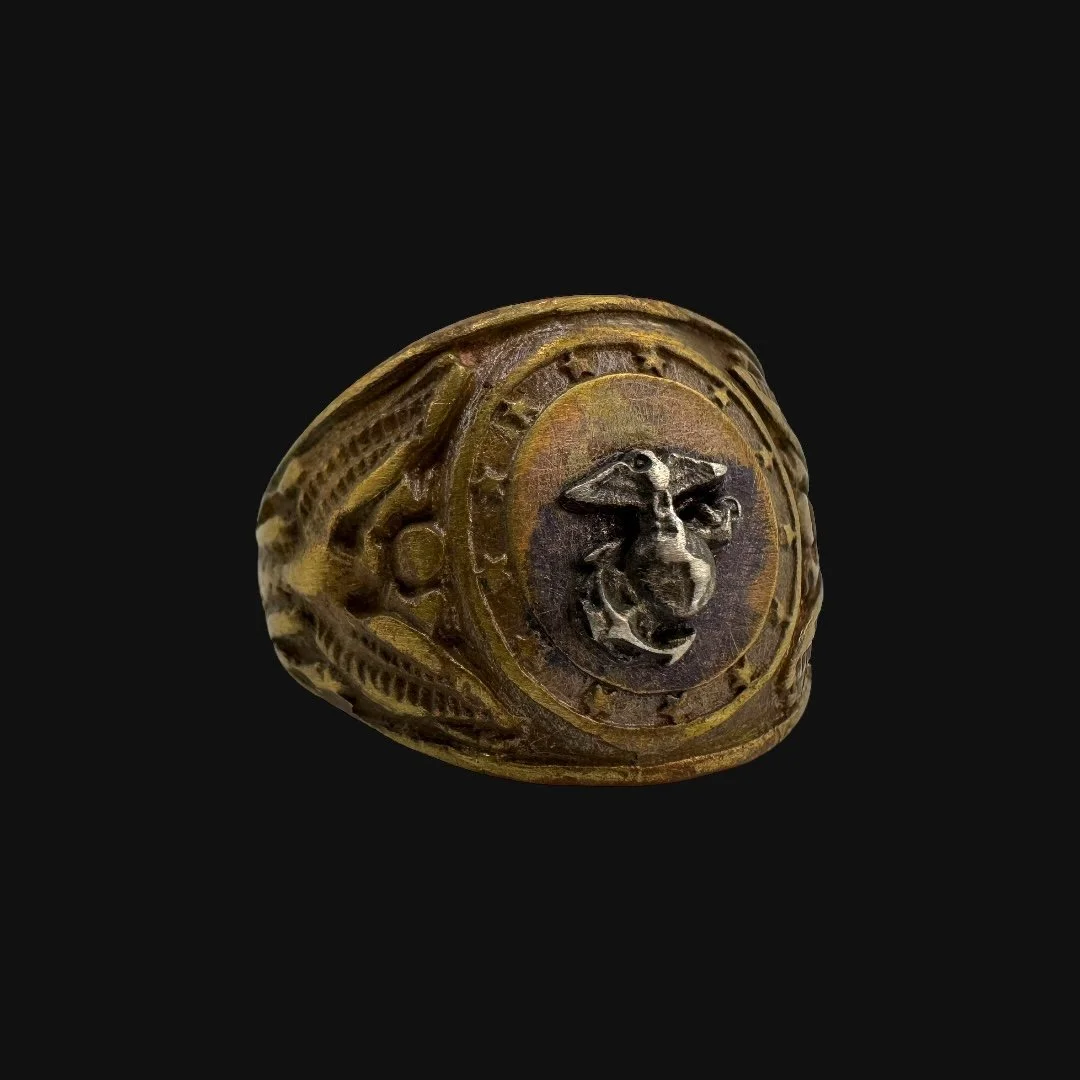
Comes with a hand-signed C.O.A. and a full historical research write-up
From: World War II
Branch: U.S. Marine Corps
Dated: 1943-1945
Ring Size: 11.25 (US)
Material: Bronze & Sterling Silver
Wearable History Collection:
This authentic 1943-1945 WWII-era ring, preserved in its original and unaltered condition, combines exceptional craftsmanship with lasting durability, making it fully suitable for modern wear today. As part of our exclusive World War II “Wearable History Ring Collection,” it offers the rare opportunity to own and wear a genuine piece of World War II. Both a timeless accessory and a tangible link to the past, this truly one-of-a-kind ring stands as a wearable tribute to the courage and sacrifice of a generation.
Historical Significance to the U.S. Marine Corps During WWII:
The U.S. Marine Corps played a decisive role in World War II, particularly in the Pacific, where it became synonymous with amphibious assault and some of the war’s fiercest battles. At the war’s outset, Marines defended Wake Island, holding off Japanese forces before being overwhelmed, setting the tone for their determination throughout the conflict. Their first major offensive came at Guadalcanal, where the 1st Marine Division endured months of combat, disease, and shortages while securing Henderson Field. This victory marked the first large-scale Allied counteroffensive against Japan and proved the Marines could defeat Japanese ground forces.
The Central Pacific campaigns pushed the Marines into increasingly costly but strategically vital battles. At Tarawa, the 2nd Marine Division stormed heavily fortified positions, suffering over 1,000 dead in just 76 hours. Saipan brought Marines within striking distance of Japan, while Peleliu tested the endurance of the 1st Marine Division against entrenched Japanese defenders. These battles refined amphibious doctrine and showcased the Marines’ ability to overcome immense obstacles at great sacrifice.
The pinnacle of Marine operations came at Iwo Jima and Okinawa. At Iwo Jima, Marines of the 3rd, 4th, and 5th Divisions fought a bloody five-week battle against 22,000 Japanese defenders. Nearly 7,000 Marines were killed, but the island provided vital airfields for B-29 bombers. The flag raising on Mount Suribachi became one of the most iconic images of the war. At Okinawa, the largest Pacific amphibious assault, Marines fought alongside the Army against fierce resistance and kamikaze attacks, securing a base for the planned invasion of Japan. The scale of casualties influenced the decision to use atomic weapons rather than invade the Japanese homeland.
By 1945, the Marine Corps had grown from 66,000 to nearly 475,000 personnel, suffering over 19,000 killed but securing a reputation for unmatched toughness and innovation. Their development of amphibious tactics, use of landing craft like the Higgins boat and LVT, and coordination with naval and air forces reshaped modern warfare. From Wake to Okinawa, the Marines’ courage, sacrifice, and effectiveness made them indispensable to Allied victory and solidified their identity as America’s elite expeditionary force.
The Legacy Within This Ring:
This original World War II U.S. Marine Corps ring is a rare and deeply personal artifact, privately commissioned by a Marine who served in the Pacific campaigns of the war. Bearing the proud eagle, globe, and anchor emblem on its face, the ring allowed its owner to carry the symbol of his service not only on his uniform but also as a constant reminder on his hand. For Marines who stormed beaches at Tarawa, Saipan, Iwo Jima, and Okinawa, such rings became more than jewelry. They were tangible reminders of sacrifice, brotherhood, and the unyielding spirit of the Corps in the face of some of the war’s bloodiest battles. Every engraved detail reflects the pride these men carried in their calling…fighters trained to strike from sea to land, who carved a path across the Pacific island by island. The eagle, globe, and anchor marked their identity as Marines, part of a tradition of service that demanded endurance, loyalty, and honor. Today, this ring endures as a wearable relic of the Marine Corps’ legacy in World War II. It represents not only the courage of those who fought through fire-swept beaches and entrenched defenses, but also the enduring bond of the Marines who proved, time and again, their devotion to one another and to the nation they swore to defend.
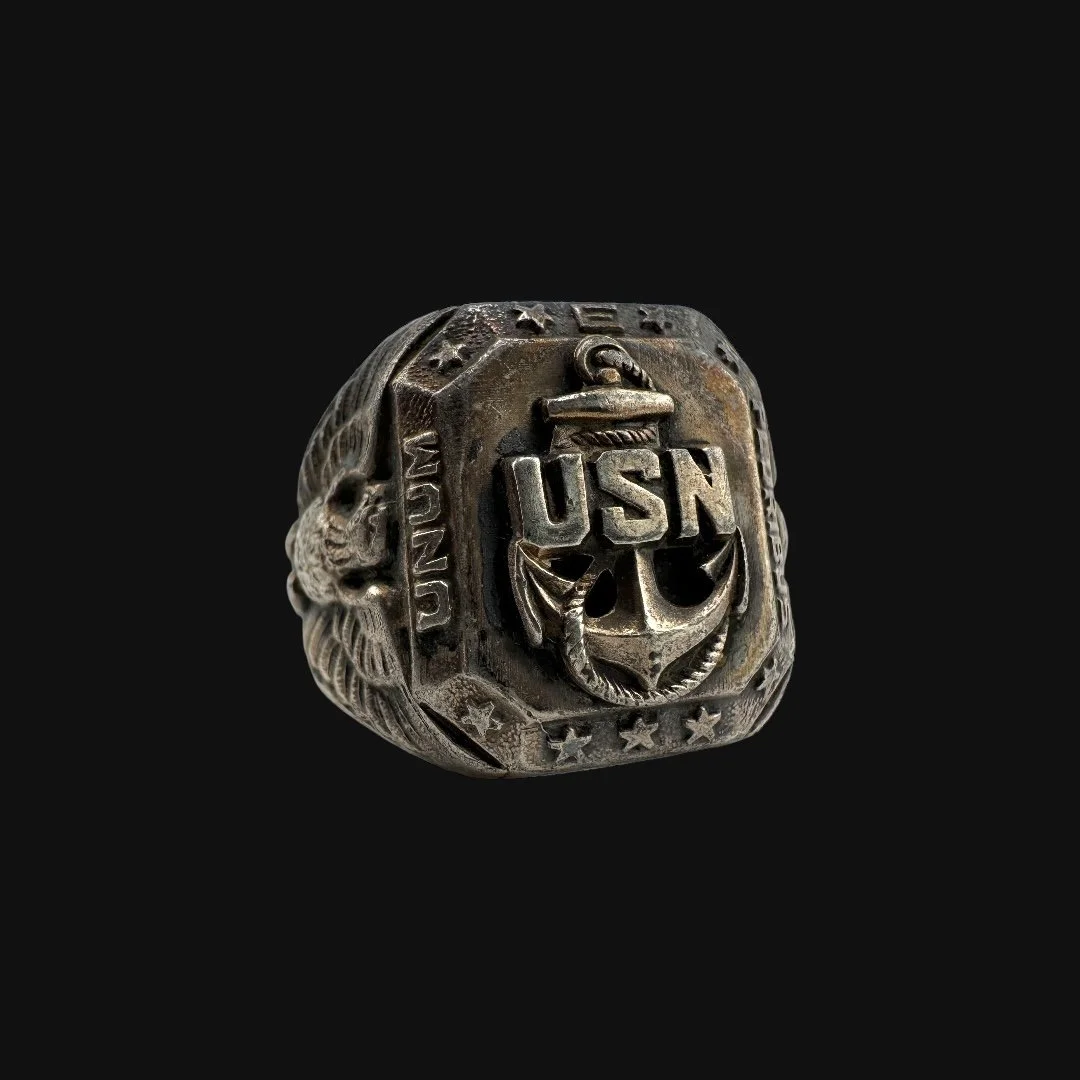
Comes with a hand-signed C.O.A. and a full historical research write-up
From: World War II
Branch: U.S. Navy
Dated: 1942-1945
Ring Size: 10.75 (US)
Material: Sterling Silver
Wearable History Collection:
This authentic 1942-1945 WWII-era ring, preserved in its original and unaltered condition, combines exceptional craftsmanship with lasting durability, making it fully suitable for modern wear today. As part of our exclusive World War II “Wearable History Ring Collection,” it offers the rare opportunity to own and wear a genuine piece of World War II. Both a timeless accessory and a tangible link to the past, this truly one-of-a-kind ring stands as a wearable tribute to the courage and sacrifice of a generation.
Historical Significance to the United States Navy During World War II:
The United States Navy during World War II emerged as one of the most powerful maritime forces in history, playing a decisive role in securing victory across multiple theaters of war. When the United States entered the conflict after the Japanese attack on Pearl Harbor on December 7, 1941, the Navy was tasked with rebuilding from severe losses while simultaneously projecting power across vast oceans. In the Pacific, it shifted from early defensive actions to decisive offense after the 1942 Battles of Coral Sea and Midway. The Navy’s island-hopping strategy relied on carriers like USS Enterprise and USS Essex, amphibious assaults at Guadalcanal, Tarawa, Saipan, Iwo Jima, and Okinawa, and submarine campaigns that destroyed Japanese shipping. Mobile logistics and the Seabees’ rapid base construction kept the fleet supplied across vast distances.
In the Atlantic, the Navy’s priority was safeguarding convoys in the Battle of the Atlantic, countering German U-boats with destroyers, escort carriers, long-range patrol aircraft, and intelligence from code-breaking. These forces enabled troop and supply movements critical for operations such as Torch (North Africa, 1942), Husky (Sicily, 1943), the Italian campaign, and Overlord (Normandy, 1944), where naval gunfire and landing craft spearheaded amphibious landings.
In the Mediterranean, ships like USS Nevada and USS Texas provided bombardment during beach assaults, while landing craft moved troops and armor ashore under fire. Operation Dragoon (Southern France, 1944) showcased the Navy’s coordination with Allied ground and air forces. The Arctic saw dangerous Murmansk convoys supplying the Soviet Union, facing both German attacks and extreme weather.
The Navy’s fleet grew to over 6,700 ships by 1945, encompassing carriers, battleships, cruisers, destroyers, submarines, amphibious craft, and auxiliaries. Carrier aviation became a dominant striking arm, battleships delivered heavy fire support, and submarines crippled enemy logistics. The Seabees built ports, airfields, and infrastructure in remote combat zones. These capabilities allowed sustained global operations, culminating in the Japanese surrender aboard USS Missouri in Tokyo Bay.
By war’s end, the Navy had secured the sea lanes, projected power on an unprecedented scale, and enabled Allied victory through mastery of combined-arms amphibious warfare, innovative logistics, and technological adaptability.
The Legacy Within This Ring:
This authentic World War II-era United States Navy ring features the iconic USN fouled anchor. On each side, a proud Eagle crest symbolizes the strength and vigilance of America’s seafaring warriors. For the sailors who served across the vast theaters of the war, such rings were more than jewelry. They were a personal emblem of identity, forged in a time of peril and duty. Each one carried the pride of service, the memory of distant seas, and the unbreakable bonds of shipmates who stood together through storms and battle. Today, this WWII ring is a preserved piece of wearable naval heritage. A wearable tribute to the skill, courage, and sacrifice of the men who carried the United States Navy to victory in the greatest conflict of the 20th century.
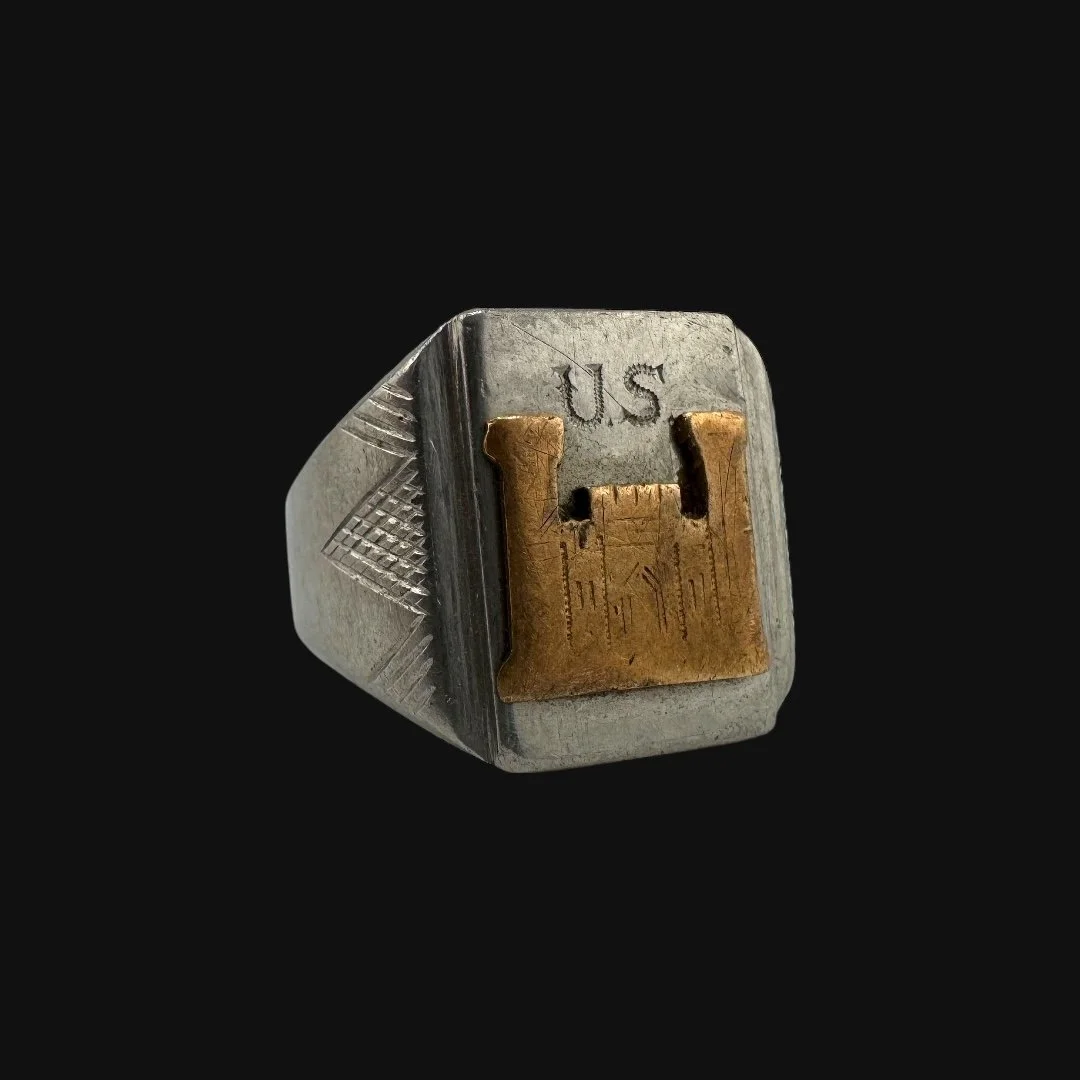
Comes with a hand-signed C.O.A. and a full historical research write-up
From: World War II
Branch: U.S. Army (Corps of Engineers)
Dated: 1942-1945
Ring Size: 8.5 (US)
Material: Fired/Discarded Battlefield Materials
Wearable History Collection:
This authentic 1942-1945 WWII-era ring, preserved in its original and unaltered condition, combines exceptional craftsmanship with lasting durability, making it fully suitable for modern wear today. As part of our exclusive World War II “Wearable History Ring Collection,” it offers the rare opportunity to own and wear a genuine piece of World War II. Both a timeless accessory and a tangible link to the past, this truly one-of-a-kind ring stands as a wearable tribute to the courage and sacrifice of a generation.
Historical Significance to the U.S. Army Corps of Engineers During WWII:
The U.S. Army Corps of Engineers was indispensable to Allied victory in World War II, shaping every campaign with a combination of construction skill, combat bravery, and technical innovation. Their responsibilities ranged from clearing obstacles and breaching enemy defenses to building roads, bridges, and airfields that kept American forces supplied and mobile across multiple continents. Before U.S. troops even entered combat, the Corps was already vital on the home front, constructing training bases, industrial facilities, and even the secret sites of the Manhattan Project. Once in the field, engineers became both builders and fighters, providing the infrastructure that made large-scale warfare possible.
In North Africa and Italy, the Engineers repaired and built critical roads and bridges under fire, cleared minefields, and constructed desert airstrips. Their role became legendary during the Normandy invasion, where combat engineers braved enemy fire to dismantle obstacles on Omaha and Utah beaches, opening the way for infantry and armor to break through. Later, they constructed Bailey bridges and pontoon crossings that allowed Allied advances across France and Germany, culminating in the massive bridging of the Rhine River in 1945. During the Battle of the Bulge, they delayed German advances by destroying bridges and creating improvised defenses, buying crucial time for U.S. forces to regroup.
In the Pacific, the Engineers faced entirely different challenges, carving airfields from jungles, building pontoon causeways on coral reefs, and constructing makeshift harbors for amphibious operations. On islands like Iwo Jima and Okinawa, they bulldozed runways under heavy fire, allowing U.S. airpower to project deeper into Japanese territory. Their innovation in amphibious engineering, bridging, and demolition technology made them as much a weapon of war as the infantry and tanks they supported.
By the end of the war, the Corps of Engineers had built over 700 airfields, thousands of bridges, and countless miles of roads, depots, and barracks. Their work not only enabled battlefield victories but also laid the foundation for postwar reconstruction. The Engineers proved that modern wars are won not only with firepower but with the ability to move, build, and adapt. Their legacy from World War II endures in both military doctrine and civilian infrastructure, marking them as one of the most critical yet often unsung forces of the Allied triumph.
The Legacy Within This Ring:
This World War II theater-made U.S. Army Corps of Engineers ring embodies the legacy of soldiers whose skill and resolve were as vital as any weapon on the battlefield. Handcrafted during the war, it was commissioned and worn by an engineer who belonged to a branch tasked with building the pathways to victory. The Corps of Engineers laid down pontoon bridges under fire, blasted through obstacles, cleared minefields, and raised fortifications in jungles, deserts, and frozen terrain alike. Their work transformed raw landscapes into lifelines for advancing armies. Each mark on the ring speaks to that blend of technical mastery and battlefield courage, a symbol of service where calculation and bravery had to exist side by side. More than a keepsake, it was a reminder of the ingenuity and sacrifice required to push the front lines forward. Preserved today, the ring endures as a wearable piece of history. A testament to the engineers who shaped the ground beneath the war itself and turned their craft into a force that carried the United States toward victory.
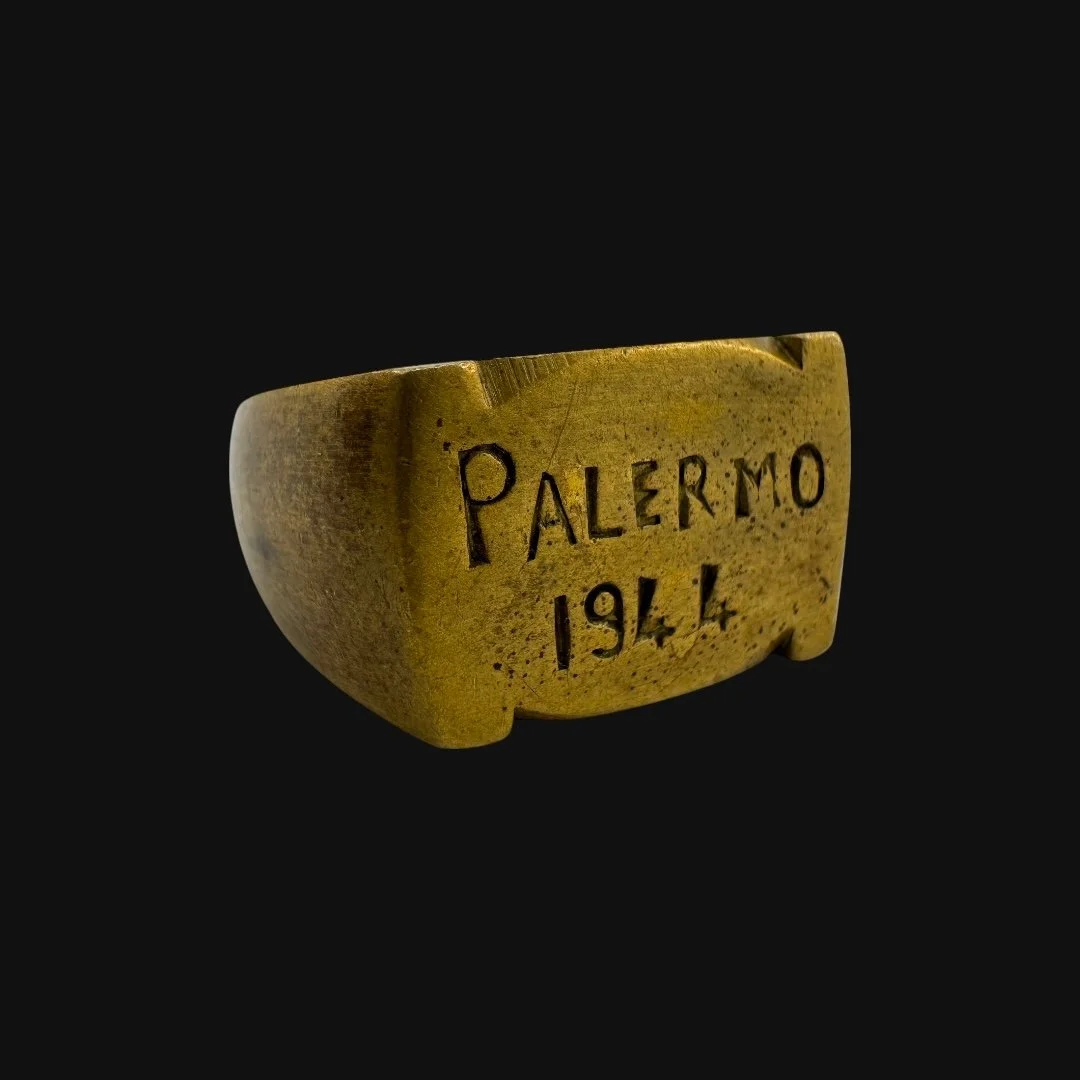
Comes with a hand-signed C.O.A. and a full historical research write-up
From: World War II
Dated: 1944
Ring Size: 9 (US)
Material: Fired Shell Casing/Discarded Battlefield Material
Theater: Mediterranean Theater (Allied Invasion of Sicily)
Wearable History Collection:
This authentic 1944 WWII-era ring, preserved in its original and unaltered condition, combines exceptional craftsmanship with lasting durability, making it fully suitable for modern wear today. As part of our exclusive World War II “Wearable History Ring Collection,” it offers the rare opportunity to own and wear a genuine piece of World War II. Both a timeless accessory and a tangible link to the past, this truly one-of-a-kind ring stands as a wearable tribute to the courage and sacrifice of a generation.
Historical Significance to Palermo (Sicily):
The Allied invasion of Sicily, codenamedOperation Husky, took place from July 9 to August 17, 1943, and marked the first large-scale assault on Axis-held Europe. Launched after the North African campaign, it aimed to secure Mediterranean shipping lanes, force Italy out of the war, and provide a staging ground for the invasion of mainland Italy. The operation combined massive amphibious landings by the U.S. Seventh Army under Lt. Gen. George S. Patton and the British Eighth Army under Gen. Bernard Montgomery, along with the first U.S. airborne combat drops by the 82nd Airborne Division.
One of the campaign’s pivotal moments was thecapture of Palermoon July 22, 1943. Patton’s rapid advance westward seized the city with minimal resistance, cutting Axis supply lines and giving the Allies control of Sicily’s largest port. The liberation was celebrated by locals and provided the Allies with a vital logistics hub to support further operations, including the drive toward Messina and the eventual invasion of mainland Italy. The success of Operation Husky also contributed to Mussolini’s overthrow and Italy’s surrender later that year.
By 1944, Palermo had transformed into a bustling Allied base. Its port, airfields, and infrastructure supported the ongoing Italian campaign and preparations for other operations, including the invasion of southern France. Many soldiers passed through Palermo for rest, resupply, and staging, sometimes creating or purchasing keepsakes to mark their service there. Artifacts inscribed “Palermo 1944” reflect this connection, linking personal soldier experiences to a city whose capture in 1943 played a decisive role in shifting the balance of the war in the Mediterranean.
The Legacy Within This Ring:
This World War II ring, inscribed “Palermo, 1944,” was skillfully made in theater from the fired shell casings, shell fragments, and other discarded materials left scattered across the battlefield. Such pieces were often crafted by soldiers as personal mementos, transforming the remnants of war into symbols of survival and remembrance. The Palermo inscription ties it to the Sicilian capital, captured by Allied forces in 1943 and serving as a key strategic base throughout 1944. More than a simple ornament, the ring preserves the physical essence of the battlefield, carrying with it the weight of combat, the resourcefulness of its maker, and the memory of a campaign that helped turn the tide of the war in the Mediterranean.
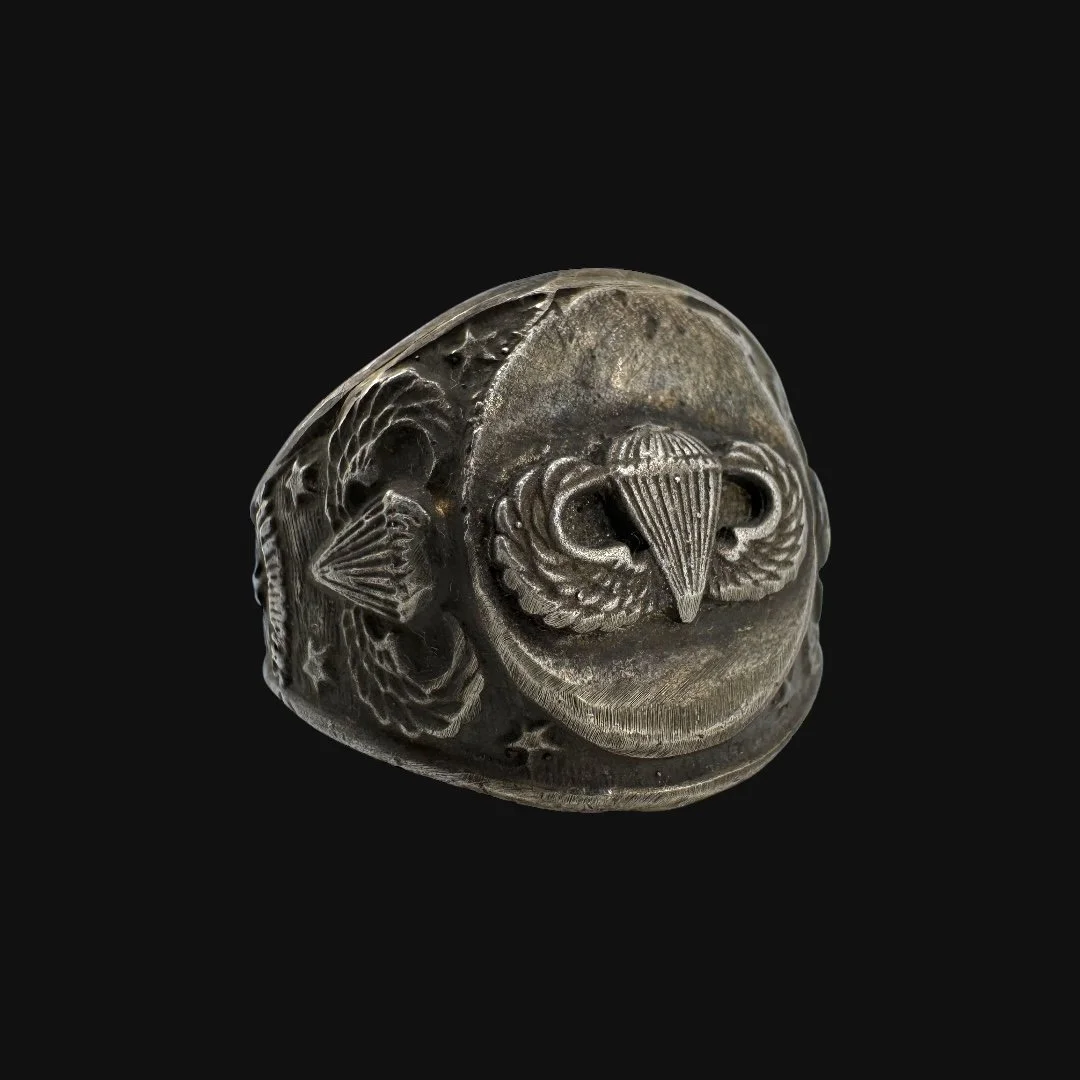
Comes with a hand-signed C.O.A. and a full historical research write-up
From: World War II
Branch: U.S. Army
Division: 101st Airborne & 82nd Airborne Divisions
Dated: 1944-1945
Ring Size: 11.5 (US)
Material: Sterling Silver
Theater: European Theater
Wearable History Collection:
This authentic 1944-1945 WWII-era ring, preserved in its original and unaltered condition, combines exceptional craftsmanship with lasting durability, making it fully suitable for modern wear today. As part of our exclusive World War II “Wearable History Ring Collection,” it offers the rare opportunity to own and wear a genuine piece of World War II. Both a timeless accessory and a tangible link to the past, this truly one-of-a-kind ring stands as a wearable tribute to the courage and sacrifice of a generation.
Historical Significance to the 101st & 82nd Airborne Divisions:
This exceptionally rare and original piece of history is a World War II U.S. Airborne Paratrooper Parachutist’s Badge (“Jump Wings”) ring, a tangible piece of history from one of the most elite fighting forces of the war. The design is based on the original Parachute Badge created during WWII by Captain William P. Yarborough of the 501st Parachute Battalion, later a Lieutenant General. The badge was awarded only to those who successfully completed the grueling Airborne jump school, marking them as members of the United States’ first generation of paratroopers.
The soldier who wore this ring served in the storied ranks of the 101st and 82nd Airborne Divisions. These elite paratroopers carved their place in history through some of the most daring and critical missions of World War II. Their combat journey began in July 1943 with Operation Husky, the Allied invasion of Sicily, where nighttime jumps scattered across the island disrupted enemy defenses and helped secure a vital foothold in the Mediterranean. Soon after came Operation Avalanche, the September 1943 invasion of mainland Italy at Salerno, where elements of the divisions provided reinforcement and secured key positions against determined German counterattacks.
In the early hours of June 6, 1944, both divisions made their legendary combat jumps during Operation Neptune, the airborne phase of the Normandy D-Day landings. Dropping behind enemy lines under heavy fire, they seized bridges, cut off German reinforcements, and secured approaches to Utah Beach. Just months later, in September 1944, they took part in Operation Market Garden, the bold but costly attempt to capture key bridges in the Netherlands and open the road into Germany. The 101st held critical bridges and towns such as Eindhoven and Veghel, while the 82nd fought for the high ground at Nijmegen.
That winter, they faced one of their greatest trials in the Ardennes during the Battle of the Bulge. Surrounded in Bastogne and elsewhere, the 101st held firm against overwhelming German assaults, while the 82nd fought fiercely along the northern shoulder of the German advance. Finally, in April 1945, they participated in Operation Varsity, the massive airborne crossing of the Rhine, helping to drive deep into the heart of Germany in the final push toward Allied victory.
From the scorching heat of Sicily to the frozen forests of Belgium, the 101st and 82nd Airborne Divisions proved time and again that they were more than soldiers. They were the tip of the spear, striking deep behind enemy lines and changing the course of the war through skill, bravery, and unbreakable will.
The Legacy Within This Ring:
Unlike standard-issue military insignia, this ring was a privately commissioned piece, handcrafted in sterling silver for an Airborne paratrooper. Such rings allowed these elite soldiers to proudly display their parachutist’s badge in a wearable form, serving as both a personal keepsake and a symbol of their accomplishment and camaraderie. Today, this ring stands not only as a remarkable collectible but as a preserved fragment of Airborne heritage. A wearable tribute to the skill, courage, and sacrifice of the men who leapt into history from the skies of WWII.
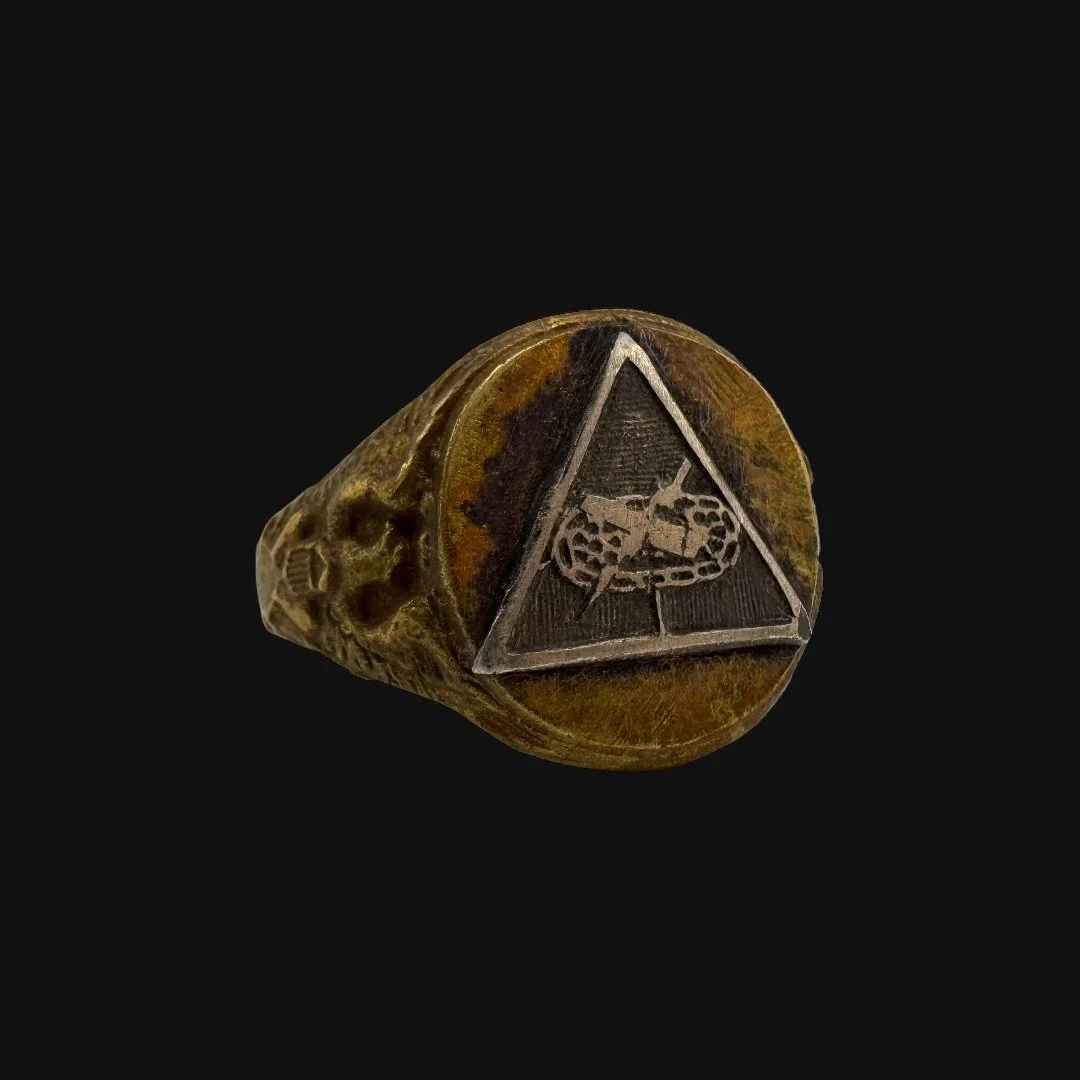
Comes with a hand-signed C.O.A. and a full historical research write-up
From: World War II
Branch: U.S. Army (Armored Corps)
Dated: 1943-1945
Ring Size: 11 (US)
Material: Bronze & Sterling Silver
Wearable History Collection:
This authentic 1943-1945 WWII-era ring, preserved in its original and unaltered condition, combines exceptional craftsmanship with lasting durability, making it fully suitable for modern wear today. As part of our exclusive World War II “Wearable History Ring Collection,” it offers the rare opportunity to own and wear a genuine piece of World War II. Both a timeless accessory and a tangible link to the past, this truly one-of-a-kind ring stands as a wearable tribute to the courage and sacrifice of a generation.
Historical Significance to the U.S. Army Armored Corps During WWII:
The U.S. Army Armored Corps emerged in World War II as one of the most decisive branches of the American military, embodying speed, firepower, and the new doctrine of mechanized warfare. Established in 1940 after witnessing German blitzkrieg tactics, the Corps grew into 16 armored divisions and numerous independent battalions, each designed for rapid penetration and exploitation. Early battles in North Africa, particularly the defeat at Kasserine Pass, exposed weaknesses in U.S. training and equipment. Yet under leaders like General George S. Patton, American armored forces adapted quickly, learning to combine tanks with artillery, infantry, and airpower in a true system of modern combined-arms warfare.
By 1944, these lessons paid off. In the Normandy campaign, American armor spearheaded the breakout from the bocage during Operation Cobra, with divisions such as the 2nd and 3rd Armored racing across France in one of the most rapid military advances in history. Patton’s Third Army demonstrated the Corps’ potential, liberating vast territories with relentless momentum. During the Battle of the Bulge, armored divisions like the 10th played pivotal defensive roles, holding key positions such as Bastogne, and later drove back the German counteroffensive. By the spring of 1945, American tanks had crossed the Rhine, breached the Siegfried Line, and were advancing deep into Germany, cementing the Corps’ reputation as the spearhead of Allied victory.
Although armor played a smaller role in the Pacific, American tanks provided vital support in battles like Okinawa and the Philippines, adapting to jungle and island warfare by delivering mobile firepower against fortified positions. Across all theaters, the Corps proved its resilience and versatility, even when facing superior German machines like the Panther and Tiger. Mass production of the reliable Sherman tank, coupled with overwhelming logistical support, ensured that U.S. armored forces maintained operational momentum.
The historical significance of the U.S. Army Armored Corps lies in its transformation of American warfare. It proved that armored divisions could execute rapid, decisive operations, reshaping modern doctrine for generations to come. From North Africa to Germany, the Corps embodied adaptability, innovation, and relentless momentum. By combining mobility and firepower with the discipline of combined-arms coordination, the Armored Corps did not merely fight in World War II—it helped redefine how wars would be fought in the modern age.
The Legacy Within This Ring:
This original World War II U.S. Army Armored Corps ring stands as a rare artifact of one of the most formidable branches of the American military. Privately commissioned by a wartime tanker, the ring allowed its owner to carry the proud symbol of the Armored Corps not just on the shoulder patch of his uniform, but also as a constant reminder on his hand. For the men who lived and fought inside steel machines, such pieces became personal emblems of resilience, brotherhood, and the thunderous power of armored warfare. The engraved details reflect not only the pride of service but also the grueling campaigns endured, from the desert heat of North Africa to the hedgerows of Normandy and the icy forests of the Ardennes. This was not simply a ring. It was a soldier’s tangible connection to the armored columns that spearheaded Allied victory. Today, it survives as a wearable relic of the Corps’ legacy, honoring the courage, sacrifice, and relentless drive of the tank crews who rolled across Europe and into history.
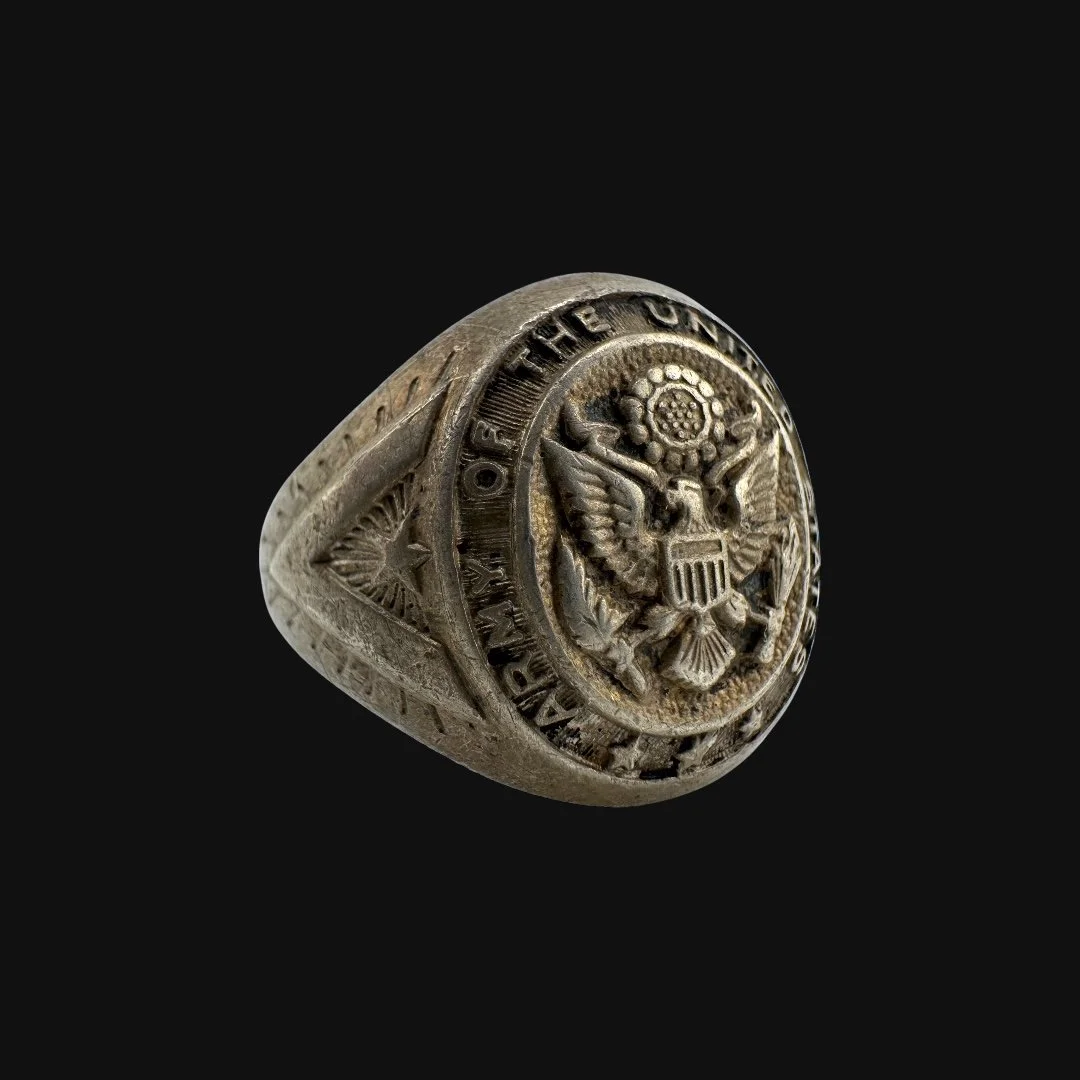
Comes with a hand-signed C.O.A. and a full historical research write-up
From: World War II
Branch: U.S. Army
Dated: 1945
Ring Size: 10.25 (US)
Material: Sterling Silver
Wearable History Collection:
This authentic 1945 WWII-era ring, preserved in its original and unaltered condition, combines exceptional craftsmanship with lasting durability, making it fully suitable for modern wear today. As part of our exclusive World War II “Wearable History Ring Collection,” it offers the rare opportunity to own and wear a genuine piece of World War II. Both a timeless accessory and a tangible link to the past, this truly one-of-a-kind ring stands as a wearable tribute to the courage and sacrifice of a generation.
Historical Significance to the United States Army During World War II:
The United States Army in World War II grew from fewer than 190,000 active-duty soldiers in 1941 to over 8.3 million by 1945, transforming into a global force capable of sustained combat across multiple continents. Rapid mobilization, industrial production, and the Selective Service draft enabled the Army to field hundreds of divisions and specialized units, supported by armor, artillery, engineers, medics, and the Army Air Forces. It fought in both the European and Pacific theaters, conducting some of the war’s most famous operations.
The Army’s first major engagement came with Operation Torch in November 1942, landing in Morocco and Algeria to fight Vichy French and German forces. Success led to the Sicily invasion (Operation Husky)in July 1943 and the Italian campaign, culminating in the capture of Rome in June 1944. In Western Europe, Operation Overlord on June 6, 1944, saw U.S. forces storm Omaha and Utah Beaches, supported by the 82nd and 101st Airborne Divisions parachuting inland. The Normandy breakout liberated Paris and drove toward Germany, but the German counterattack at the Battle of the Bulge in December 1944 tested American endurance, with Bastogne’s defense becoming legendary. By March 1945, U.S. forces had crossed the Rhine, advanced deep into Germany, and met Soviet troops on the Elbe.
In the Pacific, the Army fought a grueling island-hopping campaign under General Douglas MacArthur, reclaiming New Guinea, the Philippines, and key islands like Okinawa. Early losses such as Bataan gave way to decisive victories, including the liberation of Manila and the massive Battle of Leyte Gulf. The Army also endured fierce fighting in the Marianas, Palau, and countless smaller islands, facing both brutal combat and extreme environmental challenges.
Specialized branches played key roles: the Army Air Forces bombed enemy industry and infrastructure, the Corps of Engineers built critical infrastructure under fire, and medical units revolutionized battlefield care. Intelligence units, including the “Ghost Army,” used deception to mislead enemy forces, while logistical operations sustained campaigns across vast distances.
Victory in Europe (V-E Day, May 8, 1945) marked the defeat of Nazi Germany and the Army’s transition to occupation duties. Victory over Japan (V-J Day, September 2, 1945) ended the war entirely, validating years of sacrifice and effort. These victories symbolized the Army’s ability to project force globally, execute complex operations, and overcome two of history’s most powerful adversaries. From North Africa to Normandy, the Ardennes to the Pacific islands, the U.S. Army’s World War II record remains a defining chapter in American and world history.
The Legacy Within This Ring:
This authentic 1945 World War II-era Army of the United States victory ring, crafted in sterling silver, was worn by a soldier to commemorate the hard-fought triumph over the Axis powers. Bearing the proud “U.S. Army” insignia on its face and detailed side engravings symbolizing honor and perseverance, it served as far more than a piece of jewelry it was a personal emblem of service, forged in the crucible of war and carrying the memories of campaigns from North Africa to Normandy, the Ardennes, and the Pacific. Marking the momentous victories of V-E Day and V-J Day, this ring embodied the pride, sacrifice, and unity of the soldiers who carried the United States to victory, and today it endures as a preserved piece of wearable Army heritage from the greatest conflict of the 20th century.
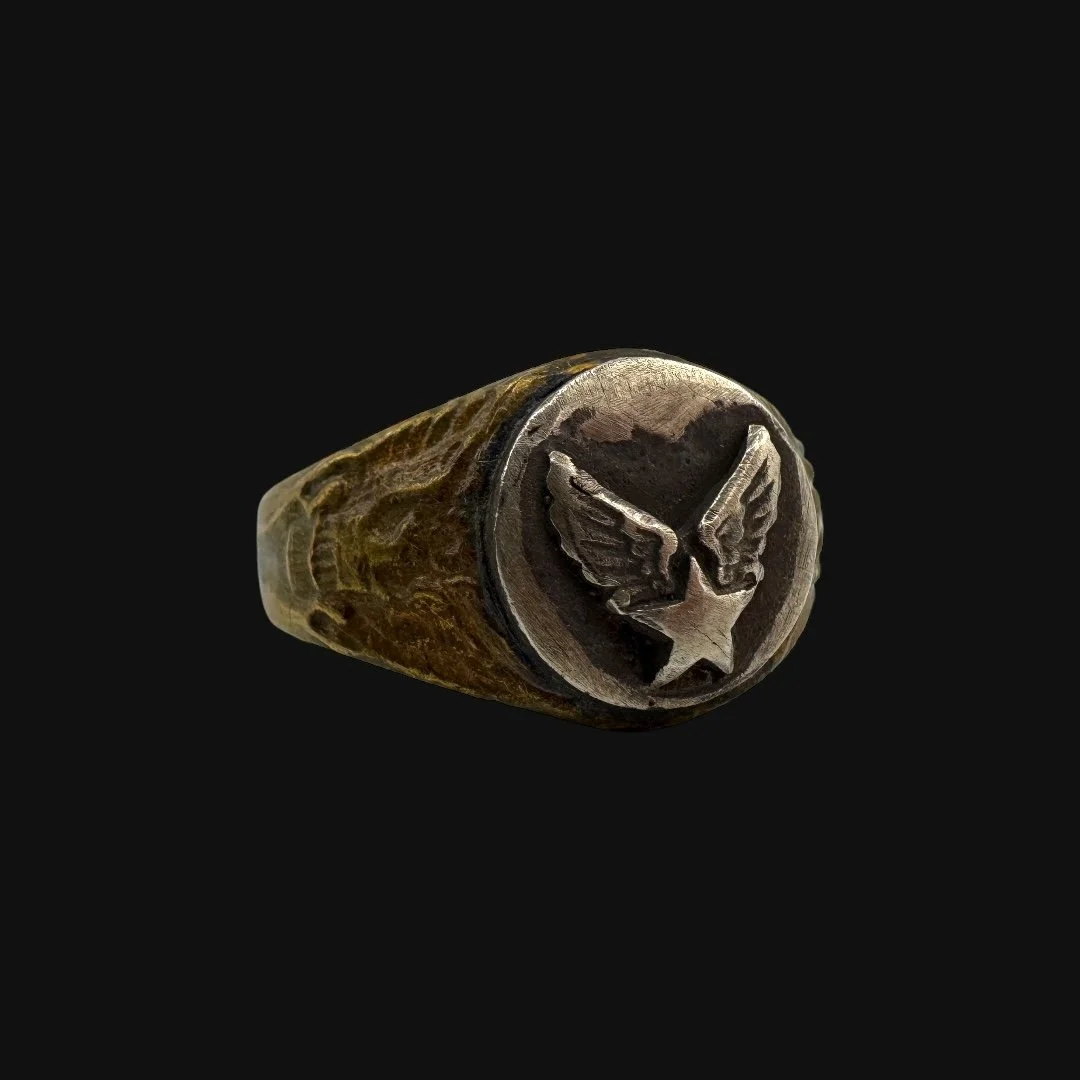
Comes with a hand-signed C.O.A. and a full historical research write-up
From: World War II
Branch: U.S. Army (Air Corps)
Dated: 1943-1945
Ring Size: 11.5 (US)
Material: Bronze & Sterling Silver
Wearable History Collection:
This authentic 1943-1945 WWII-era ring, preserved in its original and unaltered condition, combines exceptional craftsmanship with lasting durability, making it fully suitable for modern wear today. As part of our exclusive World War II “Wearable History Ring Collection,” it offers the rare opportunity to own and wear a genuine piece of World War II. Both a timeless accessory and a tangible link to the past, this truly one-of-a-kind ring stands as a wearable tribute to the courage and sacrifice of a generation.
Historical Significance to the U.S. Army Air Corps During WWII:
The U.S. Army Air Corps, later reorganized into the U.S. Army Air Forces (USAAF), was one of the most decisive elements of World War II. Entering the war in 1941 as a relatively small branch with outdated aircraft, it expanded at astonishing speed. By 1945, it fielded over 2.4 million personnel and more than 80,000 aircraft, making it one of the most powerful air arms in history. Its missions spanned every theater of the war, ranging from strategic bombing campaigns and fighter escort operations to close air support, transport, and airborne assaults, reshaping the nature of modern warfare.
In Europe, the Air Corps became central to the Allied strategy of crippling Germany through strategic bombing. Flying daylight missions with B-17s and B-24s, supported by long-range escorts like the P-51 Mustang, American airmen struck factories, oil refineries, and transportation hubs, gradually breaking Germany’s industrial capacity. These operations came at high cost but paved the way for Allied ground advances. The Air Corps also played a crucial role in Operation Overlord, with transport planes dropping the 82nd and 101st Airborne Divisions into Normandy and bombers softening up coastal defenses. In the Mediterranean, air units supported landings in North Africa, Sicily, and Italy, gaining air superiority while disrupting German supply lines.
In the Pacific, the Air Corps was indispensable in the island-hopping campaign. Aircraft provided close air support at Guadalcanal, the Philippines, and Okinawa, while long-range B-29 Superfortresses based in the Marianas struck Japan directly. The strategic bombing of Japanese cities devastated industry and infrastructure, culminating in the atomic bomb missions over Hiroshima and Nagasaki in August 1945, which directly forced Japan’s surrender. Fighters such as the P-38 Lightning and P-47 Thunderbolt also excelled in tactical missions, strafing Japanese columns and supporting amphibious landings.
The Air Corps also pioneered airborne warfare, with C-47 Skytrains delivering paratroopers during Normandy, Market Garden, and the Rhine crossing. Meanwhile, transport and cargo planes revolutionized logistics by moving troops and supplies across continents. By the war’s end, the Air Corps had destroyed the Luftwaffe, crippled Axis economies, secured Allied invasions, and delivered the weapons that ended the war. Its transformation from a modest branch into a global air power not only ensured victory in WWII but also justified the postwar creation of the U.S. Air Force as an independent service in 1947.
The historical significance of the U.S. Army Air Corps lies in its ability to prove that control of the skies could decide the outcome of wars. It was the force that carried Allied strategy into enemy territory, protected ground troops from above, and brought the war to a close in Japan. In doing so, it redefined the role of airpower and left a legacy of innovation, sacrifice, and dominance that shaped the modern American military.
The Legacy Within This Ring:
This original World War II U.S. Army Air Corps ring is a rare and personal artifact, privately commissioned by a wartime airman who served in America’s skies during the world’s most decisive conflict. Bearing the proud star and wings emblem on its front, the ring allowed its owner to carry the identity of his service not only on his uniform but also as a lasting symbol worn daily on his hand. For the men who flew long missions over Europe and the Pacific whether in B-17s and B-24s braving flak and fighters, P-51s escorting bombers deep into enemy territory, or C-47s dropping paratroopers behind the lines—such rings were more than jewelry. They were reminders of duty, sacrifice, and the unshakable brotherhood of the airmen who lived and fought together above the clouds of war. Every engraved detail reflects the pride these men carried in their calling, where danger was constant and missions often meant heavy losses. The star and wings stood as a symbol of courage, precision, and the promise of American airpower that helped turn the tide of the war. Today, this ring endures as a wearable relic of the Air Corps’ legacy, representing not only the daring of those who took flight against the Axis powers but also the enduring spirit of innovation, resilience, and camaraderie that defined the U.S. Army Air Corps in World War II. It remains a tribute to the men who carried their emblem into the skies, knowing their courage would help secure victory and shape the future of modern warfare.
Comes with a hand-signed C.O.A. and a full historical research write-up
From: World War II
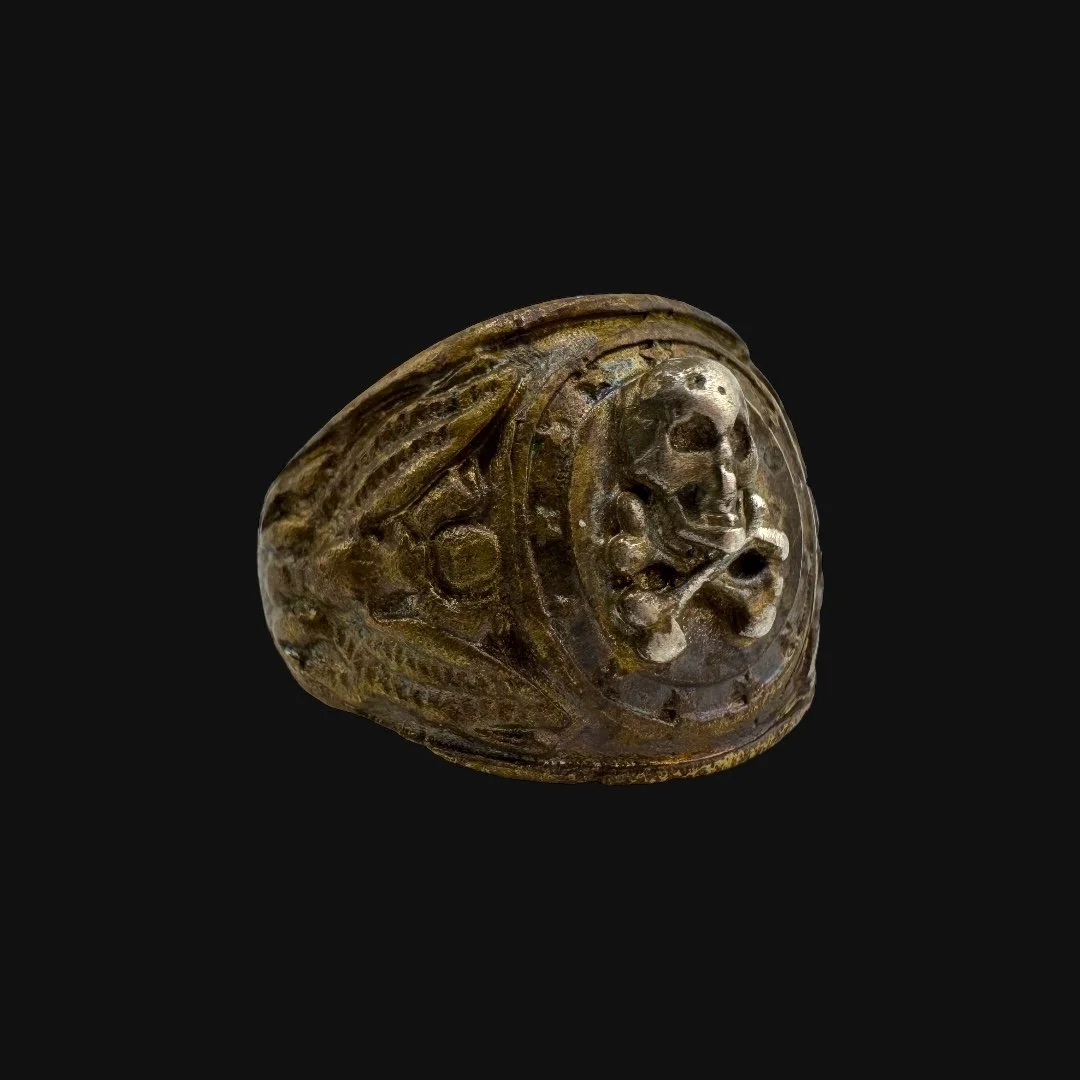
Branch: U.S. Marine Corps (Marine Raiders)
Dated: 1942-1945
Ring Size: 11 (US)
Material: Bronze & Sterling Silver
Wearable History Collection:
This authentic 1942-1945 WWII-era ring, preserved in its original and unaltered condition, combines exceptional craftsmanship with lasting durability, making it fully suitable for modern wear today. As part of our exclusive World War II “Wearable History Ring Collection,” it offers the rare opportunity to own and wear a genuine piece of World War II. Both a timeless accessory and a tangible link to the past, this truly one-of-a-kind ring stands as a wearable tribute to the courage and sacrifice of a generation.
Historical Significance to the Marine Raiders During World War II:
The Marine Raiders were among the most distinctive and historically significant units of World War II, created in 1942 at the request of President Roosevelt to conduct unconventional operations modeled after British Commandos. Organized under leaders such as Merritt “Red Mike” Edson and Evans Carlson, the Raiders were trained for amphibious raids, jungle warfare, demolitions, and infiltration. They became known for their rigorous discipline and the “gung ho” spirit of teamwork that Carlson introduced. Their identity was reinforced by their striking skull insignia, which symbolized their fearlessness and set them apart as an elite force within the Corps.
The Raiders’ combat record was brief but impactful. They carried out the Makin Island raid in August 1942, a daring amphibious strike that boosted American morale early in the Pacific war. Soon after, they earned their most celebrated victory at the Battle of Edson’s Ridge during the Guadalcanal campaign, where Edson’s Raiders held off overwhelming Japanese assaults and secured Henderson Field. This battle became a defining moment in their history and earned Edson the Medal of Honor. Raiders went on to fight in some of the Pacific’s toughest campaigns, including New Georgia and Bougainville, where they conducted grueling jungle marches, launched surprise attacks on entrenched positions, and endured extreme conditions that tested their endurance and resolve.
Although the Raider battalions were disbanded in 1944 and reorganized into conventional infantry, their achievements proved the value of small, highly trained units capable of rapid and flexible operations. They laid important groundwork for modern U.S. special operations, and their legacy was honored decades later when Marine Forces Special Operations Command (MARSOC) adopted the “Raider” name in 2006. The Raiders’ daring campaigns, their iconic skull insignia, and their reputation for resilience ensured that their story remained one of the most celebrated chapters in Marine Corps history, marking them as pioneers of America’s special warfare tradition.
The Legacy Within This Ring:
This original World War II Marine Raider ring carries the fierce spirit of America’s first special operations force. On its face rests a variation of the infamous Marine Raider Raider skull emblem, a symbol of daring, brotherhood, and the willingness to fight in the most perilous conditions. Along its sides, the details recall the airborne-style wings and weaponry that defined these warriors, men trained to strike swiftly from sea or jungle against entrenched Japanese positions. For the Raiders who marched through the heat of Guadalcanal, braved the jungles of New Georgia, or held the ridges above Henderson Field, such a ring was never just decoration. It was a quiet token of identity. A reminder of the courage demanded on night raids, the endurance through disease and exhaustion, and the unshakable camaraderie of those who lived by the “gung ho” spirit. Today, the ring stands as a rare relic of Marine Raider history, a piece of wearable heritage that preserves not only the memory of the individual who once wore it but also the legacy of an elite force whose sacrifice and innovation helped shape the path to victory in World War II.
Comes with a hand-signed C.O.A. and a full historical research write-up
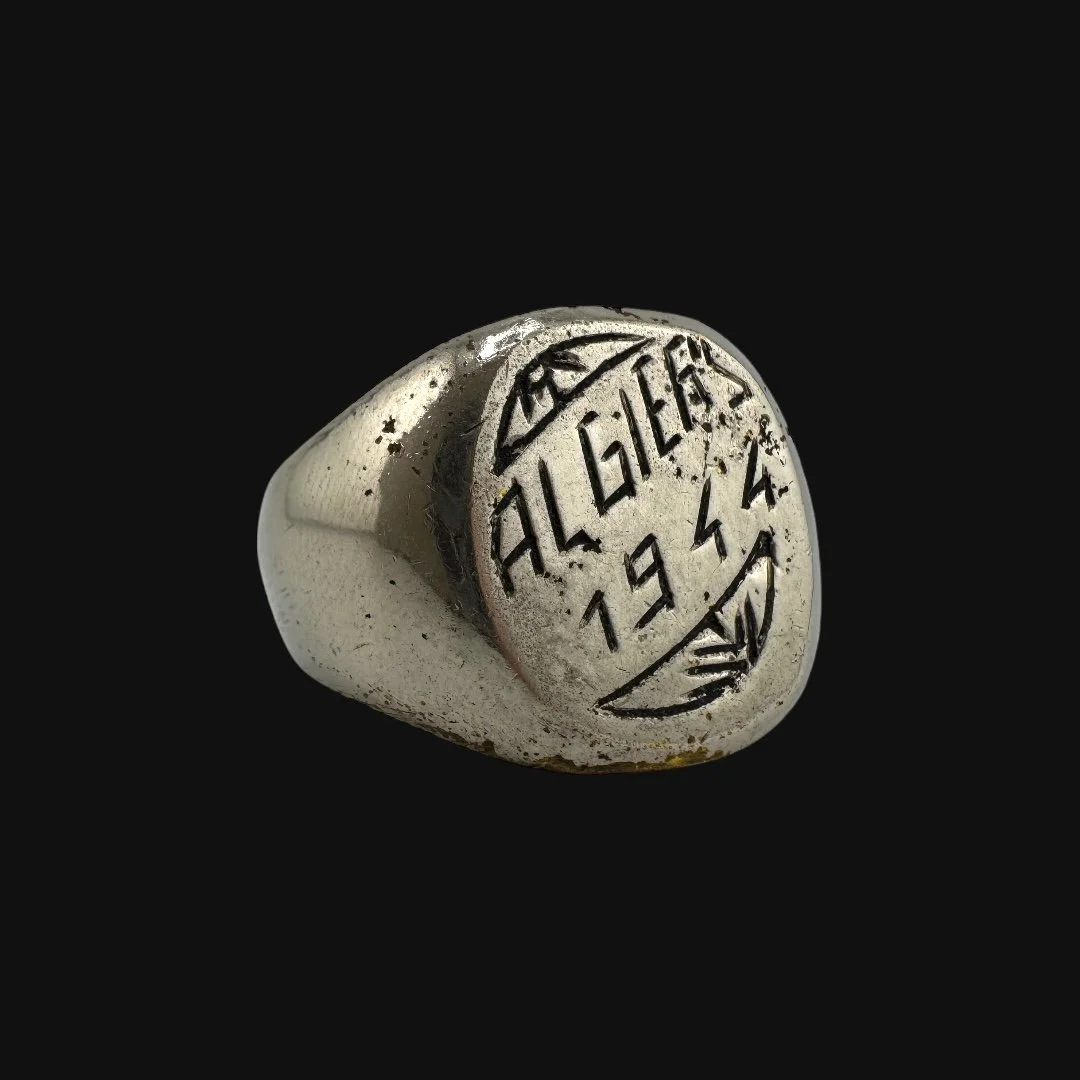
From: World War II
Dated: 1944
Ring Size: 8.75 (US)
Material: Discarded Battlefield Material
Theater: Mediterranean Theater
Wearable History Collection:
This authentic 1944 WWII-era ring, preserved in its original and unaltered condition, combines exceptional craftsmanship with lasting durability, making it fully suitable for modern wear today. As part of our exclusive World War II “Wearable History Ring Collection,” it offers the rare opportunity to own and wear a genuine piece of World War II. Both a timeless accessory and a tangible link to the past, this truly one-of-a-kind ring stands as a wearable tribute to the courage and sacrifice of a generation.
Historical Significance to Algiers (Africa):
By 1944, Algiers had become the political and operational nerve center of the Allied Mediterranean campaign. Once the capital of Vichy-controlled Algeria, it had been seized in the opening hours of Operation Torch in November 1942. In the two years since, the city transformed into the headquarters of the French Committee of National Liberation under Charles de Gaulle, serving as the de facto capital of Free France until the liberation of Paris in August 1944. Its position on the Mediterranean made it an indispensable link between the Allied supply lines from the United States and Britain and the combat zones in Italy, Corsica, and southern France. From its bustling harbors and airfields, Allied convoys, troop transports, and warplanes fanned out across the theater.
Militarily, 1944 saw Algiers functioning as a command and logistical hub for the drive into Europe. The Allied Mediterranean Theater of Operations coordinated campaigns in Italy, the Balkans, and the Aegean from offices here, while its naval facilities staged amphibious rehearsals and convoy escorts. The city played a critical supporting role in Operation Dragoon, the August 1944 invasion of southern France, serving as a staging ground for French First Army units under General de Lattre de Tassigny. Troops, tanks, artillery, and supplies were shipped from Algiers to the Riviera, enabling the rapid link-up with Allied forces advancing from Normandy. Intelligence operations flourished as well, with the OSS, SOE, and French resistance networks using Algiers as a secure base for espionage and sabotage missions into occupied Europe.
The city itself reflected the pressures and opportunities of wartime. Allied troops from multiple nations crowded the streets, markets were alive with activity, and the port worked around the clock unloading Liberty ships. Warehouses brimmed with ammunition and fuel while airfields bustled with reconnaissance and transport aircraft. Civilians experienced both economic opportunity and hardship jobs were plentiful, yet inflation, rationing, and overcrowding strained daily life. By the year’s end, Algiers’ strategic role began to diminish as the war’s center of gravity shifted to France and Germany. Yet in 1944, its harbors, political offices, and military headquarters had been central to sustaining the Mediterranean front and launching the operations that helped bring about Nazi Germany’s defeat.
The Legacy Within This Ring:
This World War II ring, inscribed “ALGIERS 1944,” was handcrafted in theater by a U.S. soldier from discarded wartime/battlefield materials. Created in the bustling Allied stronghold of Algiers, it reflects both the ingenuity of its maker and the city’s vital role in 1944 as the political center of Free France and a key base for Mediterranean operations, including preparations for the invasion of southern France. More than a souvenir, it is a preserved fragment of resilience, artistry, and the campaign that pushed the Allies toward victory in Europe.
Comes with a hand-signed C.O.A. and a full historical research write-up
From: World War II
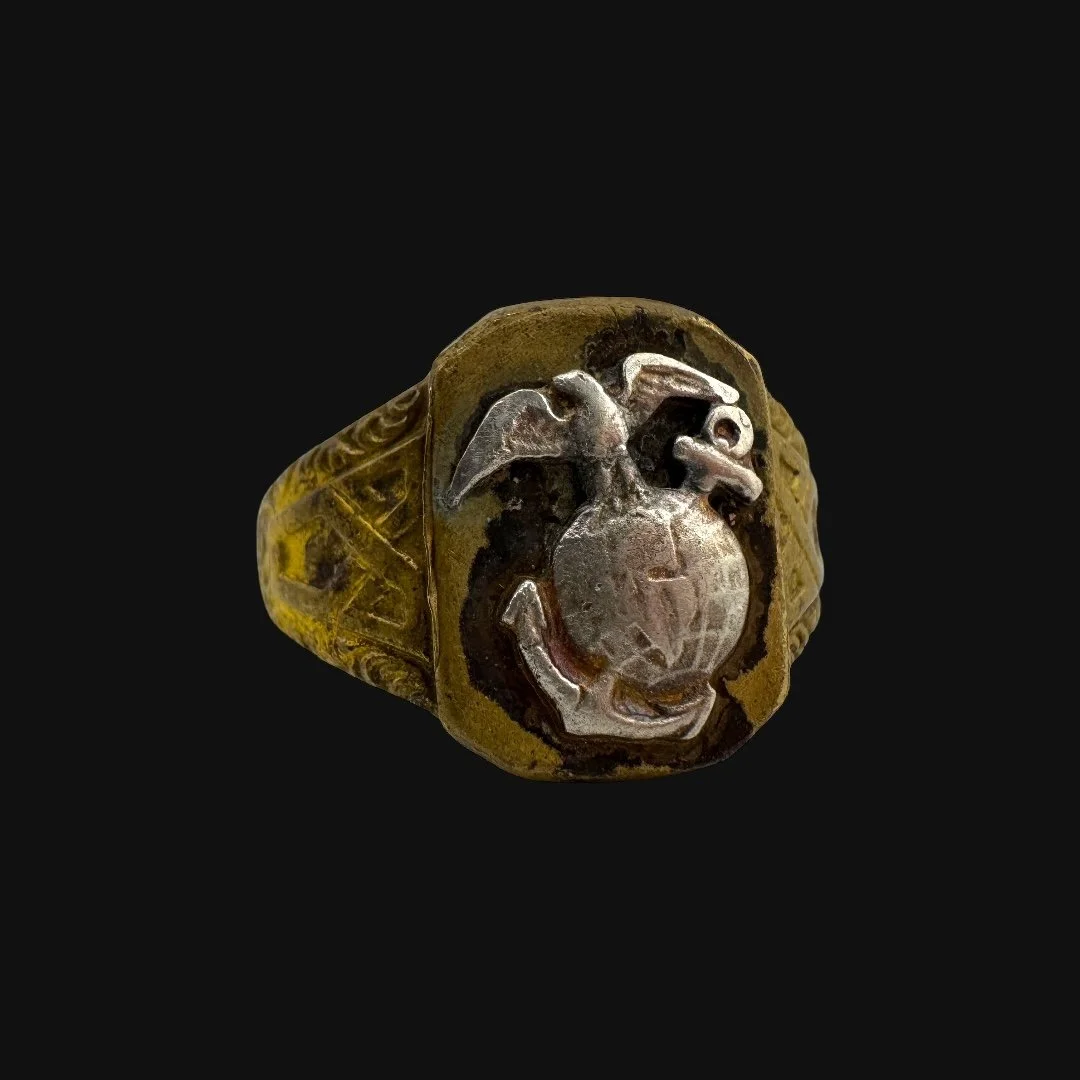
Branch: U.S. Marine Corps
Dated: 1943-1945
Ring Size: 10.5 (US)
Material: Bronze & Sterling Silver
Wearable History Collection:
This authentic 1943-1945 WWII-era ring, preserved in its original and unaltered condition, combines exceptional craftsmanship with lasting durability, making it fully suitable for modern wear today. As part of our exclusive World War II “Wearable History Ring Collection,” it offers the rare opportunity to own and wear a genuine piece of World War II. Both a timeless accessory and a tangible link to the past, this truly one-of-a-kind ring stands as a wearable tribute to the courage and sacrifice of a generation.
Historical Significance to the U.S. Marine Corps During WWII:
The U.S. Marine Corps played a decisive role in World War II, particularly in the Pacific, where it became synonymous with amphibious assault and some of the war’s fiercest battles. At the war’s outset, Marines defended Wake Island, holding off Japanese forces before being overwhelmed, setting the tone for their determination throughout the conflict. Their first major offensive came at Guadalcanal, where the 1st Marine Division endured months of combat, disease, and shortages while securing Henderson Field. This victory marked the first large-scale Allied counteroffensive against Japan and proved the Marines could defeat Japanese ground forces.
The Central Pacific campaigns pushed the Marines into increasingly costly but strategically vital battles. At Tarawa, the 2nd Marine Division stormed heavily fortified positions, suffering over 1,000 dead in just 76 hours. Saipan brought Marines within striking distance of Japan, while Peleliu tested the endurance of the 1st Marine Division against entrenched Japanese defenders. These battles refined amphibious doctrine and showcased the Marines’ ability to overcome immense obstacles at great sacrifice.
The pinnacle of Marine operations came at Iwo Jima and Okinawa. At Iwo Jima, Marines of the 3rd, 4th, and 5th Divisions fought a bloody five-week battle against 22,000 Japanese defenders. Nearly 7,000 Marines were killed, but the island provided vital airfields for B-29 bombers. The flag raising on Mount Suribachi became one of the most iconic images of the war. At Okinawa, the largest Pacific amphibious assault, Marines fought alongside the Army against fierce resistance and kamikaze attacks, securing a base for the planned invasion of Japan. The scale of casualties influenced the decision to use atomic weapons rather than invade the Japanese homeland.
By 1945, the Marine Corps had grown from 66,000 to nearly 475,000 personnel, suffering over 19,000 killed but securing a reputation for unmatched toughness and innovation. Their development of amphibious tactics, use of landing craft like the Higgins boat and LVT, and coordination with naval and air forces reshaped modern warfare. From Wake to Okinawa, the Marines’ courage, sacrifice, and effectiveness made them indispensable to Allied victory and solidified their identity as America’s elite expeditionary force.
The Legacy Within This Ring:
This original World War II U.S. Marine Corps ring is a rare and deeply personal artifact, privately commissioned by a Marine who served in the Pacific campaigns of the war. Bearing the proud eagle, globe, and anchor emblem on its face, the ring allowed its owner to carry the symbol of his service not only on his uniform but also as a constant reminder on his hand. For Marines who stormed beaches at Tarawa, Saipan, Iwo Jima, and Okinawa, such rings became more than jewelry. They were tangible reminders of sacrifice, brotherhood, and the unyielding spirit of the Corps in the face of some of the war’s bloodiest battles. Every engraved detail reflects the pride these men carried in their calling…fighters trained to strike from sea to land, who carved a path across the Pacific island by island. The eagle, globe, and anchor marked their identity as Marines, part of a tradition of service that demanded endurance, loyalty, and honor. Today, this ring endures as a wearable relic of the Marine Corps’ legacy in World War II. It represents not only the courage of those who fought through fire-swept beaches and entrenched defenses, but also the enduring bond of the Marines who proved, time and again, their devotion to one another and to the nation they swore to defend.
Comes with a hand-signed C.O.A. and a full historical research write-up
From: World War II
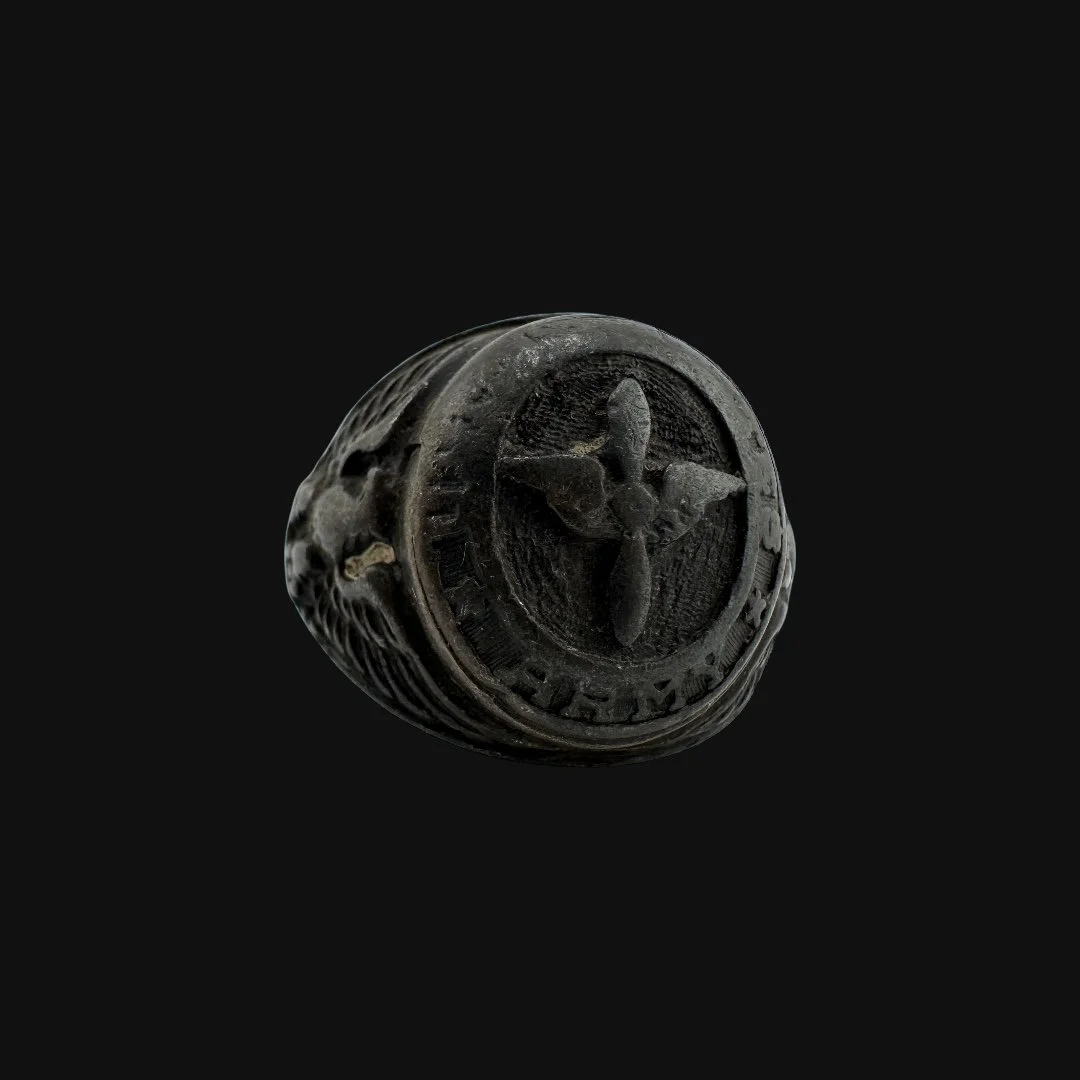
Branch: U.S. Army Air Force (USAAF)
Dated: 1943-1945
Ring Size: 10 (US)
Wearable History Collection:
This authentic 1943-1945 WWII-era ring, preserved in its original and unaltered condition, combines exceptional craftsmanship with lasting durability, making it fully suitable for modern wear today. As part of our exclusive World War II “Wearable History Ring Collection,” it offers the rare opportunity to own and wear a genuine piece of World War II. Both a timeless accessory and a tangible link to the past, this truly one-of-a-kind ring stands as a wearable tribute to the courage and sacrifice of a generation.
Historical Significance to the U.S. Army Air Corps During WWII:
The U.S. Army Air Force (USAAF), was one of the most decisive elements of World War II. Entering the war in 1941 as a relatively small branch with outdated aircraft, it expanded at astonishing speed. By 1945, it fielded over 2.4 million personnel and more than 80,000 aircraft, making it one of the most powerful air arms in history. Its missions spanned every theater of the war, ranging from strategic bombing campaigns and fighter escort operations to close air support, transport, and airborne assaults, reshaping the nature of modern warfare.
In Europe, the U.S. Army Air Force became central to the Allied strategy of crippling Germany through strategic bombing. Flying daylight missions with B-17s and B-24s, supported by long-range escorts like the P-51 Mustang, American airmen struck factories, oil refineries, and transportation hubs, gradually breaking Germany’s industrial capacity. These operations came at high cost but paved the way for Allied ground advances. The Air Corps also played a crucial role in Operation Overlord, with transport planes dropping the 82nd and 101st Airborne Divisions into Normandy and bombers softening up coastal defenses. In the Mediterranean, air units supported landings in North Africa, Sicily, and Italy, gaining air superiority while disrupting German supply lines.
In the Pacific, the USAAF was indispensable in the island-hopping campaign. Aircraft provided close air support at Guadalcanal, the Philippines, and Okinawa, while long-range B-29 Superfortresses based in the Marianas struck Japan directly. The strategic bombing of Japanese cities devastated industry and infrastructure, culminating in the atomic bomb missions over Hiroshima and Nagasaki in August 1945, which directly forced Japan’s surrender. Fighters such as the P-38 Lightning and P-47 Thunderbolt also excelled in tactical missions, strafing Japanese columns and supporting amphibious landings.
The USAAF also pioneered airborne warfare, with C-47 Skytrains delivering paratroopers during Normandy, Market Garden, and the Rhine crossing. Meanwhile, transport and cargo planes revolutionized logistics by moving troops and supplies across continents. By the war’s end, the U.S. Army Air Force had destroyed the Luftwaffe, crippled Axis economies, secured Allied invasions, and delivered the weapons that ended the war.
The historical significance of the U.S. Army Air Force lies in its ability to prove that control of the skies could decide the outcome of wars. It was the force that carried Allied strategy into enemy territory, protected ground troops from above, and brought the war to a close in Japan. In doing so, it redefined the role of airpower and left a legacy of innovation, sacrifice, and dominance that shaped the modern American military.
The Legacy Within This Ring:
This original World War II U.S. Army Air Force ring is a rare and personal artifact, privately commissioned by a wartime USAAF pilot who served in America’s skies during the world’s most decisive conflict. Bearing the WWII prop and wings insignia on its front, the ring allowed its owner to carry the identity of his service not only on his uniform but also as a lasting symbol worn daily on his hand. For the men who flew long missions over Europe and the Pacific whether in B-17s and B-24s braving flak and fighters, P-51s escorting bombers deep into enemy territory, or C-47s dropping paratroopers behind the lines such rings were more than jewelry. They were reminders of duty, sacrifice, and the unshakable brotherhood of the airmen who lived and fought together above the clouds of war. Every engraved detail reflects the pride these men carried in their calling, where danger was constant and missions often meant heavy losses. Today, this ring endures as a wearable relic of the USAAF legacy, representing not only the daring of those who took flight against the Axis powers but also the enduring spirit of innovation, resilience, and camaraderie that defined the U.S. Army Air Force in World War II. It remains a tribute to the men who carried their emblem into the skies, knowing their courage would help secure victory and shape the future of modern warfare.
Comes with a hand-signed C.O.A. and a full historical research write-up
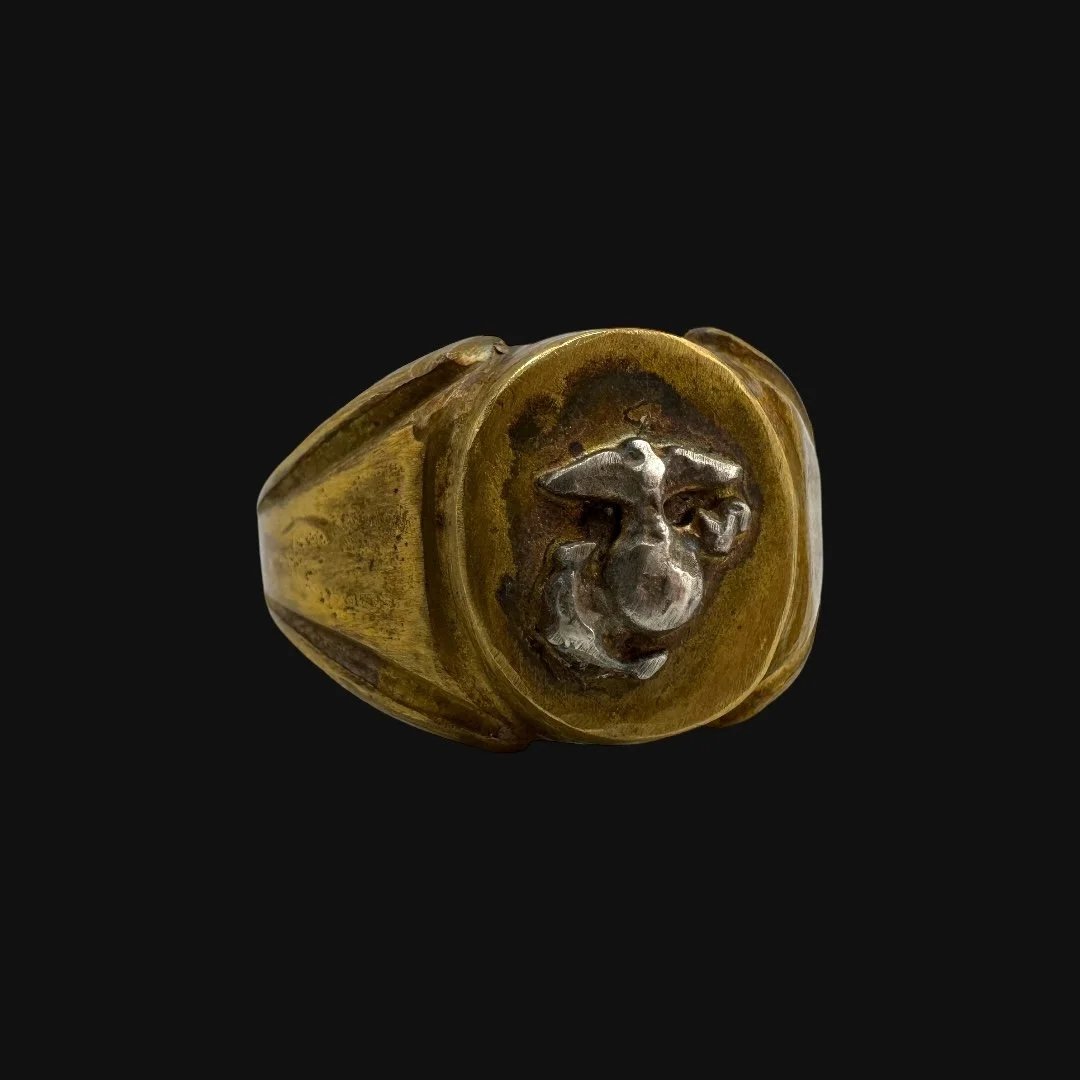
From: World War II
Branch: U.S. Marine Corps
Dated: 1943-1945
Ring Size: 10.25 (US)
Material: Bronze & Sterling Silver
Wearable History Collection:
This authentic 1943-1945 WWII-era ring, preserved in its original and unaltered condition, combines exceptional craftsmanship with lasting durability, making it fully suitable for modern wear today. As part of our exclusive World War II “Wearable History Ring Collection,” it offers the rare opportunity to own and wear a genuine piece of World War II. Both a timeless accessory and a tangible link to the past, this truly one-of-a-kind ring stands as a wearable tribute to the courage and sacrifice of a generation.
Historical Significance to the U.S. Marine Corps During WWII:
The U.S. Marine Corps played a decisive role in World War II, particularly in the Pacific, where it became synonymous with amphibious assault and some of the war’s fiercest battles. At the war’s outset, Marines defended Wake Island, holding off Japanese forces before being overwhelmed, setting the tone for their determination throughout the conflict. Their first major offensive came at Guadalcanal, where the 1st Marine Division endured months of combat, disease, and shortages while securing Henderson Field. This victory marked the first large-scale Allied counteroffensive against Japan and proved the Marines could defeat Japanese ground forces.
The Central Pacific campaigns pushed the Marines into increasingly costly but strategically vital battles. At Tarawa, the 2nd Marine Division stormed heavily fortified positions, suffering over 1,000 dead in just 76 hours. Saipan brought Marines within striking distance of Japan, while Peleliu tested the endurance of the 1st Marine Division against entrenched Japanese defenders. These battles refined amphibious doctrine and showcased the Marines’ ability to overcome immense obstacles at great sacrifice.
The pinnacle of Marine operations came at Iwo Jima and Okinawa. At Iwo Jima, Marines of the 3rd, 4th, and 5th Divisions fought a bloody five-week battle against 22,000 Japanese defenders. Nearly 7,000 Marines were killed, but the island provided vital airfields for B-29 bombers. The flag raising on Mount Suribachi became one of the most iconic images of the war. At Okinawa, the largest Pacific amphibious assault, Marines fought alongside the Army against fierce resistance and kamikaze attacks, securing a base for the planned invasion of Japan. The scale of casualties influenced the decision to use atomic weapons rather than invade the Japanese homeland.
By 1945, the Marine Corps had grown from 66,000 to nearly 475,000 personnel, suffering over 19,000 killed but securing a reputation for unmatched toughness and innovation. Their development of amphibious tactics, use of landing craft like the Higgins boat and LVT, and coordination with naval and air forces reshaped modern warfare. From Wake to Okinawa, the Marines’ courage, sacrifice, and effectiveness made them indispensable to Allied victory and solidified their identity as America’s elite expeditionary force.
The Legacy Within This Ring:
This original World War II U.S. Marine Corps ring is a rare and deeply personal artifact, privately commissioned by a Marine who served in the Pacific campaigns of the war. Bearing the proud eagle, globe, and anchor emblem on its face, the ring allowed its owner to carry the symbol of his service not only on his uniform but also as a constant reminder on his hand. For Marines who stormed beaches at Tarawa, Saipan, Iwo Jima, and Okinawa, such rings became more than jewelry. They were tangible reminders of sacrifice, brotherhood, and the unyielding spirit of the Corps in the face of some of the war’s bloodiest battles. Every engraved detail reflects the pride these men carried in their calling…fighters trained to strike from sea to land, who carved a path across the Pacific island by island. The eagle, globe, and anchor marked their identity as Marines, part of a tradition of service that demanded endurance, loyalty, and honor. Today, this ring endures as a wearable relic of the Marine Corps’ legacy in World War II. It represents not only the courage of those who fought through fire-swept beaches and entrenched defenses, but also the enduring bond of the Marines who proved, time and again, their devotion to one another and to the nation they swore to defend.
Comes with a hand-signed C.O.A. and a full historical research write-up
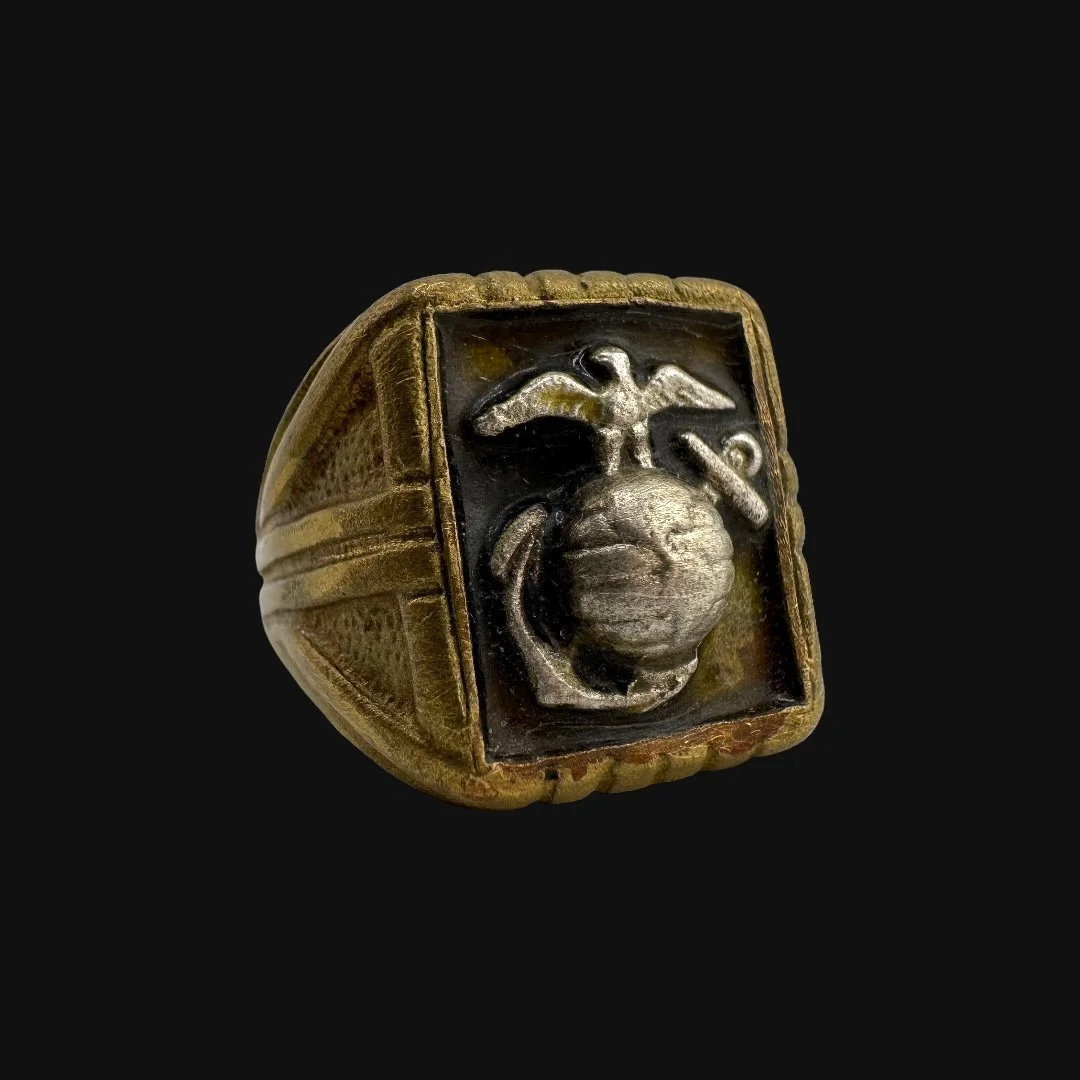
From: World War II
Branch: U.S. Marine Corps
Dated: 1943-1945
Ring Size: 9 (US)
Material: Bronze & Sterling Silver
Wearable History Collection:
This authentic 1943-1945 WWII-era ring, preserved in its original and unaltered condition, combines exceptional craftsmanship with lasting durability, making it fully suitable for modern wear today. As part of our exclusive World War II “Wearable History Ring Collection,” it offers the rare opportunity to own and wear a genuine piece of World War II. Both a timeless accessory and a tangible link to the past, this truly one-of-a-kind ring stands as a wearable tribute to the courage and sacrifice of a generation.
Historical Significance to the U.S. Marine Corps During WWII:
The U.S. Marine Corps played a decisive role in World War II, particularly in the Pacific, where it became synonymous with amphibious assault and some of the war’s fiercest battles. At the war’s outset, Marines defended Wake Island, holding off Japanese forces before being overwhelmed, setting the tone for their determination throughout the conflict. Their first major offensive came at Guadalcanal, where the 1st Marine Division endured months of combat, disease, and shortages while securing Henderson Field. This victory marked the first large-scale Allied counteroffensive against Japan and proved the Marines could defeat Japanese ground forces.
The Central Pacific campaigns pushed the Marines into increasingly costly but strategically vital battles. At Tarawa, the 2nd Marine Division stormed heavily fortified positions, suffering over 1,000 dead in just 76 hours. Saipan brought Marines within striking distance of Japan, while Peleliu tested the endurance of the 1st Marine Division against entrenched Japanese defenders. These battles refined amphibious doctrine and showcased the Marines’ ability to overcome immense obstacles at great sacrifice.
The pinnacle of Marine operations came at Iwo Jima and Okinawa. At Iwo Jima, Marines of the 3rd, 4th, and 5th Divisions fought a bloody five-week battle against 22,000 Japanese defenders. Nearly 7,000 Marines were killed, but the island provided vital airfields for B-29 bombers. The flag raising on Mount Suribachi became one of the most iconic images of the war. At Okinawa, the largest Pacific amphibious assault, Marines fought alongside the Army against fierce resistance and kamikaze attacks, securing a base for the planned invasion of Japan. The scale of casualties influenced the decision to use atomic weapons rather than invade the Japanese homeland.
By 1945, the Marine Corps had grown from 66,000 to nearly 475,000 personnel, suffering over 19,000 killed but securing a reputation for unmatched toughness and innovation. Their development of amphibious tactics, use of landing craft like the Higgins boat and LVT, and coordination with naval and air forces reshaped modern warfare. From Wake to Okinawa, the Marines’ courage, sacrifice, and effectiveness made them indispensable to Allied victory and solidified their identity as America’s elite expeditionary force.
The Legacy Within This Ring:
This original World War II U.S. Marine Corps ring is a rare and deeply personal artifact, privately commissioned by a Marine who served in the Pacific campaigns of the war. Bearing the proud eagle, globe, and anchor emblem on its face, the ring allowed its owner to carry the symbol of his service not only on his uniform but also as a constant reminder on his hand. For Marines who stormed beaches at Tarawa, Saipan, Iwo Jima, and Okinawa, such rings became more than jewelry. They were tangible reminders of sacrifice, brotherhood, and the unyielding spirit of the Corps in the face of some of the war’s bloodiest battles. Every engraved detail reflects the pride these men carried in their calling…fighters trained to strike from sea to land, who carved a path across the Pacific island by island. The eagle, globe, and anchor marked their identity as Marines, part of a tradition of service that demanded endurance, loyalty, and honor. Today, this ring endures as a wearable relic of the Marine Corps’ legacy in World War II. It represents not only the courage of those who fought through fire-swept beaches and entrenched defenses, but also the enduring bond of the Marines who proved, time and again, their devotion to one another and to the nation they swore to defend.
Comes with a hand-signed C.O.A. and a full historical research write-up
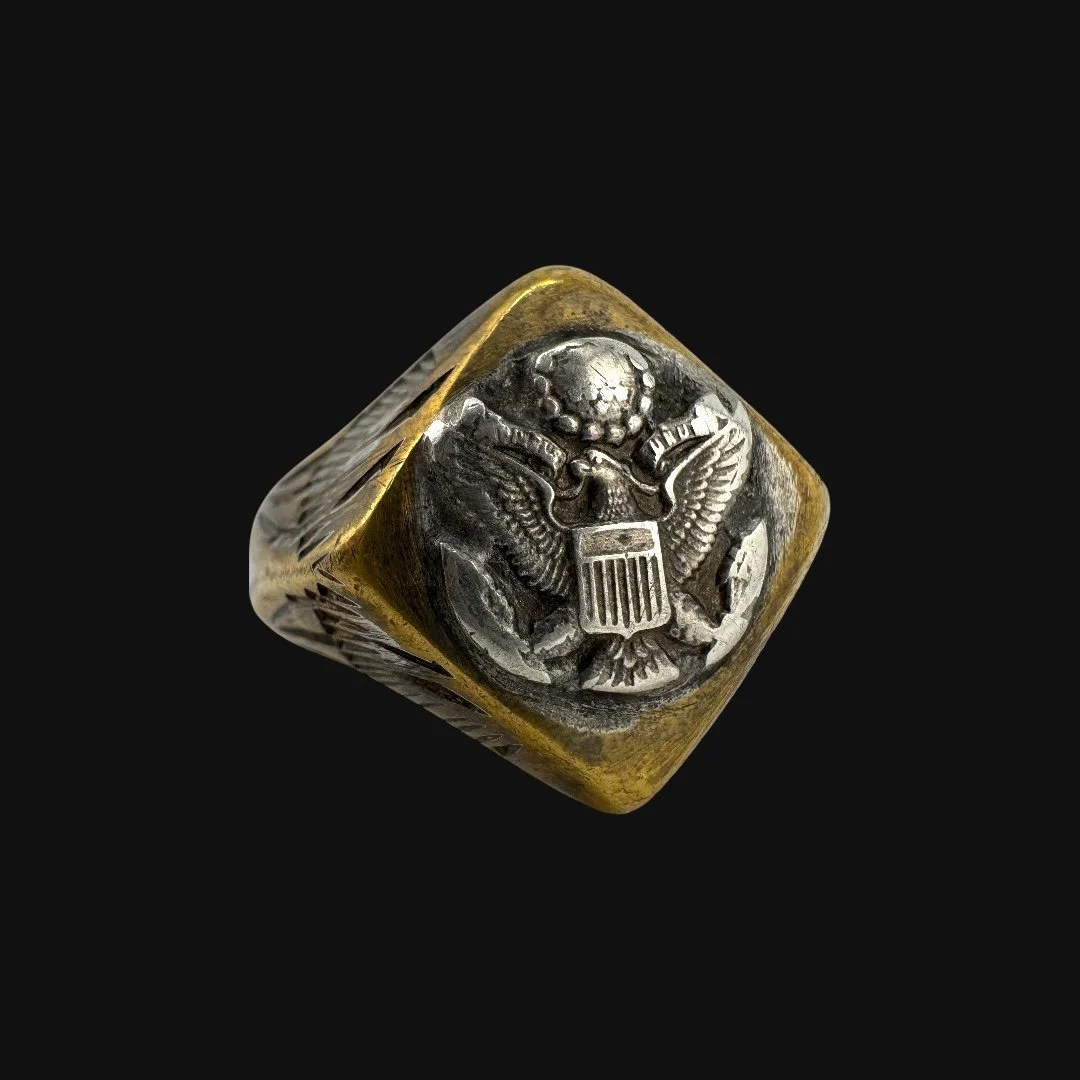
From: World War II
Branch: U.S. Army
Dated: 1942-1945
Ring Size: 9.75 (US)
Material: Fired Shell Casing/Discarded Battlefield Material
Wearable History Collection:
This authentic 1942-1945 WWII-era ring, preserved in its original and unaltered condition, combines exceptional craftsmanship with lasting durability, making it fully suitable for modern wear today. As part of our exclusive World War II “Wearable History Ring Collection,” it offers the rare opportunity to own and wear a genuine piece of World War II. Both a timeless accessory and a tangible link to the past, this truly one-of-a-kind ring stands as a wearable tribute to the courage and sacrifice of a generation.
Historical Significance to the United States Army During World War II:
The United States Army in World War II grew from fewer than 190,000 active-duty soldiers in 1941 to over 8.3 million by 1945, transforming into a global force capable of sustained combat across multiple continents. Rapid mobilization, industrial production, and the Selective Service draft enabled the Army to field hundreds of divisions and specialized units, supported by armor, artillery, engineers, medics, and the Army Air Forces. It fought in both the European and Pacific theaters, conducting some of the war’s most famous operations.
The Army’s first major engagement came with Operation Torch in November 1942, landing in Morocco and Algeria to fight Vichy French and German forces. Success led to the Sicily invasion (Operation Husky)in July 1943 and the Italian campaign, culminating in the capture of Rome in June 1944. In Western Europe, Operation Overlord on June 6, 1944, saw U.S. forces storm Omaha and Utah Beaches, supported by the 82nd and 101st Airborne Divisions parachuting inland. The Normandy breakout liberated Paris and drove toward Germany, but the German counterattack at the Battle of the Bulge in December 1944 tested American endurance, with Bastogne’s defense becoming legendary. By March 1945, U.S. forces had crossed the Rhine, advanced deep into Germany, and met Soviet troops on the Elbe.
In the Pacific, the Army fought a grueling island-hopping campaign under General Douglas MacArthur, reclaiming New Guinea, the Philippines, and key islands like Okinawa. Early losses such as Bataan gave way to decisive victories, including the liberation of Manila and the massive Battle of Leyte Gulf. The Army also endured fierce fighting in the Marianas, Palau, and countless smaller islands, facing both brutal combat and extreme environmental challenges.
Specialized branches played key roles: the Army Air Forces bombed enemy industry and infrastructure, the Corps of Engineers built critical infrastructure under fire, and medical units revolutionized battlefield care. Intelligence units, including the “Ghost Army,” used deception to mislead enemy forces, while logistical operations sustained campaigns across vast distances.
Victory in Europe (V-E Day, May 8, 1945) marked the defeat of Nazi Germany and the Army’s transition to occupation duties. Victory over Japan (V-J Day, September 2, 1945) ended the war entirely, validating years of sacrifice and effort. These victories symbolized the Army’s ability to project force globally, execute complex operations, and overcome two of history’s most powerful adversaries. From North Africa to Normandy, the Ardennes to the Pacific islands, the U.S. Army’s World War II record remains a defining chapter in American and world history.
The Legacy Within This Ring:
This original World War II United States Army ring, handmade between 1942 and 1945, was skillfully crafted from discarded battlefield materials gathered in the midst of the war. Each contour and engraving reflects the ingenuity and determination of the soldier who shaped it. The face proudly bears the “U.S. Army” insignia, while the sides carry intricate details that speak to honor, duty, and perseverance under fire. Forged from the remnants of war, it carries within its metal the memory of campaigns fought from the deserts of North Africa to the hedgerows of Normandy, through the frozen forests of the Ardennes, and across the vast reaches of the Pacific. This was not simply a piece of jewelry. It was a soldier’s personal emblem, a tangible reminder of comradeship, sacrifice, and survival.
Comes with a hand-signed C.O.A. and a full historical research write-up
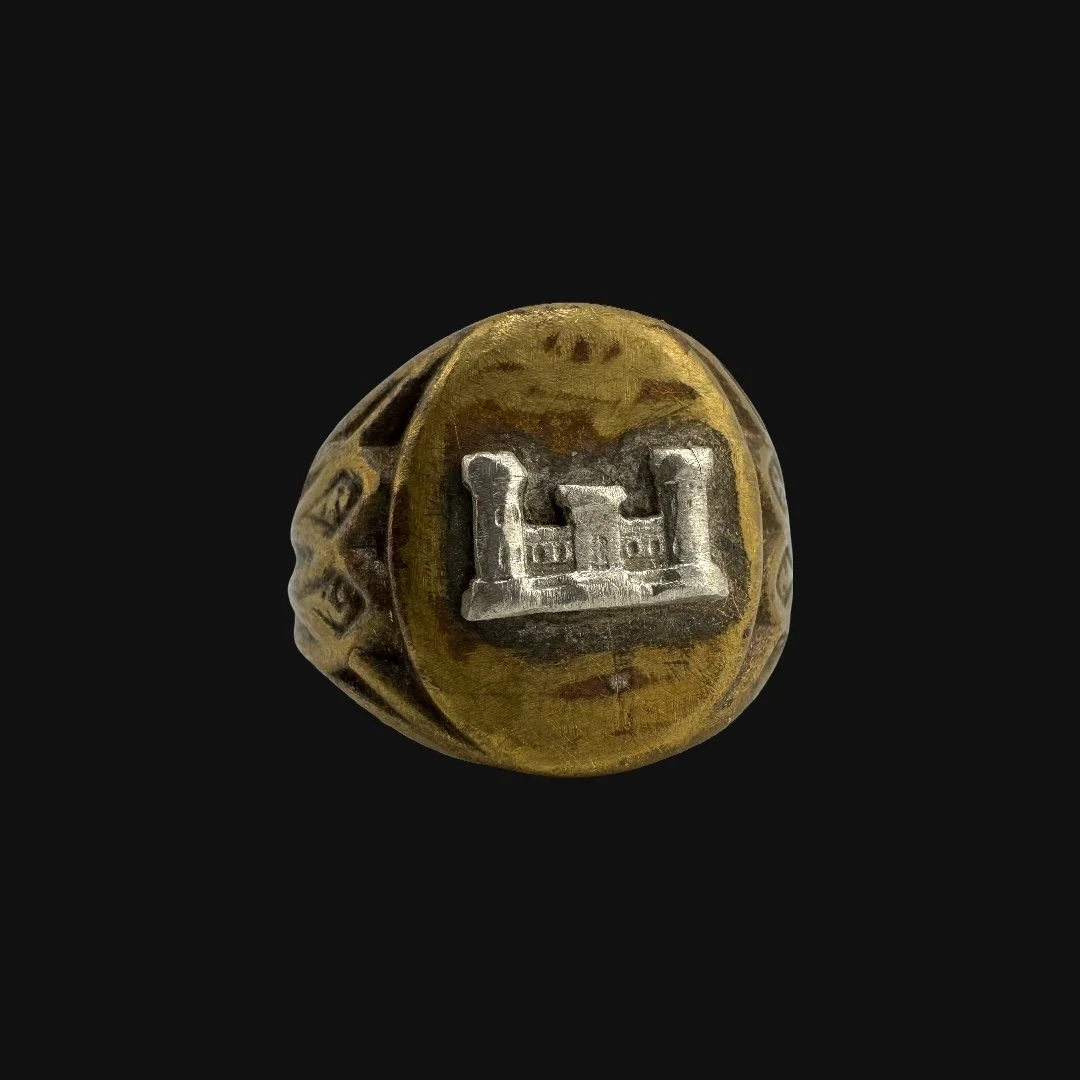
From: World War II
Branch: U.S. Army (Corps of Engineers)
Dated: 1943-1945
Ring Size: 11 (US)
Material: Bronze & Sterling Silver
Wearable History Collection:
This authentic 1943-1945 WWII-era ring, preserved in its original and unaltered condition, combines exceptional craftsmanship with lasting durability, making it fully suitable for modern wear today. As part of our exclusive World War II “Wearable History Ring Collection,” it offers the rare opportunity to own and wear a genuine piece of World War II. Both a timeless accessory and a tangible link to the past, this truly one-of-a-kind ring stands as a wearable tribute to the courage and sacrifice of a generation.
Historical Significance to the U.S. Army Corps of Engineers During WWII:
The U.S. Army Corps of Engineers was indispensable to Allied victory in World War II, shaping every campaign with a combination of construction skill, combat bravery, and technical innovation. Their responsibilities ranged from clearing obstacles and breaching enemy defenses to building roads, bridges, and airfields that kept American forces supplied and mobile across multiple continents. Before U.S. troops even entered combat, the Corps was already vital on the home front, constructing training bases, industrial facilities, and even the secret sites of the Manhattan Project. Once in the field, engineers became both builders and fighters, providing the infrastructure that made large-scale warfare possible.
In North Africa and Italy, the Engineers repaired and built critical roads and bridges under fire, cleared minefields, and constructed desert airstrips. Their role became legendary during the Normandy invasion, where combat engineers braved enemy fire to dismantle obstacles on Omaha and Utah beaches, opening the way for infantry and armor to break through. Later, they constructed Bailey bridges and pontoon crossings that allowed Allied advances across France and Germany, culminating in the massive bridging of the Rhine River in 1945. During the Battle of the Bulge, they delayed German advances by destroying bridges and creating improvised defenses, buying crucial time for U.S. forces to regroup.
In the Pacific, the Engineers faced entirely different challenges, carving airfields from jungles, building pontoon causeways on coral reefs, and constructing makeshift harbors for amphibious operations. On islands like Iwo Jima and Okinawa, they bulldozed runways under heavy fire, allowing U.S. airpower to project deeper into Japanese territory. Their innovation in amphibious engineering, bridging, and demolition technology made them as much a weapon of war as the infantry and tanks they supported.
By the end of the war, the Corps of Engineers had built over 700 airfields, thousands of bridges, and countless miles of roads, depots, and barracks. Their work not only enabled battlefield victories but also laid the foundation for postwar reconstruction. The Engineers proved that modern wars are won not only with firepower but with the ability to move, build, and adapt. Their legacy from World War II endures in both military doctrine and civilian infrastructure, marking them as one of the most critical yet often unsung forces of the Allied triumph.
The Legacy Within This Ring:
This original World War II U.S. Army Corps of Engineers ring is a rare and meaningful artifact, privately commissioned and worn by a wartime engineer who served in one of the Army’s most indispensable branches. For the men who built bridges under fire, cleared minefields, and carved airstrips from jungles and beaches, such rings became more than adornments. They were enduring reminders of the grit, ingenuity, and sacrifice required to keep the Army moving forward across every theater of the war. Each engraved detail reflects the pride these soldiers held in their calling, balancing technical skill with courage in combat. Today, the ring survives as a wearable relic of the Engineers’ legacy, honoring the determination of those who turned steel, stone, and earth into instruments of victory in the most demanding conditions of World War II.
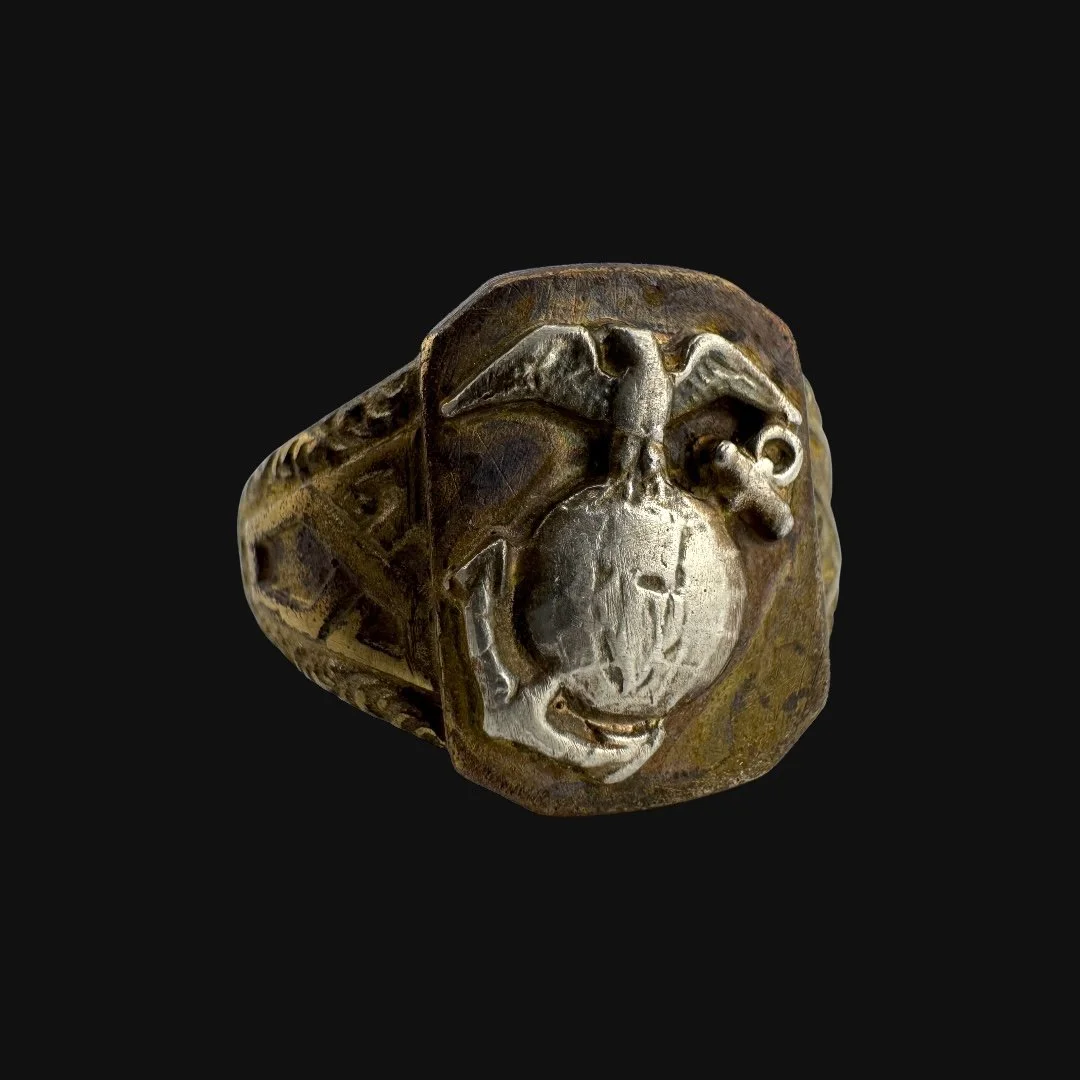
Comes with a hand-signed C.O.A. and a full historical research write-up
From: World War II
Branch: U.S. Marine Corps
Dated: 1942-1945
Ring Size: 10.5 (US)
Wearable History Collection:
This authentic 1942-1945 WWII-era ring, preserved in its original and unaltered condition, combines exceptional craftsmanship with lasting durability, making it fully suitable for modern wear today. As part of our exclusive World War II “Wearable History Ring Collection,” it offers the rare opportunity to own and wear a genuine piece of World War II. Both a timeless accessory and a tangible link to the past, this truly one-of-a-kind ring stands as a wearable tribute to the courage and sacrifice of a generation.
Historical Significance to the United States Marine Corps During World War II:
The United States Marine Corps emerged as one of the most decisive forces in the Pacific Theater during World War II, growing from 66,000 personnel in 1941 to over 485,000 by 1945. At the war’s outset, Marines were scattered across the Pacific, manning remote outposts from China to Midway. When Japan struck Pearl Harbor on December 7, 1941, Marine detachments were immediately in action. On Wake Island, a garrison of fewer than 2,000 Marines and civilians held off repeated Japanese attacks for 15 days, sinking two destroyers and damaging other ships before being overwhelmed. In the Philippines, Marines fought alongside Army units in the desperate defenses of Bataan and Corregidor, resisting until supplies and ammunition were gone.
The first major Marine offensive came in August 1942 with the 1st Marine Division landing on Guadalcanal. Facing disease, jungle warfare, and relentless Japanese assaults, Marines held Henderson Field in a six-month campaign that marked Japan’s first major land defeat. This victory opened the way for the island-hopping strategy that would define the Pacific war. Marines soon tested and refined amphibious assault doctrine at Tarawa in November 1943, where 4,500 Japanese defenders fought nearly to the last man. Coral reefs stranded landing craft, forcing Marines to wade through chest-deep water under heavy fire. In just 76 hours, they took the island at the cost of over 1,000 dead and 2,300 wounded, a sobering lesson in planning and equipment.
In 1944, the Marines struck in the Marshall and Mariana Islands. At Saipan, they fought alongside the Army for three weeks against 30,000 Japanese defenders, enduring fierce counterattacks and civilian tragedies. Victory there triggered political upheaval in Tokyo. On Tinian, Marines executed one of the war’s most brilliant landings, surprising defenders by attacking narrow beaches considered impossible, securing the island with fewer casualties and enabling the construction of massive airfields for B-29 raids on Japan.
By 1945, the Corps faced its deadliest battles. At Iwo Jima, beginning February 19, 70,000 Marines fought a month-long struggle against 21,000 entrenched Japanese. The battle claimed nearly 7,000 Marine lives and over 19,000 wounded. The flag raising on Mount Suribachi became an enduring symbol of sacrifice. Weeks later, Marines took part in Okinawa, the largest amphibious assault of the Pacific War, where kamikaze attacks, fierce ground combat, and mass civilian deaths marked the brutal reality of Japan’s final defenses.
Throughout the war, the Marines perfected amphibious warfare, integrating naval gunfire, air support, and logistics into a cohesive assault doctrine that remains foundational to modern operations. From the desperate stands of 1941 to the climactic victories of 1945, the Corps’ blend of adaptability, aggressive tactics, and unyielding spirit forged a legacy that still defines the Marine ethos.
The Legacy Within This Ring:
This original World War II 1942–1945 United States Marine Corps ring proudly bears the iconic Eagle, Globe, and Anchor emblem at its center, the timeless symbol of the Corps’ honor, courage, and commitment. Worn by a WWII Marine who served during the defining years of the Pacific War, it stood as more than a piece of jewelry. It was a personal badge of identity, forged in an era of relentless battle and unshakable duty. Each mark and contour reflects the pride of service, the memory of island beaches won at great cost, and the brotherhood formed in the crucible of war. This ring carries the echoes of campaigns from Guadalcanal to Iwo Jima, embodying the spirit of the Marines who fought across oceans and into history. Today, it endures as a preserved piece of wearable Marine Corps heritage. A lasting tribute to the grit, sacrifice, and unyielding resolve that helped carry the United States to victory in the greatest conflict of the 20th century.
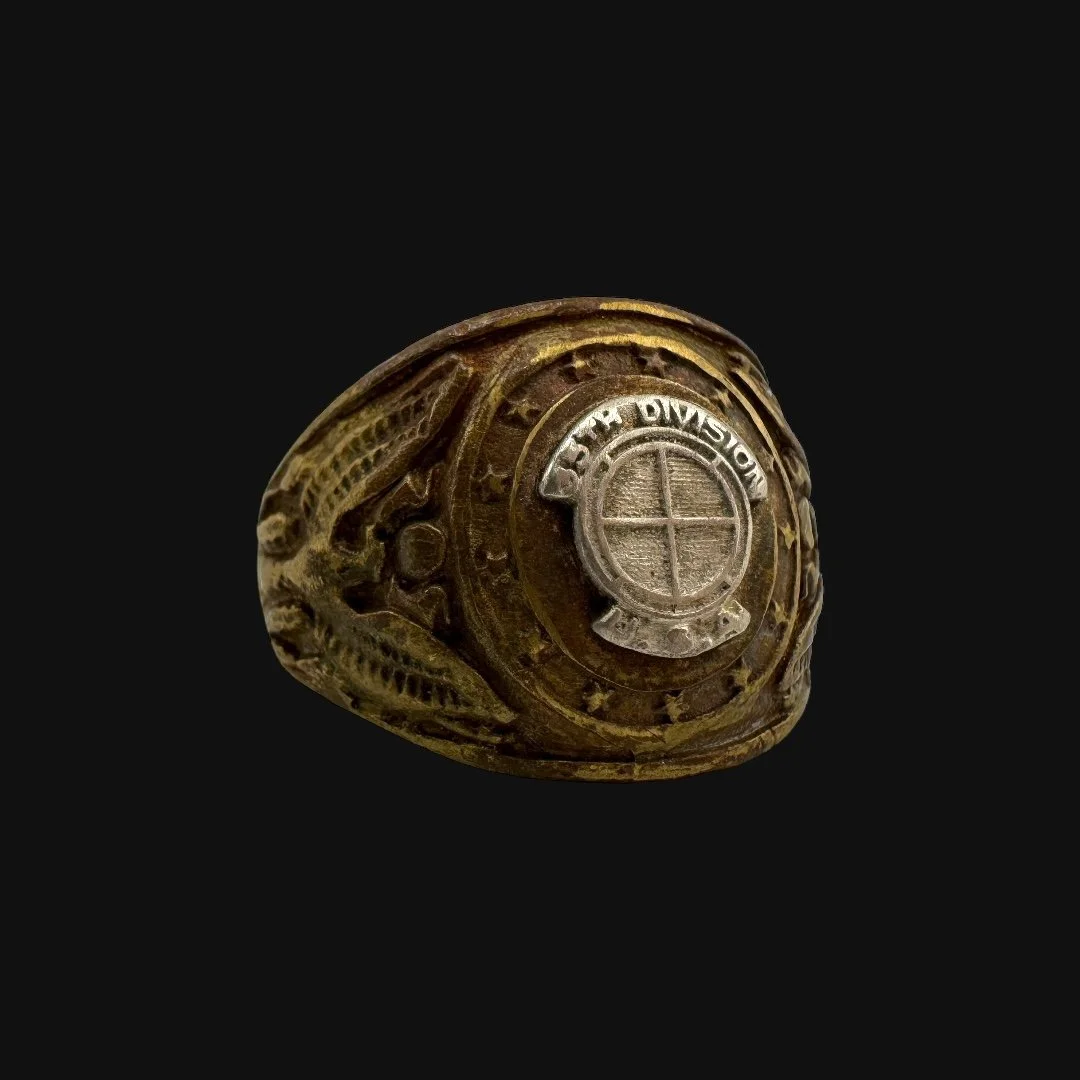
Comes with a hand-signed C.O.A. and a full historical research write-up
From: World War II
Branch: U.S. Army
Division: 35th Infantry Division (Santa Fe Division)
Dated: 1943-1945
Ring Size: 11 (US)
Material: Bronze & Sterling Silver
Wearable History Collection:
This authentic 1943-1945 WWII-era ring, preserved in its original and unaltered condition, combines exceptional craftsmanship with lasting durability, making it fully suitable for modern wear today. As part of our exclusive World War II “Wearable History Ring Collection,” it offers the rare opportunity to own and wear a genuine piece of World War II. Both a timeless accessory and a tangible link to the past, this truly one-of-a-kind ring stands as a wearable tribute to the courage and sacrifice of a generation.
Historical Significance to the 35th Infantry Division During WWII:
The 35th Infantry Division, the “Santa Fe Division” drawn largely from Kansas, Missouri, and Nebraska National Guard units, played a vital role in the European Theater during World War II. Activated in 1940, it entered combat in Normandy in July 1944, where its baptism of fire came in the brutal hedgerows. The division’s most significant early achievement was the capture of Saint-Lô, a fiercely contested objective whose fall enabled Operation Cobra, the breakout from Normandy. This success allowed Patton’s Third Army to launch its rapid drive across France, and the 35th proved itself capable of tough, sustained fighting in its first campaign.
Through the fall of 1944, the division took part in the Lorraine Campaign, enduring mud, rain, and attritional warfare against fortified German defenses around Nancy and the Foret de Gremecey. Despite fierce resistance, it pressed forward, securing ground that paved the way for future advances. Its defining test came during the Battle of the Bulge, when the 35th was rushed north to help defend and relieve Bastogne. Fighting in freezing weather and against repeated German assaults, the division’s tenacity on the southern shoulder of the Bulge contributed directly to halting Hitler’s last major offensive in the west.
In 1945, the 35th joined the Allied advance into Germany, helping breach the Siegfried Line, cross the Rhine River, and encircle German forces in the Ruhr Pocket, capturing thousands of prisoners. It continued pushing east until Germany’s surrender in May. Over 264 days of combat, the division sustained more than 27,000 casualties but earned distinction for resilience and effectiveness.
The historical significance of the 35th lies in its central role in pivotal campaigns: breaking out of Normandy at Saint-Lô, enduring prolonged combat in Lorraine, standing firm at Bastogne, and driving into Germany in the war’s final months. Its legacy also reflects the strength of the citizen-soldier, proving that National Guard troops could adapt quickly to modern mechanized warfare and carry their share of the fight in history’s greatest conflict.
The Legacy Within This Ring:
This original World War II 35th Infantry Division ring is a rare and deeply personal artifact, privately commissioned by a soldier of the “Santa Fe Division.” Bearing the division’s emblem on its front, the ring allowed its owner to carry the proud symbol of his service not only on his uniform but also as a daily reminder worn on his hand. For the men of the 35th who fought through the hedgerows of Normandy, secured the shattered city of Saint-Lô, endured the brutal Lorraine Campaign, and battled in the freezing Ardennes to relieve Bastogne, such a ring became more than jewelry. It was a tangible emblem of sacrifice, perseverance, and brotherhood earned in some of the most decisive battles of the European Theater. Every engraved detail reflects the pride these soldiers carried in their division’s legacy—ordinary citizen-soldiers transformed into combat veterans who spent over 260 days in continuous battle. The emblem of the 35th stood as a mark of identity in the push across France, through Germany’s Siegfried Line, and over the Rhine into the heart of the Reich. It represented their resilience under fire and their critical role in dismantling the Nazi war machine. Today, this ring endures as a wearable relic of the 35th Infantry Division’s World War II service. It honors not only the courage of those who gave everything in Europe, but also the enduring spirit of the Santa Fe Division, whose determination carried them from the blood-soaked fields of Normandy to final victory in Germany. More than a collectible, it remains a lasting tribute to sacrifice, unity, and the strength of America’s citizen-soldiers in the greatest conflict of the 20th century.
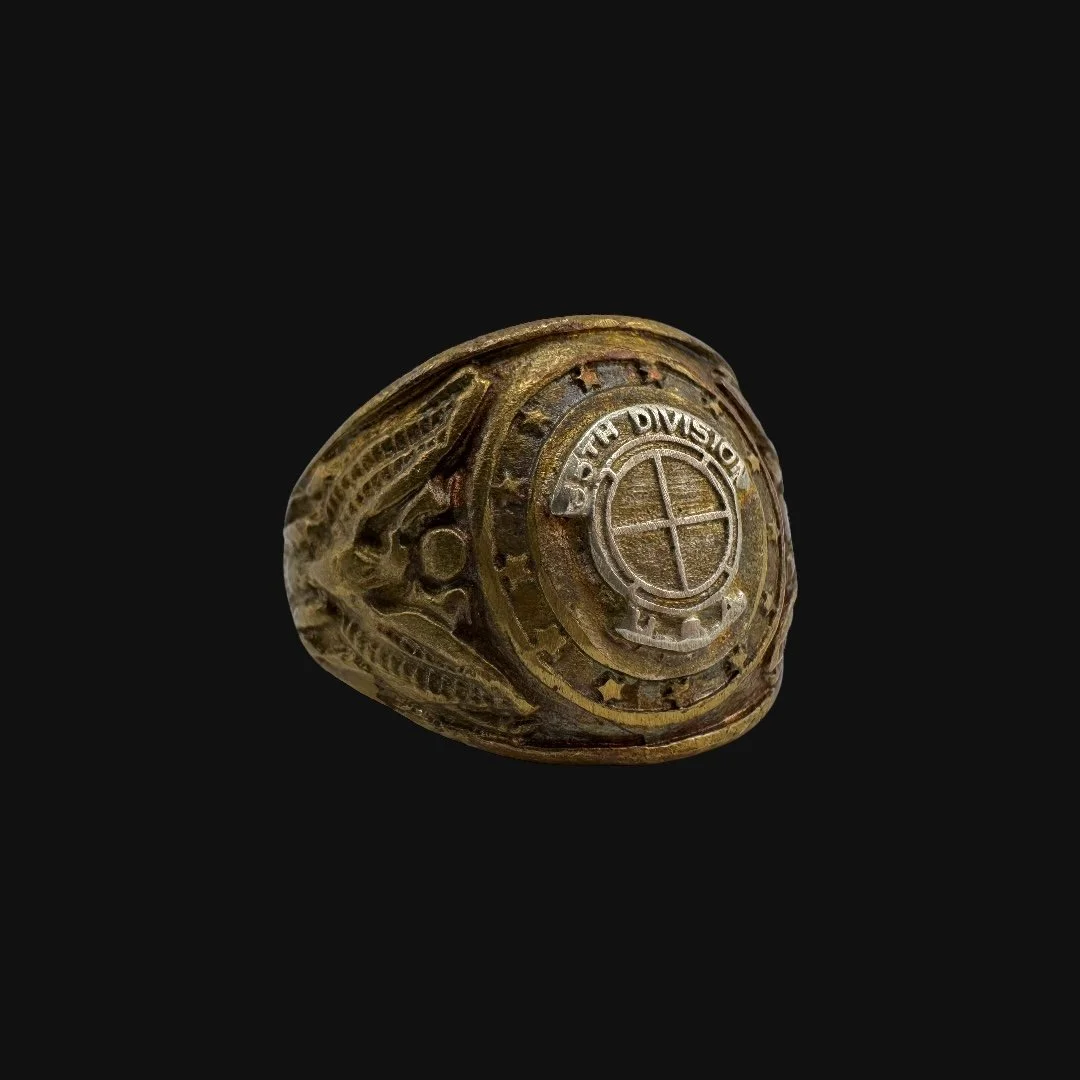
Comes with a hand-signed C.O.A. and a full historical research write-up
From: World War II
Branch: U.S. Army
Division: 35th Infantry Division (Santa Fe Division)
Dated: 1943-1945
Ring Size: 11 (US)
Material: Bronze & Sterling Silver
Wearable History Collection:
This authentic 1943-1945 WWII-era ring, preserved in its original and unaltered condition, combines exceptional craftsmanship with lasting durability, making it fully suitable for modern wear today. As part of our exclusive World War II “Wearable History Ring Collection,” it offers the rare opportunity to own and wear a genuine piece of World War II. Both a timeless accessory and a tangible link to the past, this truly one-of-a-kind ring stands as a wearable tribute to the courage and sacrifice of a generation.
Historical Significance to the 35th Infantry Division During WWII:
The 35th Infantry Division, the “Santa Fe Division” drawn largely from Kansas, Missouri, and Nebraska National Guard units, played a vital role in the European Theater during World War II. Activated in 1940, it entered combat in Normandy in July 1944, where its baptism of fire came in the brutal hedgerows. The division’s most significant early achievement was the capture of Saint-Lô, a fiercely contested objective whose fall enabled Operation Cobra, the breakout from Normandy. This success allowed Patton’s Third Army to launch its rapid drive across France, and the 35th proved itself capable of tough, sustained fighting in its first campaign.
Through the fall of 1944, the division took part in the Lorraine Campaign, enduring mud, rain, and attritional warfare against fortified German defenses around Nancy and the Foret de Gremecey. Despite fierce resistance, it pressed forward, securing ground that paved the way for future advances. Its defining test came during the Battle of the Bulge, when the 35th was rushed north to help defend and relieve Bastogne. Fighting in freezing weather and against repeated German assaults, the division’s tenacity on the southern shoulder of the Bulge contributed directly to halting Hitler’s last major offensive in the west.
In 1945, the 35th joined the Allied advance into Germany, helping breach the Siegfried Line, cross the Rhine River, and encircle German forces in the Ruhr Pocket, capturing thousands of prisoners. It continued pushing east until Germany’s surrender in May. Over 264 days of combat, the division sustained more than 27,000 casualties but earned distinction for resilience and effectiveness.
The historical significance of the 35th lies in its central role in pivotal campaigns: breaking out of Normandy at Saint-Lô, enduring prolonged combat in Lorraine, standing firm at Bastogne, and driving into Germany in the war’s final months. Its legacy also reflects the strength of the citizen-soldier, proving that National Guard troops could adapt quickly to modern mechanized warfare and carry their share of the fight in history’s greatest conflict.
The Legacy Within This Ring:
This original World War II 35th Infantry Division ring is a rare and deeply personal artifact, privately commissioned by a soldier of the “Santa Fe Division.” Bearing the division’s emblem on its front, the ring allowed its owner to carry the proud symbol of his service not only on his uniform but also as a daily reminder worn on his hand. For the men of the 35th who fought through the hedgerows of Normandy, secured the shattered city of Saint-Lô, endured the brutal Lorraine Campaign, and battled in the freezing Ardennes to relieve Bastogne, such a ring became more than jewelry. It was a tangible emblem of sacrifice, perseverance, and brotherhood earned in some of the most decisive battles of the European Theater. Every engraved detail reflects the pride these soldiers carried in their division’s legacy—ordinary citizen-soldiers transformed into combat veterans who spent over 260 days in continuous battle. The emblem of the 35th stood as a mark of identity in the push across France, through Germany’s Siegfried Line, and over the Rhine into the heart of the Reich. It represented their resilience under fire and their critical role in dismantling the Nazi war machine. Today, this ring endures as a wearable relic of the 35th Infantry Division’s World War II service. It honors not only the courage of those who gave everything in Europe, but also the enduring spirit of the Santa Fe Division, whose determination carried them from the blood-soaked fields of Normandy to final victory in Germany. More than a collectible, it remains a lasting tribute to sacrifice, unity, and the strength of America’s citizen-soldiers in the greatest conflict of the 20th century.
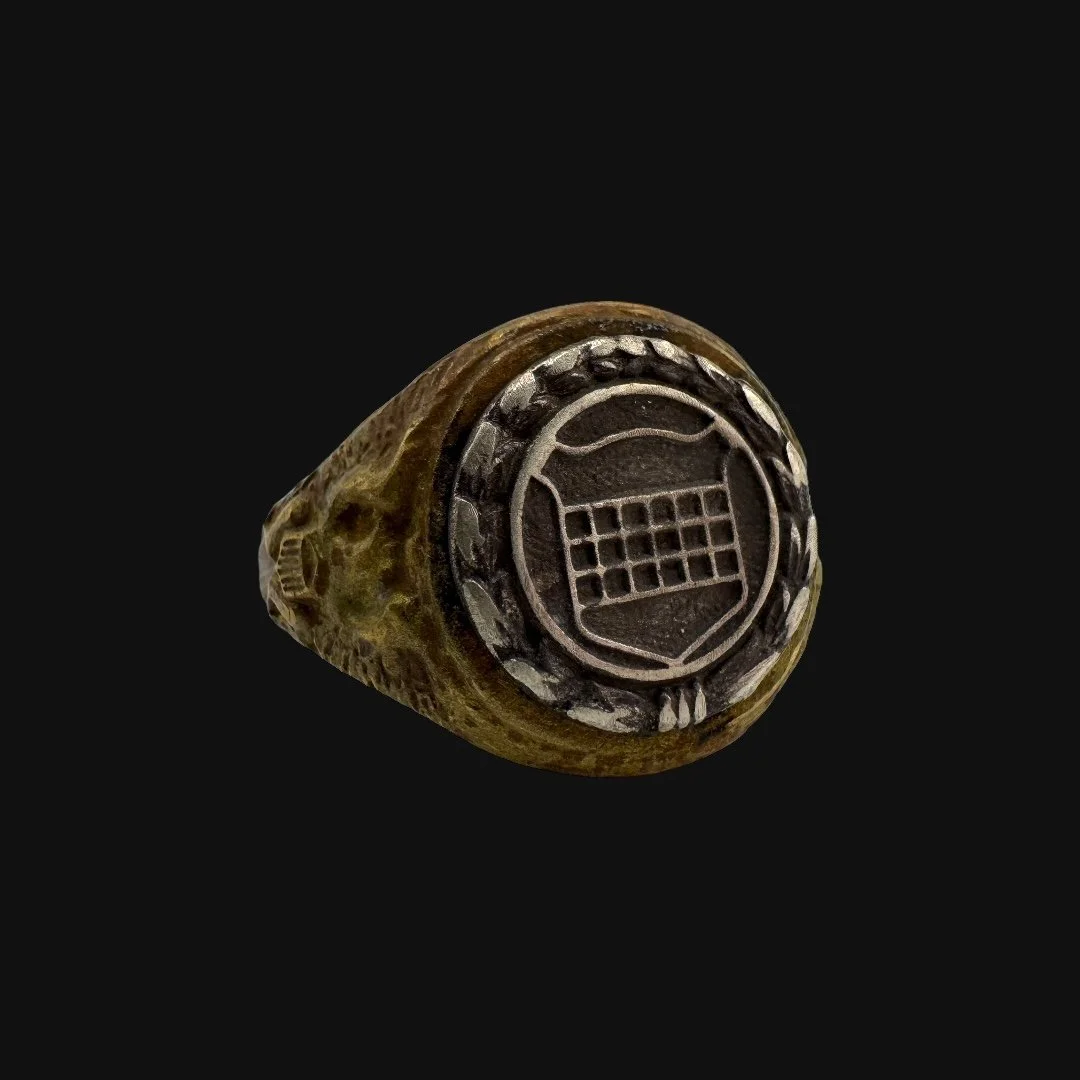
Comes with a hand-signed C.O.A. and a full historical research write-up
From: World War II
Branch: U.S. Army
Division: 99th Infantry Division (Checkerboard Division)
Dated: 1943-1945
Ring Size: 11 (US)
Material: Bronze & Sterling Silver
Wearable History Collection:
This authentic 1943-1945 WWII-era ring, preserved in its original and unaltered condition, combines exceptional craftsmanship with lasting durability, making it fully suitable for modern wear today. As part of our exclusive World War II “Wearable History Ring Collection,” it offers the rare opportunity to own and wear a genuine piece of World War II. Both a timeless accessory and a tangible link to the past, this truly one-of-a-kind ring stands as a wearable tribute to the courage and sacrifice of a generation.
Historical Significance to the 44th Infantry Division During WWII:
The 99th Infantry Division, the “Checkerboard Division,” was one of the U.S. Army’s most remarkable formations of World War II, achieving distinction despite being composed largely of young, inexperienced draftees when it entered combat in late 1944. Activated in 1942 and commanded by Major General Walter E. Lauer, the 99th trained extensively before taking up positions in the Ardennes in November 1944, a sector considered relatively quiet. That illusion was shattered on December 16, 1944, when the Germans launched their massive Ardennes Counteroffensive, better known as the Battle of the Bulge.
The 99th found itself directly in the path of the German Fifth Panzer Army near Elsenborn Ridge, facing overwhelming odds of nearly 5 to 1. Despite its inexperience, the division fought stubbornly at places like Höfen, Monschau, and Krinkelt-Rocherath, halting repeated assaults by German armor and infantry. Their defense of Elsenborn Ridge denied the enemy vital road networks, a factor historians agree was critical in blunting Hitler’s offensive. What began as a baptism of fire became one of the most important defensive stands of the war, earning the 99th lasting respect as a combat-hardened unit.
Following the Bulge, the division transitioned to the offensive. In early 1945, it crossed the Roer River, broke through the Siegfried Line, and helped secure crossings over the Rhine, proving its adaptability in large-scale attacks. The 99th then joined in clearing the Ruhr Pocket, capturing thousands of German troops, before advancing into Bavaria and overseeing surrenders as the war came to an end. Over 200 days of combat, its soldiers earned numerous decorations for valor and established themselves as equals among veteran divisions.
The historical significance of the 99th Infantry Division lies in its transformation from an untested formation into a decisive contributor to Allied victory. Its stand at the Battle of the Bulge ensured the failure of Germany’s last major offensive, while its role in breaching the Siegfried Line, crossing the Rhine, and dismantling the Ruhr cemented its importance in the final drive into Germany. The Checkerboard Division’s legacy is one of resilience, sacrifice, and the enduring strength of America’s citizen-soldiers when thrust into history’s greatest conflict.
The Legacy Within This Ring:
This original World War II 99th Infantry Division ring is a rare and deeply personal artifact, privately commissioned by a soldier of the famed “Checkerboard Division.” Bearing the division’s distinctive black-and-white emblem on the front, the ring allowed its owner to carry the symbol of his service not only on his uniform but also as a constant reminder on his hand. For the men of the 99th—young and often untested when they entered combat—the emblem became a badge of resilience, earned on the frozen fields of the Battle of the Bulge and carried with them through the brutal advance into Germany. Such rings were more than jewelry. They stood as tokens of sacrifice, endurance, and brotherhood forged in fire. Every engraved detail reflects the pride these men held in their division, whose steadfast defense on Elsenborn Ridgedenied the German Fifth Panzer Army the breakthroughs it sought and helped blunt Hitler’s last great offensive. From that desperate stand, through the breaching of the Siegfried Line and the crossing of the Rhine, to the final drive into Bavaria, the emblem of the 99th marked soldiers who had risen to the challenge of history’s greatest conflict. Today, this ring endures as a wearable relic of the 99th Infantry Division’s legacy. It represents not only the courage of those who held the line against overwhelming odds in December 1944, but also the enduring spirit of the Checkerboard Division, ordinary citizen-soldiers who became extraordinary in the crucible of war. More than a collectible, it is a symbol of resilience, loyalty, and the sacrifices that secured victory in Europe.
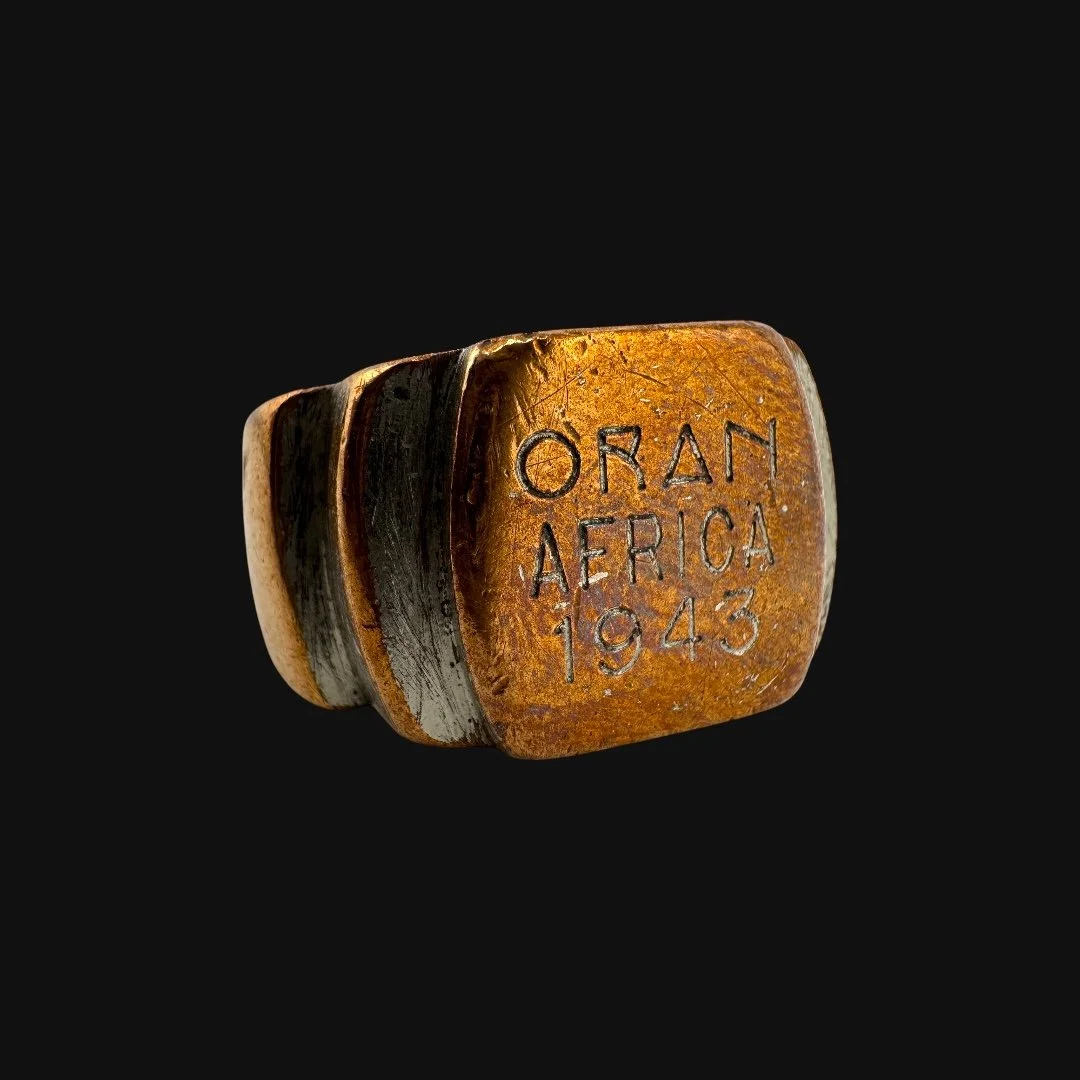
Comes with a hand-signed C.O.A. and a full historical research write-up
From: World War II
Dated: 1943
Ring Size: 11.5 (US)
Material: Fired Shell Casing/Discarded Battlefield Material
Theater: Mediterranean Theater (Operation Torch)
Wearable History Collection:
This authentic 1943 WWII-era ring, preserved in its original and unaltered condition, combines exceptional craftsmanship with lasting durability, making it fully suitable for modern wear today. As part of our exclusive World War II “Wearable History Ring Collection,” it offers the rare opportunity to own and wear a genuine piece of World War II. Both a timeless accessory and a tangible link to the past, this truly one-of-a-kind ring stands as a wearable tribute to the courage and sacrifice of a generation.
Historical Significance to Oran (Africa):
Oran, Algeria, was a critical Allied objective during World War II, coming to prominence inOperation Torch, the first major Anglo-American combined operation, launched on November 8, 1942. Chosen for its deep-water harbor, road and rail links, and strategic position near the Strait of Gibraltar, Oran was essential for securing a foothold in North Africa. U.S. forces, including the 1st Infantry Division and 1st Armored Division, landed under heavy resistance from Vichy French forces. Naval battles unfolded in the harbor, with American destroyers and cruisers clashing with French ships before Oran surrendered on November 10, 1942.
By early 1943, Oran had been transformed into a major Allied logistics and command hub. Its harbor handled an unbroken flow of troop convoys, equipment, and supplies, while nearby La Sénia Airfield became a key base for reconnaissance and bombing missions over Axis positions in Tunisia. The city also served as a major medical evacuation point, treating casualties from the North African front.
After the Axis surrender in North Africa in May 1943, Oran became a principal staging ground forOperation Husky, the invasion of Sicily. Thousands of troops and vast quantities of supplies passed through its docks, making it one of the busiest military ports in the world. Its location allowed the Allies to secure western Mediterranean shipping lanes, enabling safe passage for convoys supporting the Italian Campaign.
Oran’s capture and use in 1943 demonstrated the power of coordinated Allied operations, integrating land, sea, and air forces to secure a logistical stronghold. Its role ensured the rapid buildup of forces for the Mediterranean campaign, directly contributing to the success of operations in Sicily, Italy, and beyond.
The Legacy Within This Ring:
This World War II ring, hand-inscribed “ORAN AFRICA 1943,” was skillfully crafted in theater from fired shell casings, fragments, and other discarded wartime materials left behind after the battles that secured the city. Such rings were often made by soldiers as personal keepsakes, transforming the debris of conflict into lasting symbols of survival, resilience, and remembrance. The Oran inscription ties it to the pivotal North African port captured during Operation Torch and transformed in 1943 into a major Allied logistical hub. From its busy harbor and nearby airfields, troops and supplies flowed toward the Tunisian front and later to the invasion forces bound for Sicily. More than a piece of wartime artistry, this ring holds the physical essence of the battlefield. It reflects the ingenuity of its maker, the realities of combat in the Mediterranean theater, and the memory of a campaign that shifted the balance of power in the region and paved the way for Allied advances into Europe.
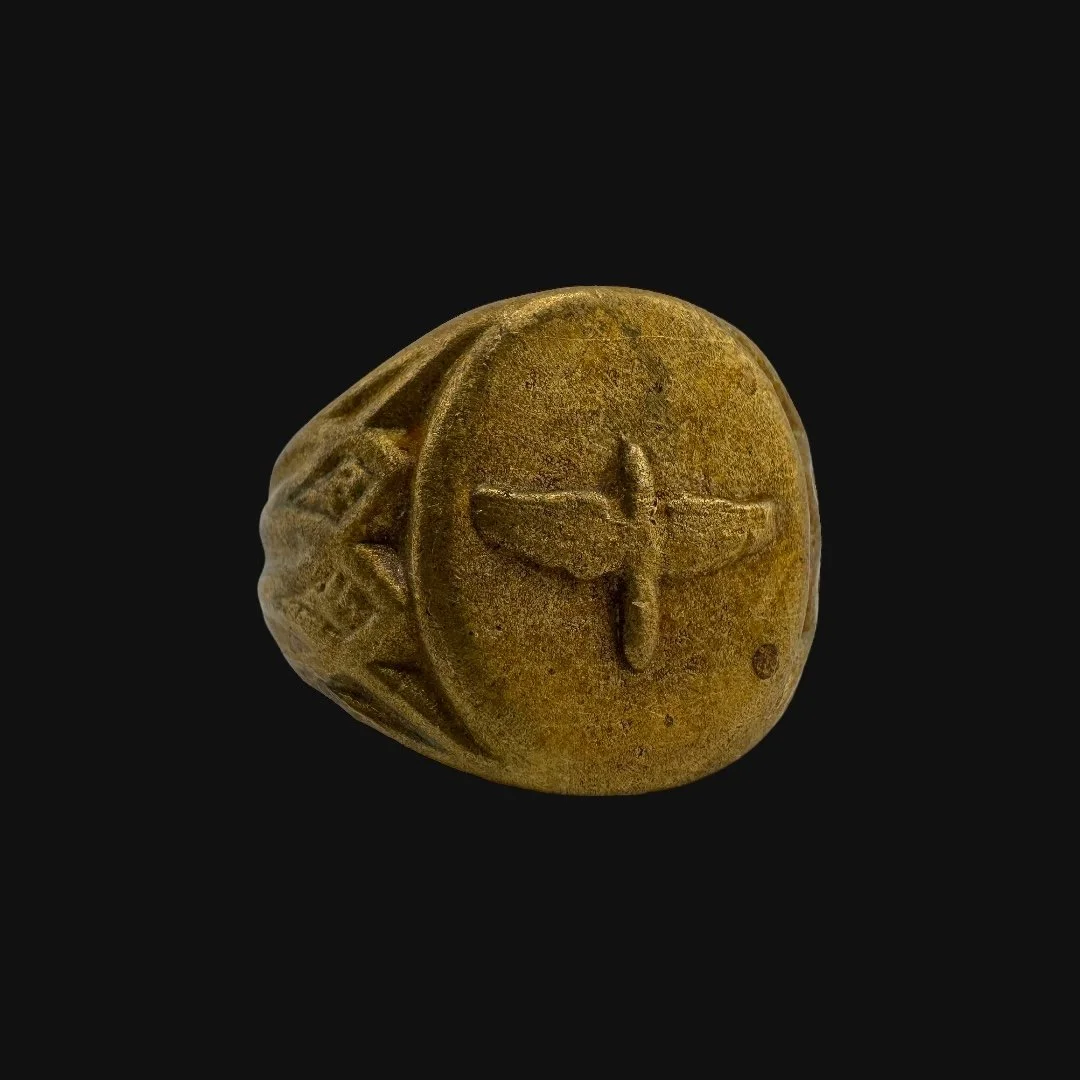
Comes with a hand-signed C.O.A. and a full historical research write-up
From: World War II
Branch: U.S. Army Air Force (USAAF)
Dated: 1943-1945
Ring Size: 11 (US)
Material: Bronze & Sterling Silver
Wearable History Collection:
This authentic 1943-1945 WWII-era ring, preserved in its original and unaltered condition, combines exceptional craftsmanship with lasting durability, making it fully suitable for modern wear today. As part of our exclusive World War II “Wearable History Ring Collection,” it offers the rare opportunity to own and wear a genuine piece of World War II. Both a timeless accessory and a tangible link to the past, this truly one-of-a-kind ring stands as a wearable tribute to the courage and sacrifice of a generation.
Historical Significance to the U.S. Army Air Corps During WWII:
The U.S. Army Air Force (USAAF), was one of the most decisive elements of World War II. Entering the war in 1941 as a relatively small branch with outdated aircraft, it expanded at astonishing speed. By 1945, it fielded over 2.4 million personnel and more than 80,000 aircraft, making it one of the most powerful air arms in history. Its missions spanned every theater of the war, ranging from strategic bombing campaigns and fighter escort operations to close air support, transport, and airborne assaults, reshaping the nature of modern warfare.
In Europe, the U.S. Army Air Force became central to the Allied strategy of crippling Germany through strategic bombing. Flying daylight missions with B-17s and B-24s, supported by long-range escorts like the P-51 Mustang, American airmen struck factories, oil refineries, and transportation hubs, gradually breaking Germany’s industrial capacity. These operations came at high cost but paved the way for Allied ground advances. The Air Corps also played a crucial role in Operation Overlord, with transport planes dropping the 82nd and 101st Airborne Divisions into Normandy and bombers softening up coastal defenses. In the Mediterranean, air units supported landings in North Africa, Sicily, and Italy, gaining air superiority while disrupting German supply lines.
In the Pacific, the USAAF was indispensable in the island-hopping campaign. Aircraft provided close air support at Guadalcanal, the Philippines, and Okinawa, while long-range B-29 Superfortresses based in the Marianas struck Japan directly. The strategic bombing of Japanese cities devastated industry and infrastructure, culminating in the atomic bomb missions over Hiroshima and Nagasaki in August 1945, which directly forced Japan’s surrender. Fighters such as the P-38 Lightning and P-47 Thunderbolt also excelled in tactical missions, strafing Japanese columns and supporting amphibious landings.
The USAAF also pioneered airborne warfare, with C-47 Skytrains delivering paratroopers during Normandy, Market Garden, and the Rhine crossing. Meanwhile, transport and cargo planes revolutionized logistics by moving troops and supplies across continents. By the war’s end, the U.S. Army Air Force had destroyed the Luftwaffe, crippled Axis economies, secured Allied invasions, and delivered the weapons that ended the war.
The historical significance of the U.S. Army Air Force lies in its ability to prove that control of the skies could decide the outcome of wars. It was the force that carried Allied strategy into enemy territory, protected ground troops from above, and brought the war to a close in Japan. In doing so, it redefined the role of airpower and left a legacy of innovation, sacrifice, and dominance that shaped the modern American military.
The Legacy Within This Ring:
This original World War II U.S. Army Air Force ring is a rare and personal artifact, privately commissioned by a wartime USAAF pilot who served in America’s skies during the world’s most decisive conflict. Bearing the WWII prop and wings insignia on its front, the ring allowed its owner to carry the identity of his service not only on his uniform but also as a lasting symbol worn daily on his hand. For the men who flew long missions over Europe and the Pacific whether in B-17s and B-24s braving flak and fighters, P-51s escorting bombers deep into enemy territory, or C-47s dropping paratroopers behind the lines such rings were more than jewelry. They were reminders of duty, sacrifice, and the unshakable brotherhood of the airmen who lived and fought together above the clouds of war. Every engraved detail reflects the pride these men carried in their calling, where danger was constant and missions often meant heavy losses. Today, this ring endures as a wearable relic of the USAAF legacy, representing not only the daring of those who took flight against the Axis powers but also the enduring spirit of innovation, resilience, and camaraderie that defined the U.S. Army Air Force in World War II. It remains a tribute to the men who carried their emblem into the skies, knowing their courage would help secure victory and shape the future of modern warfare.
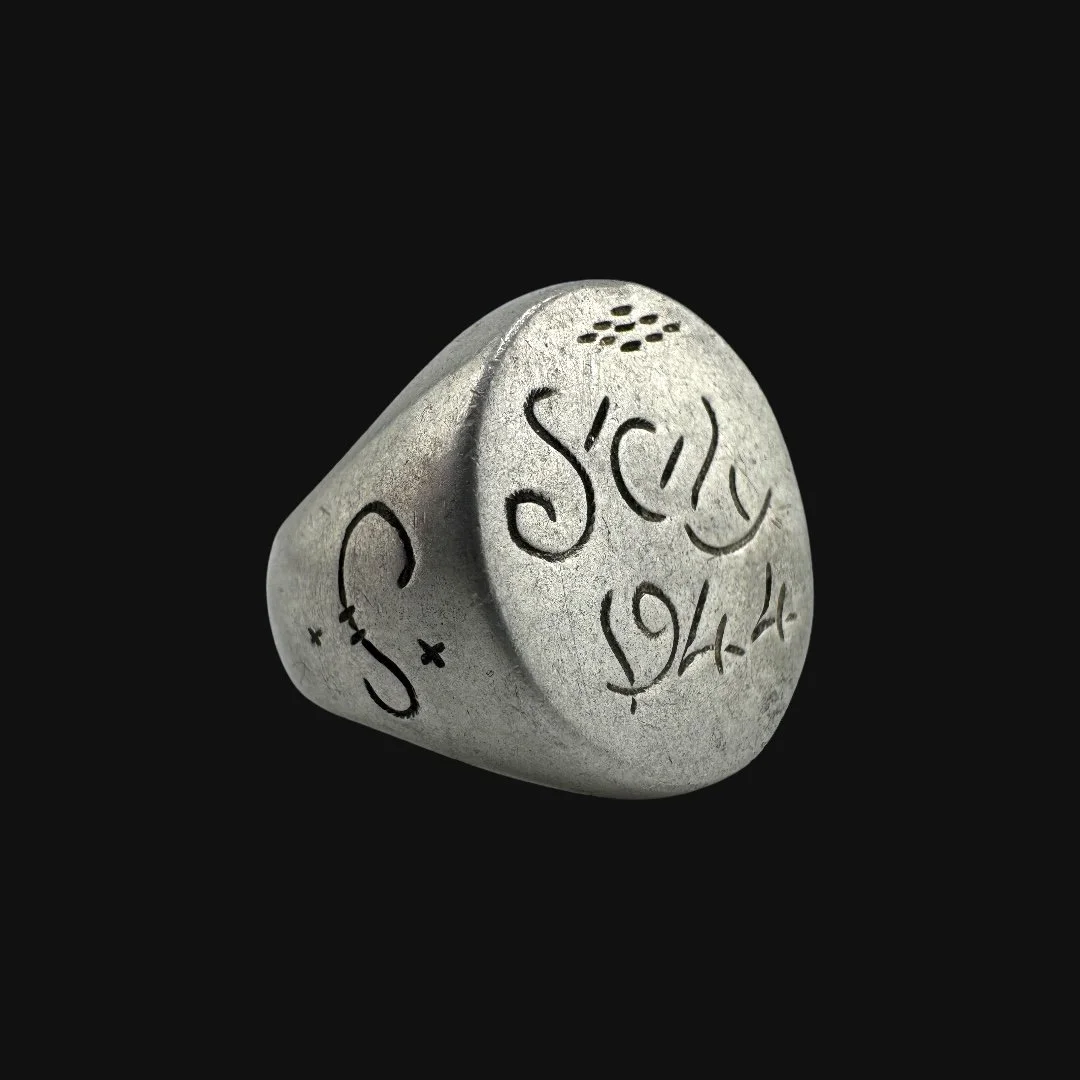
Comes with a hand-signed C.O.A. and a full historical research write-up
From: World War II
Dated: 1944
Ring Size: 9.75 (US)
Material: Allied/Axis Aircraft Wreckage
Theater: Mediterranean Theater (Allied Invasion of Sicily)
Wearable History Collection:
This authentic 1944 WWII-era ring, preserved in its original and unaltered condition, combines exceptional craftsmanship with lasting durability, making it fully suitable for modern wear today. As part of our exclusive World War II “Wearable History Ring Collection,” it offers the rare opportunity to own and wear a genuine piece of World War II. Both a timeless accessory and a tangible link to the past, this truly one-of-a-kind ring stands as a wearable tribute to the courage and sacrifice of a generation.
Historical Significance of Sicily During WWII:
Sicily’s role in World War II was both strategic and transformative. Its location at the heart of the Mediterranean made it a critical bridge between North Africa and mainland Europe. The island’s turning point came with Operation Husky, launched on July 9–10, 1943. This massive amphibious and airborne assault, one of the largest of the war, brought U.S., British, and Canadian forces ashore under General Dwight D. Eisenhower’s overall command. Facing fierce resistance from Italian and German defenders, the Allies advanced through Sicily’s rugged interior. General George S. Patton’s U.S. Seventh Army drove west to capture Palermo while General Bernard Montgomery’s British Eighth Army pushed up the eastern coast toward Catania. By August 17, Axis forces had evacuated over 100,000 troops to the Italian mainland. The victory not only secured the Mediterranean sea lanes but directly contributed to Mussolini’s overthrow on July 25, 1943, and Italy’s surrender in September.
In 1944, though no longer a battlefield, Sicily became a vital Allied stronghold. Its ports at Palermo, Messina, and Augusta transformed into supply and repair hubs for the Italian Campaign, feeding the fight at Monte Cassino, Anzio, and beyond. Expanded airfields served the U.S. Fifteenth Air Force and RAF squadrons, enabling strategic bombing of German positions in northern Italy, southern France, and the Balkans. The island’s secure position allowed constant flow of troops, fuel, and equipment, making it an indispensable logistical artery. Under the Allied Military Government of Occupied Territories, Sicily’s infrastructure and services were restored, fostering civilian cooperation and stability.
By 1944, Sicily had evolved from the hard-fought prize of a daring invasion into the operational backbone of the Mediterranean war. It projected air power deep into Axis territory, sustained the Allied advance through Italy, and stood as a powerful symbol that liberation of Europe was not only possible but inevitable.
The Legacy Within This Ring:
This World War II ring, inscribed “Sicily 1944,” was skillfully made in theater from the lightweight metal of downed or damage Allied/Axis aircraft. Such pieces were often crafted by soldiers as personal mementos, transforming the remnants of war into symbols of survival and remembrance. This World War II Sicily ring preserves the physical essence of the battlefield, carrying with it the weight of combat, the resourcefulness of its maker, and the memory of a campaign that helped turn the tide of the war in the Mediterranean.
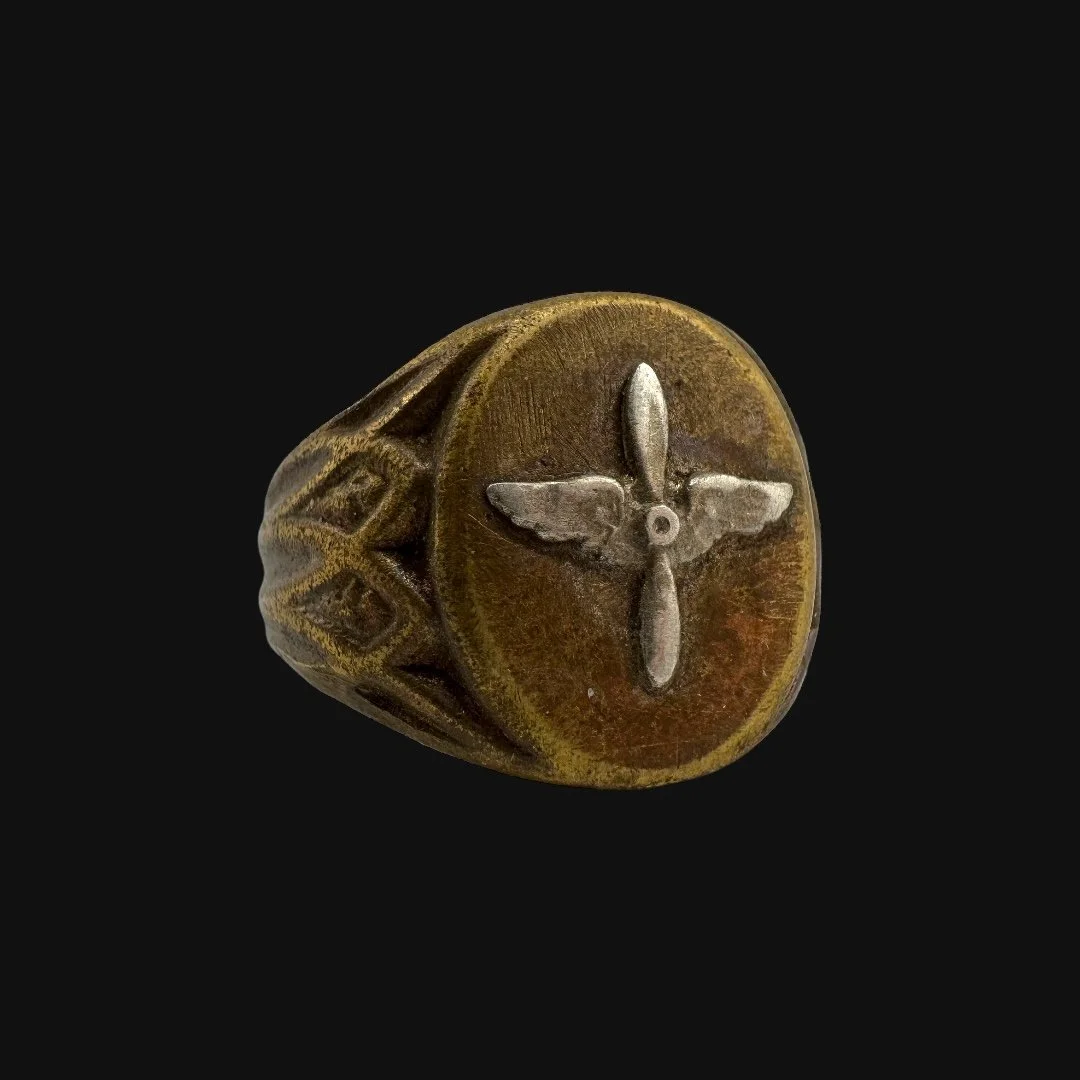
Comes with a hand-signed C.O.A. and a full historical research write-up
From: World War II
Branch: U.S. Army Air Force (USAAF)
Dated: 1943-1945
Ring Size: 11 (US)
Material: Bronze & Sterling Silver
Wearable History Collection:
This authentic 1943-1945 WWII-era ring, preserved in its original and unaltered condition, combines exceptional craftsmanship with lasting durability, making it fully suitable for modern wear today. As part of our exclusive World War II “Wearable History Ring Collection,” it offers the rare opportunity to own and wear a genuine piece of World War II. Both a timeless accessory and a tangible link to the past, this truly one-of-a-kind ring stands as a wearable tribute to the courage and sacrifice of a generation.
Historical Significance to the U.S. Army Air Corps During WWII:
The U.S. Army Air Force (USAAF), was one of the most decisive elements of World War II. Entering the war in 1941 as a relatively small branch with outdated aircraft, it expanded at astonishing speed. By 1945, it fielded over 2.4 million personnel and more than 80,000 aircraft, making it one of the most powerful air arms in history. Its missions spanned every theater of the war, ranging from strategic bombing campaigns and fighter escort operations to close air support, transport, and airborne assaults, reshaping the nature of modern warfare.
In Europe, the U.S. Army Air Force became central to the Allied strategy of crippling Germany through strategic bombing. Flying daylight missions with B-17s and B-24s, supported by long-range escorts like the P-51 Mustang, American airmen struck factories, oil refineries, and transportation hubs, gradually breaking Germany’s industrial capacity. These operations came at high cost but paved the way for Allied ground advances. The Air Corps also played a crucial role in Operation Overlord, with transport planes dropping the 82nd and 101st Airborne Divisions into Normandy and bombers softening up coastal defenses. In the Mediterranean, air units supported landings in North Africa, Sicily, and Italy, gaining air superiority while disrupting German supply lines.
In the Pacific, the USAAF was indispensable in the island-hopping campaign. Aircraft provided close air support at Guadalcanal, the Philippines, and Okinawa, while long-range B-29 Superfortresses based in the Marianas struck Japan directly. The strategic bombing of Japanese cities devastated industry and infrastructure, culminating in the atomic bomb missions over Hiroshima and Nagasaki in August 1945, which directly forced Japan’s surrender. Fighters such as the P-38 Lightning and P-47 Thunderbolt also excelled in tactical missions, strafing Japanese columns and supporting amphibious landings.
The USAAF also pioneered airborne warfare, with C-47 Skytrains delivering paratroopers during Normandy, Market Garden, and the Rhine crossing. Meanwhile, transport and cargo planes revolutionized logistics by moving troops and supplies across continents. By the war’s end, the U.S. Army Air Force had destroyed the Luftwaffe, crippled Axis economies, secured Allied invasions, and delivered the weapons that ended the war.
The historical significance of the U.S. Army Air Force lies in its ability to prove that control of the skies could decide the outcome of wars. It was the force that carried Allied strategy into enemy territory, protected ground troops from above, and brought the war to a close in Japan. In doing so, it redefined the role of airpower and left a legacy of innovation, sacrifice, and dominance that shaped the modern American military.
The Legacy Within This Ring:
This original World War II U.S. Army Air Force ring is a rare and personal artifact, privately commissioned by a wartime USAAF pilot who served in America’s skies during the world’s most decisive conflict. Bearing the WWII prop and wings insignia on its front, the ring allowed its owner to carry the identity of his service not only on his uniform but also as a lasting symbol worn daily on his hand. For the men who flew long missions over Europe and the Pacific whether in B-17s and B-24s braving flak and fighters, P-51s escorting bombers deep into enemy territory, or C-47s dropping paratroopers behind the lines such rings were more than jewelry. They were reminders of duty, sacrifice, and the unshakable brotherhood of the airmen who lived and fought together above the clouds of war. Every engraved detail reflects the pride these men carried in their calling, where danger was constant and missions often meant heavy losses. Today, this ring endures as a wearable relic of the USAAF legacy, representing not only the daring of those who took flight against the Axis powers but also the enduring spirit of innovation, resilience, and camaraderie that defined the U.S. Army Air Force in World War II. It remains a tribute to the men who carried their emblem into the skies, knowing their courage would help secure victory and shape the future of modern warfare.
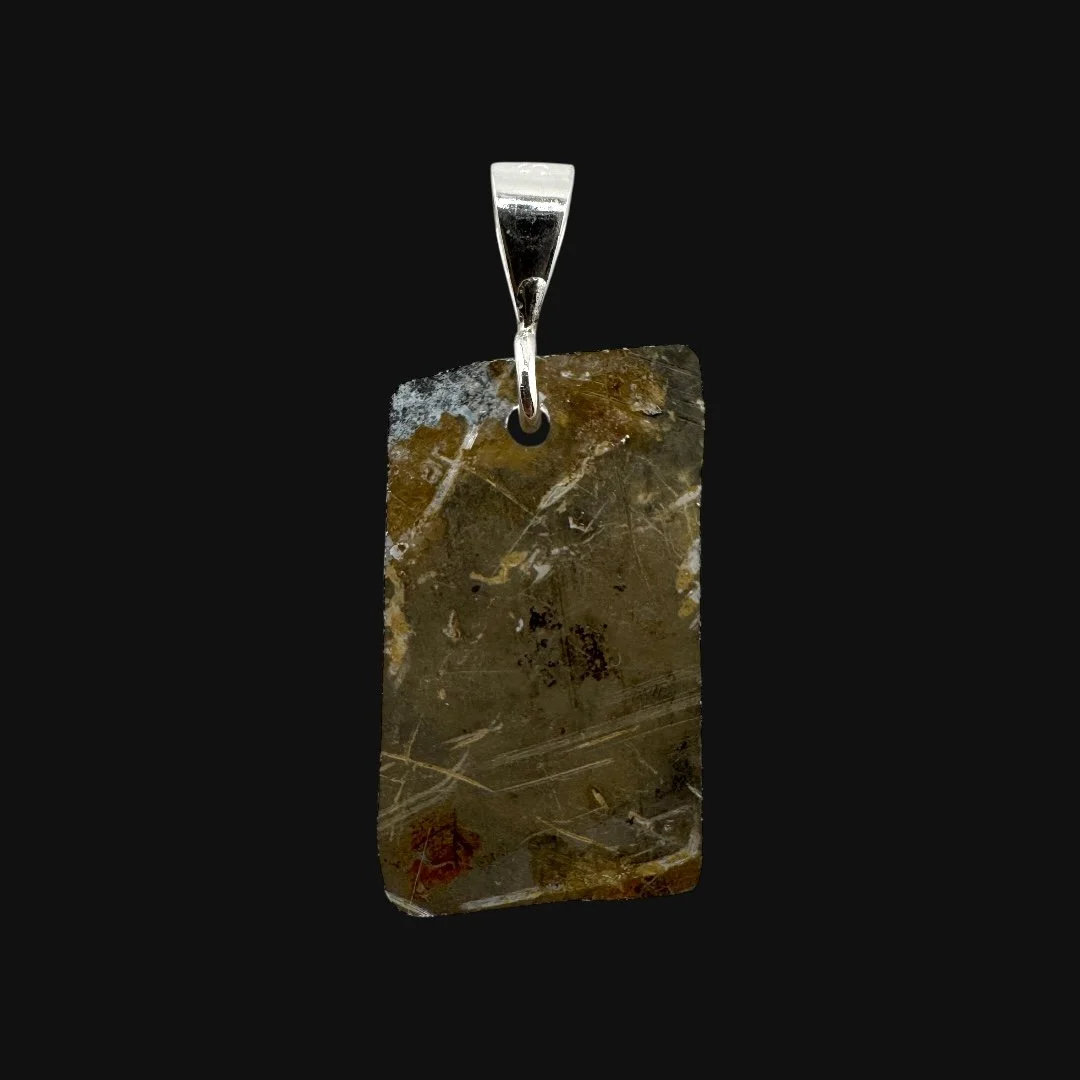
Comes with a hand-signed C.O.A. and a full historical research write-up
From: World War II
Dated: 1944-1945
Aircraft: Boeing B-17 Flying Fortress
Type: Heavy Bomber
From: European Theater “Combat Flown” U.S. Army Air Force (USAAF) 8th Air Force - 95th Bomb Group
National Origin: United States (American)
Necklace Pendant Size: Roughly 1 inch x ½ inch
Pendant Clap Material: .925 Sterling Silver
*EACH WORLD WAR II “COMBAT FLOWN” AIRCRAFT METAL PENDANT IS HANDMADE AND TRULY ONE-OF-A-KIND. THIS IS THE EXACT WWII AIRCRAFT NECKLACE PENDANT YOU WILL RECEIVE.
Wearable History Collection:
This World War II necklace aircraft pendant is more truly one-of-a-kind. It is a preserved piece of an original WWII aircraft, transformed into a wearable artifact that carries with it the stories of a generation. No two pendants are alike, which makes each one truly unique and irreplaceable. Rich with aviation history, this “combat flown” aircraft pendant offers its wearer the rare chance to carry a genuine fragment of World War II aviation heritage. Every mark in the metal, every detail, holds a connection to the past and serves as a tangible reminder of courage, sacrifice, and resilience. As part of our exclusive Wearable History Collection, it is not only a timeless accessory but also a powerful conversation starter. Flown in the heat of combat during World War II and preserved across generations, this WWII aircraft pendant is a relic unlike any other. Featured in our Wearable History Collection, it represents a rare chance to wear a true fragment of the past.
Strength and Sacrifice: The Legacy of the B-17 Flying Fortress:
The Boeing B-17 Flying Fortress was one of the most iconic and influential aircraft of the Second World War. Built for endurance and heavy defensive firepower, the B-17 was designed to withstand enemy attack and deliver precision bombing deep into enemy territory. With four powerful engines, a rugged frame, and up to thirteen machine guns, it embodied the name “Flying Fortress,” earning a reputation for bringing its crews home even when battered by flak and fighters.
When the United States entered the European air war, the B-17 became the backbone of the 8th Air Force, based in England. Daylight bombing campaigns carried American airpower directly over Nazi-occupied Europe, targeting industrial centers, oil refineries, and transportation hubs. Among the most distinguished units to fly the Fortress was the 95th Bomb Group, which pioneered long-range strategic missions and endured some of the fiercest opposition of the war.
Flying in massive combat box formations, the 95th and their sister groups faced relentless attacks from German fighters and the deadly curtain of flak that awaited them over cities like Regensburg, Schweinfurt, and Berlin. Losses were staggering, and missions often tested the resolve of even the most seasoned crews. Yet, the B-17’s durability and the determination of the men inside carried the campaign forward. Each successful strike weakened the German war machine, setting the stage for Allied ground offensives.
The B-17’s defining contribution came during the relentless air campaign of 1943 and 1944, when the 8th Air Force fought for air superiority over Europe. By the time of D-Day in June 1944, the skies were largely under Allied control, thanks in no small part to the sacrifices of B-17 crews. The 95th Bomb Group, flying from Horham, Suffolk, continued striking railways, bridges, and airfields, ensuring German forces could not disrupt the landings in Normandy.
Beyond its destructive power, the B-17 carried immense symbolic weight. To the Allies, it represented resilience and the promise of eventual victory. To civilians in occupied Europe, its contrails overhead signaled hope. And to German forces, the sight of a thousand-plane raid testified to the industrial might and determination of the United States.
In retrospect, the legacy of the B-17 is one of both heroism and sacrifice. It demonstrated the strategic value of precision bombing but also underscored the human cost of such campaigns. The 95th Bomb Group became a symbol of that struggle, its men flying mission after mission in the face of unimaginable danger. The Flying Fortress not only helped pave the road to victory in Europe but also secured its place as one of the most iconic aircraft of the twentieth century, remembered as much for the courage of its crews as for the strength of the machine itself.
The Flying Fortress in the European War:
Early Missions and Heavy Losses (1942–1943)
First Raids from England (1942) – The Boeing B-17 Flying Fortress began its European campaign with the 8th Air Force, flying out of bases in England. Designed for long-range precision bombing, it was tasked with striking deep into occupied Europe. Crews quickly learned that daylight raids came at a heavy cost, as formations were savaged by flak and German fighters.
The 95th Bomb Group Joins the Fight (1943) – Activated in 1942 and deployed to Horham, Suffolk, the 95th became one of the first groups to carry the burden of sustained strategic bombing. Their missions against U-boat pens, aircraft factories, and industrial targets proved both the potential and the peril of America’s daylight bombing strategy.
Forging a Strategy (1943–1944)
Regensburg and Schweinfurt (1943) – The 95th Bomb Group took part in the famed raids against German ball-bearing factories and aircraft plants. Losses were staggering, but these missions demonstrated American resolve and the B-17’s role as the workhorse of the 8th Air Force.
Building Air Superiority – Flying in tight defensive formations, the Fortresses unleashed destruction on the German war machine while absorbing punishment that would have downed lesser aircraft. Their endurance set the stage for long-term strategic bombing success once long-range escorts like the P-51 Mustang arrived.
D-Day and the Battle for Normandy (June 1944)
June 6, 1944 – On D-Day, B-17s of the 95th Bomb Group bombed coastal defenses, road networks, and communication hubs across northern France. Their mission was to isolate the battlefield, prevent reinforcements from reaching Normandy, and soften German resistance for the troops storming the beaches.
Sustained Operations Over France – In the weeks that followed, the group continued striking railways, bridges, and fortified positions behind enemy lines. Each mission supported the breakout from Normandy and the eventual liberation of Paris.
Driving the War Home (1944–1945)
The Strategic Bombing Offensive – As the Allies gained air superiority, the 95th Bomb Group and other units of the 8th Air Force shifted to crippling Germany’s industrial heartland. Oil refineries, rail yards, and manufacturing plants were relentlessly targeted, starving the Wehrmacht of fuel and weapons.
Battle of the Bulge (1944–1945) – Flying in brutal winter conditions, B-17s struck supply depots, troop concentrations, and transportation routes, aiding the defense of American lines during Germany’s last great counteroffensive.
Final Missions into Germany – In early 1945, the Fortresses continued bombing campaigns that destroyed bridges across the Rhine and shattered what remained of German infrastructure. Their missions paved the way for Allied forces to push into the heart of the Reich.
The Legacy Within This WWII Necklace Pendant:
This handcrafted World War II necklace pendant has been created from the very metal of a Boeing B-17 Flying Fortress, once flown in combat by the 8th Air Force’s 95th Bomb Group. The B-17 was the backbone of America’s daylight bombing campaign over Europe, a rugged and resilient aircraft that carried its crews deep into enemy territory. Flying from bases in England, the 95th Bomb Group braved waves of German fighters and deadly flak to strike at factories, railways, and fortifications that fueled the Nazi war machine.
Every mark in this metal carries echoes of those missions. It recalls the roar of four engines lifting into the cold morning skies over Suffolk. It remembers the black bursts of flak that dotted the horizon above Berlin, and the determination of the crews who held formation against impossible odds. Forged into a pendant, this fragment ceases to be just a remnant of a machine. It becomes a symbol of resilience, sacrifice, and the relentless fight that brought victory in Europe.
Each pendant is unique, a singular survivor of history. To wear it is to hold not just jewelry, but a piece of the air war over Europe. It invites conversation, sparks reflection, and connects the present to the courage of those who flew with the 95th Bomb Group. More than an accessory, this pendant is a living fragment of history. A remembrance of sacrifice. And a lasting tribute to the men and missions that helped carry the war to its end.
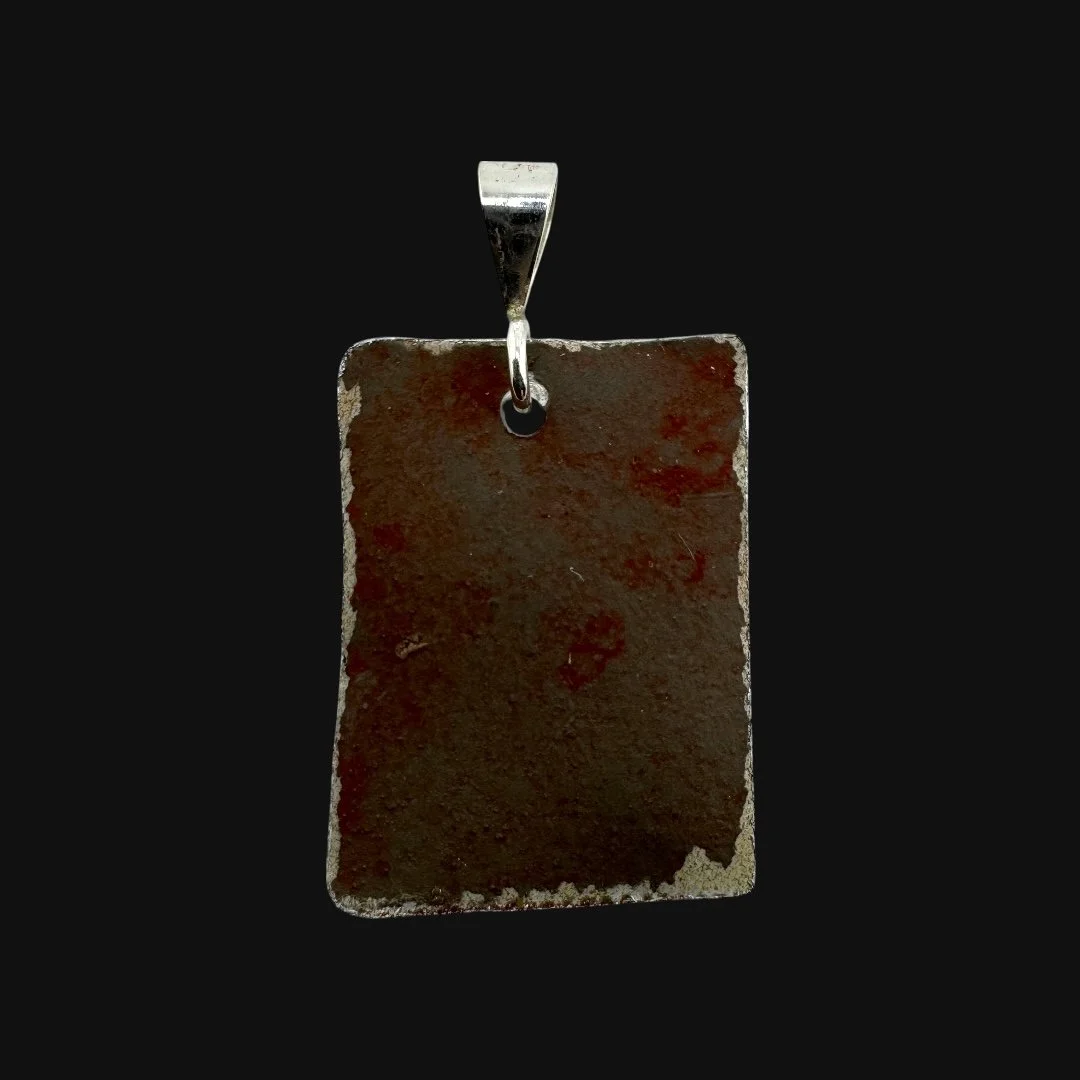
Comes with a hand-signed C.O.A. and a full historical research write-up
From: World War II
Dated: 1945
Aircraft: Gloster Meteor
Type: JetFighter Aircraft (The 1st British jet fighter and the only Allied jet to see combat during the Second World War)
From: Royal Air Force (RAF) 2nd Tactical Air Force No. 616 Squadron Gloster Meteor Aircraft Recovered From Melsbroek, Belgium
National Origin: United Kingdom (British)
Necklace Pendant Size: Roughly 1 inch x ½ inch
Pendant Clap Material: .925 Sterling Silver
*EACH WORLD WAR II “COMBAT FLOWN” AIRCRAFT METAL PENDANT IS HANDMADE AND TRULY ONE-OF-A-KIND. THIS IS THE EXACT WWII AIRCRAFT NECKLACE PENDANT YOU WILL RECEIVE.
Wearable History Collection:
This World War II necklace aircraft pendant is more truly one-of-a-kind. It is a preserved piece of an original WWII aircraft, transformed into a wearable artifact that carries with it the stories of a generation. No two pendants are alike, which makes each one truly unique and irreplaceable. Rich with aviation history, this “combat flown” aircraft pendant offers its wearer the rare chance to carry a genuine fragment of World War II aviation heritage. Every mark in the metal, every detail, holds a connection to the past and serves as a tangible reminder of courage, sacrifice, and resilience. As part of our exclusive Wearable History Collection, it is not only a timeless accessory but also a powerful conversation starter. Flown in the heat of combat during World War II and preserved across generations, this WWII aircraft pendant is a relic unlike any other. Featured in our Wearable History Collection, it represents a rare chance to wear a true fragment of the past.
Innovation and Resolve: The Significance of the Gloster Meteor
The Gloster Meteor was a revolutionary aircraft of the Second World War. As Britain’s first operational jet fighter, it represented a dramatic leap forward in aviation technology at a time when the skies of Europe were still dominated by piston-engine fighters. Unlike its German counterpart, the Me 262, which was rushed into service late in the war, the Meteor was steadily introduced into combat under the Royal Air Force, marking the beginning of a new era in aerial warfare.
Initially deployed in July 1944 with No. 616 Squadron RAF, the Meteor was first tasked with countering the V-1 flying bomb threat over Britain. Its speed made it one of the few aircraft capable of catching and destroying the pilotless weapons before they reached civilian targets. This mission demonstrated not only the Meteor’s effectiveness but also the RAF’s foresight in harnessing jet technology for both defense and offense.
The Meteor’s combat story expanded when No. 616 Squadron was deployed to the European mainland in early 1945. Operating from Melsbroek airfield in Belgium, Meteor pilots engaged in patrols, ground attack missions, and interception duties during the final push into Germany. Although deliberately kept from engaging German jets to prevent the risk of a Meteor being captured intact, the aircraft still played a critical role. It provided cover for advancing Allied armies, attacked transport networks, and demonstrated Allied mastery of jet technology at a decisive moment in the war.
For the pilots of No. 616 Squadron, flying from Melsbroek symbolized both progress and responsibility. They were not only combat aviators but pioneers, mastering an entirely new form of flight in the middle of a world war. Each mission flown from Belgian soil underscored that the age of the jet fighter had arrived, and it belonged not only to the Germans but also to the Allies who had embraced innovation and discipline.
In retrospect, the Gloster Meteor’s significance lies less in the number of enemy aircraft it destroyed than in what it represented. It was the first Allied jet to engage in wartime operations, proof that Britain had broken into a new technological frontier. Its missions with No. 616 Squadron from Melsbroek showed that jet-powered aircraft could be integrated into frontline combat, paving the way for the future of military aviation.
The Meteor’s legacy is therefore one of innovation and transition. It bridged the gap between the propeller-driven fighters of the early war and the jet age that would dominate the skies for decades to come. As both a practical weapon of war and a symbol of progress, the Gloster Meteor secured its place as one of the most influential aircraft of the twentieth century.
The Meteor in the European War:
Early Deployment and Pioneering Flights (1944)
Britain’s Jet Debut (July 1944) – The Gloster Meteor entered service with the Royal Air Force as the first operational Allied jet fighter. Initially assigned to No. 616 Squadron, the Meteor’s earliest missions were defensive, hunting V-1 flying bombs threatening British cities. With its unprecedented speed, it became one of the few aircraft able to intercept and destroy these weapons before they reached their targets.
Mastering the Jet Age – Pilots had to quickly adapt to jet propulsion, learning new tactics and flight characteristics. Unlike piston-engine fighters, the Meteor offered blistering speed and smooth performance, but demanded innovation in aerial combat methods.
To the Continent (Late 1944 – 1945)
Arrival in Europe – In early 1945, No. 616 Squadron deployed to Melsbroek Airfield in Belgium, bringing the Meteor into the heart of the European war. Operating from forward bases placed the jet within striking distance of German forces, marking the Allies’ full embrace of jet technology on the continent.
Operational Missions – While restricted from direct combat with German Me 262 jets to prevent capture of Allied jet technology, the Meteors carried out patrols, reconnaissance, and ground attack missions. They strafed transport networks, targeted enemy airfields, and provided cover for advancing Allied armies as they pressed deeper into German-held territory.
The Final Push into Germany (1945)
Rhine Operations – From Melsbroek, Meteors supported operations during the Allied crossing of the Rhine, flying missions against retreating German units and striking supply lines. Their presence signaled not only combat effectiveness but also the Allies’ technological superiority as the war neared its conclusion.
Consolidation of Air Power – By spring 1945, Meteor squadrons were fully integrated into RAF operations in Europe. Though their combat record was limited compared to piston-engine fighters, their arrival marked a decisive step into the future of air warfare.
The Legacy Within This WWII Necklace Pendant:
This handcrafted World War II necklace pendant has been created from the very metal of a Gloster Meteor, the first operational British jet fighter and the only Allied jet aircraft to see combat during the war. Flown by No. 616 Squadron of the Royal Air Force, Meteors represented the dawn of a new age in aviation. In early 1945, they were stationed at Melsbroek Airfield in Belgium, where they carried out patrols, ground attack missions, and reconnaissance flights during the final Allied push into Germany.
Every detail in the metal carries the echoes of that transformation. It recalls the roar of jet engines lifting from Belgian runways, the urgency of pilots adapting to an entirely new form of flight, and the determination to carry the fight into the heart of occupied Europe. Forged into a pendant, this fragment ceases to be just a remnant of a machine. It becomes a symbol of innovation, resilience, and the moment the jet age took its place on the battlefield.
Each pendant is one of a kind, carrying its own story of survival. To wear it is to hold not just jewelry, but a piece of history that marked the turning point from propellers to jets. It sparks conversation, invites reflection, and connects the present to the courage of those who flew into uncharted skies. More than an accessory, this pendant is a living fragment of history. A remembrance of sacrifice. And a tribute to the pioneering spirit of the men and machines of No. 616 Squadron RAF at Melsbroek.
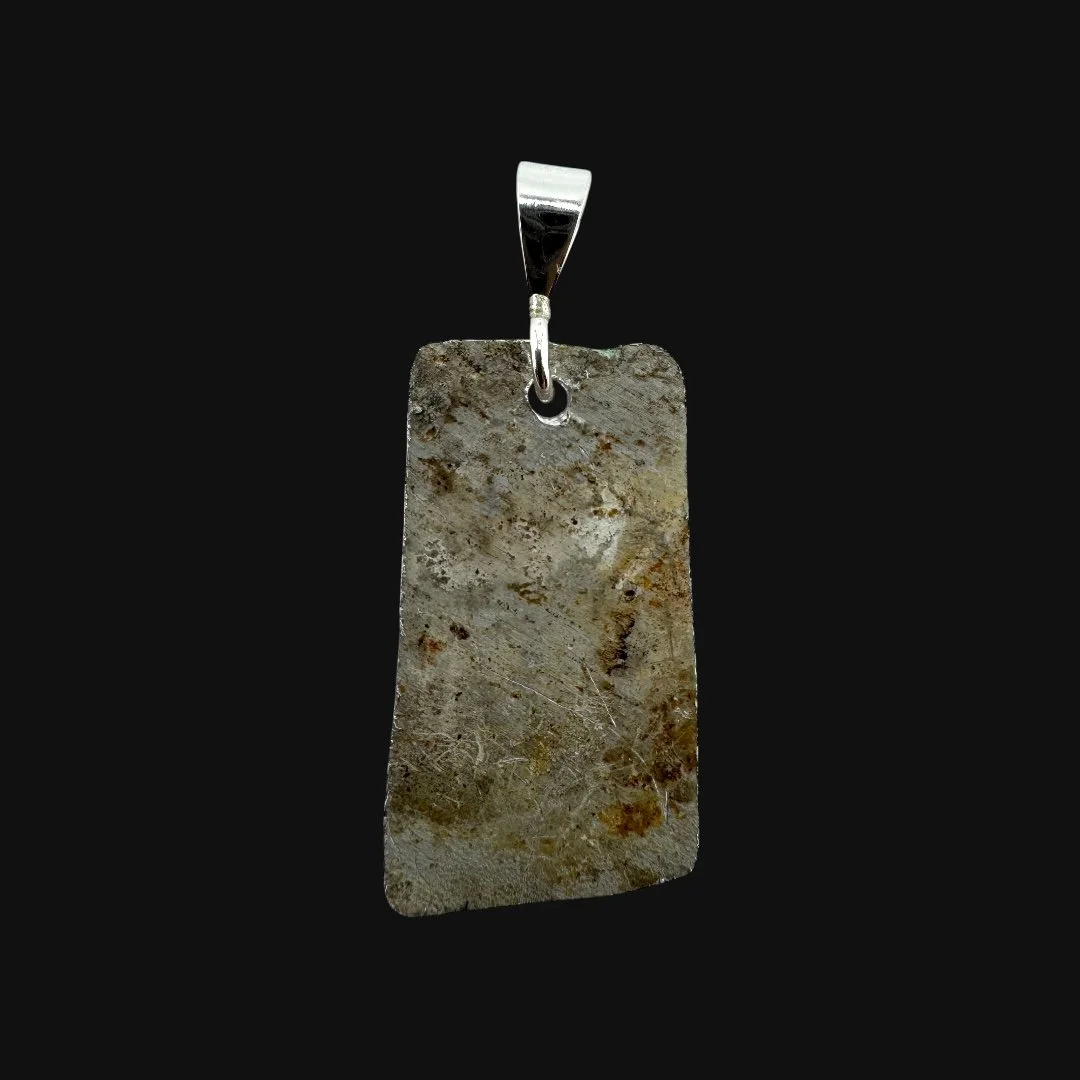
Comes with a hand-signed C.O.A. and a full historical research write-up
From: World War II
Dated: June 6th, 1944
Aircraft: Martin B-26 Marauder
Type: Medium Bomber
From: D-Day Mission “Combat Flown” U.S. Army Air Force (USAAF) 9th Air Force - 394th Bomb Group - 587th Bombardment Squadron
National Origin: United States (American)
Necklace Pendant Size: Roughly 1 inch x ½ inch
Pendant Clap Material: .925 Sterling Silver
*EACH WORLD WAR II “COMBAT FLOWN” AIRCRAFT METAL PENDANT IS HANDMADE AND TRULY ONE-OF-A-KIND. THIS IS THE EXACT WWII AIRCRAFT NECKLACE PENDANT YOU WILL RECEIVE.
Wearable History Collection:
This World War II necklace aircraft pendant is more truly one-of-a-kind. It is a preserved piece of an original WWII aircraft, transformed into a wearable artifact that carries with it the stories of a generation. No two pendants are alike, which makes each one truly unique and irreplaceable. Rich with aviation history, this “combat flown” aircraft pendant offers its wearer the rare chance to carry a genuine fragment of World War II aviation heritage. Every mark in the metal, every detail, holds a connection to the past and serves as a tangible reminder of courage, sacrifice, and resilience. As part of our exclusive Wearable History Collection, it is not only a timeless accessory but also a powerful conversation starter. Flown in the heat of combat during World War II and preserved across generations, this WWII aircraft pendant is a relic unlike any other. Featured in our Wearable History Collection, it represents a rare chance to wear a true fragment of the past.
Precision and Power: The Legacy of the Martin B-26 Marauder
The Martin B-26 Marauder was one of the most formidable medium bombers of the Second World War. Designed for speed and precision, the twin-engine aircraft earned both respect and notoriety. Early in the war, its high landing speeds and challenging flight characteristics gave it a reputation as the “Widowmaker.” But in skilled hands, the Marauder became a fast, resilient, and highly effective bomber that carried the fight deep into occupied Europe.
By 1943, Marauders were integrated into the 9th Air Force, where they would prove their worth as tactical bombers. Among the most distinguished units to fly them was the 394th Bomb Group, which became central to the air war over Western Europe. Operating from bases in England, the group specialized in precision strikes against bridges, rail lines, and fortified positions. These missions directly supported ground forces by disrupting German reinforcements and supply routes, setting the stage for the Allied invasion of France.
On D-Day, June 6, 1944, the Marauder came into its own. The 394th Bomb Group launched a series of carefully coordinated missions against German coastal defenses and transportation networks behind the beaches of Normandy. Flying through flak-filled skies, B-26 crews struck at critical road junctions, railway hubs, and artillery positions. Their objective was clear: isolate the battlefield, prevent German counterattacks, and give the landing forces a fighting chance. Unlike the heavy bombers that carpet-bombed inland, the Marauders of the 9th Air Force flew at lower altitudes, relying on speed and accuracy to deliver their payloads where they mattered most.
The Marauder’s contribution to D-Day cannot be overstated. By crippling transportation links and striking defensive positions, they ensured that German forces were delayed in mounting an organized counter-offensive. Casualties were heavy, but the precision and determination of the 394th Bomb Group helped secure the foothold that would ultimately liberate Western Europe.
In retrospect, the B-26 Marauder’s legacy is one of vindication. Once doubted, it went on to achieve the lowest loss rate of any Allied bomber in the European Theater. Its speed, durability, and accuracy made it indispensable to the tactical air war, particularly in the days when every bridge destroyed or train halted meant fewer German reinforcements on the front. For the crews of the 394th Bomb Group, the Marauder was not just a machine, but a weapon of precision that helped change the course of history.
Today, the Martin B-26 stands as a symbol of resilience and adaptation. Its role on D-Day with the 394th Bomb Group highlights the critical connection between air power and ground success, proving that victory in Normandy was as much about the skies as it was about the beaches.
The Marauder in the European War:
Early Combat and Growing Pains (1942–1943)
North Africa (1942–1943) – The Martin B-26 Marauder first entered combat in the Mediterranean Theater, where its speed and durability made it an asset for striking German supply lines. Initially known for its demanding flight characteristics, the Marauder earned a tough reputation. Yet, with experienced crews, it soon became one of the most reliable medium bombers in the Allied arsenal.
Italy and the Mediterranean Campaign (1943) – Marauders flew missions against bridges, railroads, and harbor facilities, disrupting Axis defenses as Allied forces advanced up the Italian peninsula.
Into the Heart of Europe (1943–1944)
Arrival in England – By late 1943, the B-26 had become a cornerstone of the 9th Air Force’s tactical bombing strategy. Among its most distinguished units was the 394th Bomb Group, stationed in England, tasked with crippling German transportation networks and softening fortifications ahead of the invasion of France.
Pre-Invasion Missions – Throughout early 1944, the 394th struck rail yards, bridges, and supply depots across occupied France. Every sortie weakened German mobility, paving the way for Operation Overlord.
D-Day and the Battle for Normandy (June 1944)
June 6, 1944 – On D-Day, Marauders of the 394th Bomb Group launched precision bombing runs against German gun emplacements, road junctions, and communication hubs near the Normandy coast. Flying at medium altitudes through anti-aircraft fire, they aimed to block German reinforcements from reaching the beaches. Their strikes on bridges and crossroads proved vital in isolating the battlefield and protecting Allied troops as they fought their way ashore.
Hedgerows of Normandy – In the weeks that followed, B-26 crews provided continuous support to ground forces, targeting fortified positions and supply lines deep in occupied France.
Driving Toward Victory (1944–1945)
Breakout from Normandy – The Marauder’s speed and precision allowed it to deliver punishing strikes on German defensive lines during Operation Cobra, helping the Allies break free from the bocage and begin the drive across France.
The Low Countries and the Rhine – As the war pressed eastward, Marauders hammered bridges and industrial targets, clearing the way for Allied advances into Belgium, Holland, and Germany itself.
Final Months of the War
Winter of 1944–1945 – During the Battle of the Bulge, Marauders flew in bitter weather to strike German supply depots and troop concentrations, supporting the embattled American lines.
Crossing the Rhine – In the final push into Germany, B-26s bombed enemy positions with relentless precision, hastening the collapse of Nazi defenses.
The Legacy Within This WWII Necklace Pendant:
This handcrafted World War II necklace pendant has been created from the very metal of a Martin B-26 Marauder bomber, once flown in combat during the largest invasion in history. The Marauder, known for its speed and precision, was the backbone of the 9th Air Force’s tactical bombing force. On June 6th, 1944, aircraft of the 394th Bomb Grouplaunched from English airfields to strike German defenses and transportation hubs, ensuring that reinforcements could not reach the beaches of Normandy.
Every mark in this metal carries echoes of that day. It recalls the thunder of engines as squadrons of Marauders roared across the Channel. It remembers the bursts of flak that filled the sky, and the resolve of crews who pressed on to deliver their bombs with accuracy. Transformed into a pendant, this fragment ceases to be a remnant of a machine alone. It becomes a symbol of precision, courage, and the pivotal moments that decided the fate of Europe.
Each pendant is unique, a singular survivor of history. To wear it is to hold not just jewelry, but a piece of the air war over Normandy. It sparks conversation, invites reflection, and connects the present to the legacy of those who flew against overwhelming odds. More than an accessory, this pendant is a living fragment of history. A remembrance of sacrifice. And a lasting tribute to the men and missions that carried D-Day to victory.
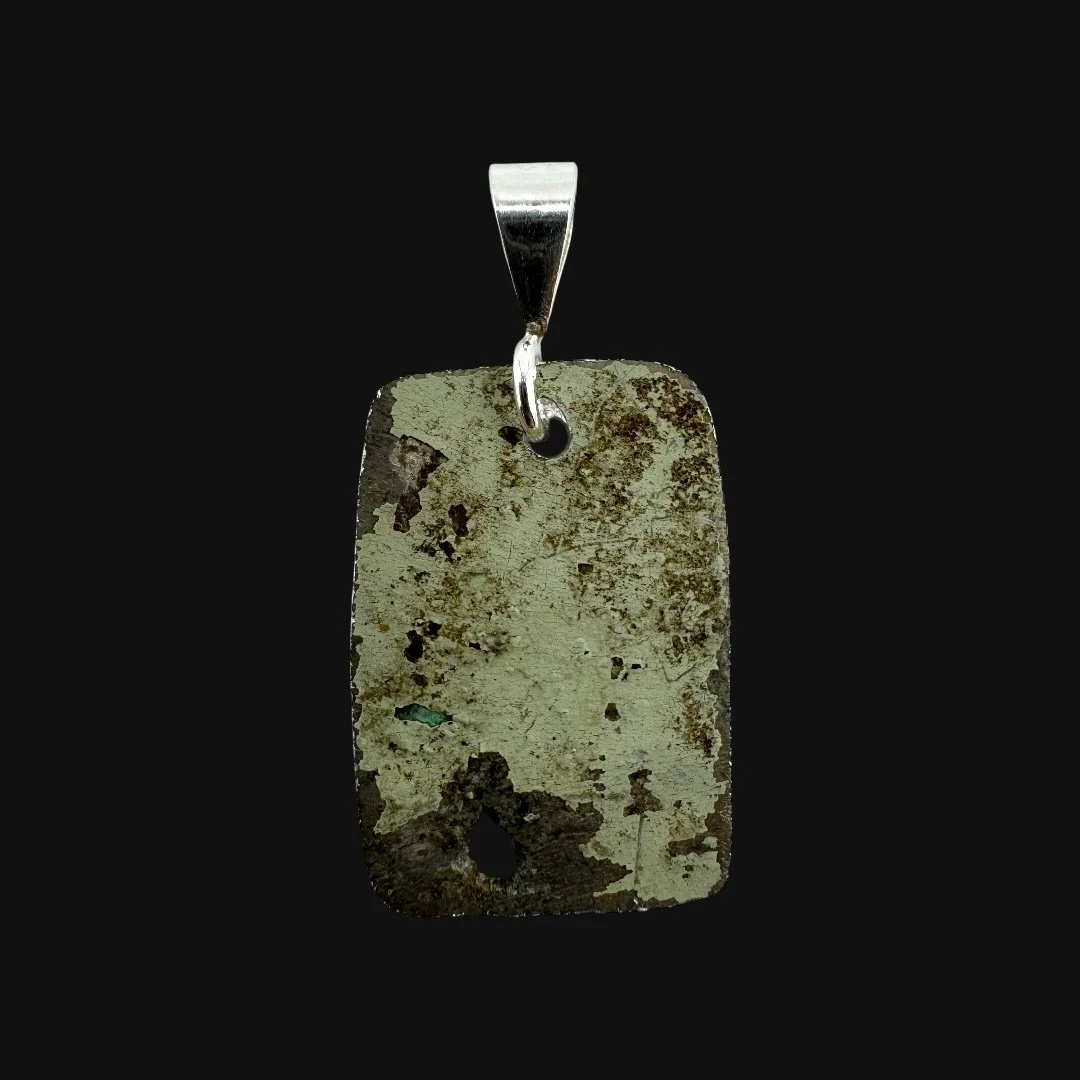
Comes with a hand-signed C.O.A. and a full historical research write-up
From: World War II
Dated: 1942-1943
Aircraft: Grumman F4F Wildcat
Type: Fighter Aircraft
Recovered: Henderson Field - Battle of Guadalcanal
National Origin: United States (American)
Necklace Pendant Size: Roughly 1 inch x ½ inch
Pendant Clap Material: .925 Sterling Silver
*EACH WORLD WAR II “COMBAT FLOWN” AIRCRAFT METAL PENDANT IS HANDMADE AND TRULY ONE-OF-A-KIND. THIS IS THE EXACT WWII AIRCRAFT NECKLACE PENDANT YOU WILL RECEIVE.
Wearable History Collection:
This World War II necklace aircraft pendant is more truly one-of-a-kind. It is a preserved piece of an original WWII aircraft, transformed into a wearable artifact that carries with it the stories of a generation. No two pendants are alike, which makes each one truly unique and irreplaceable. Rich with aviation history, this “combat flown” aircraft pendant offers its wearer the rare chance to carry a genuine fragment of World War II aviation heritage. Every mark in the metal, every detail, holds a connection to the past and serves as a tangible reminder of courage, sacrifice, and resilience. As part of our exclusive Wearable History Collection, it is not only a timeless accessory but also a powerful conversation starter. Flown in the heat of combat during World War II and preserved across generations, this WWII aircraft pendant is a relic unlike any other. Featured in our Wearable History Collection, it represents a rare chance to wear a true fragment of the past.
Courage in the Skies: The Grumman F4F Wildcat at Guadalcanal
The Grumman F4F Wildcat was the workhorse fighter of the United States Navy and Marine Corps during the early years of World War II. Compact, rugged, and dependable, the Wildcat faced overwhelming odds in the Pacific Theater, where it became synonymous with courage in the face of adversity. With folding wings and a powerful radial engine, it was designed to launch from aircraft carriers and endure punishing damage that might have destroyed more delicate planes.
Its defining chapter came in the struggle for Henderson Field on Guadalcanal. After U.S. Marines captured the unfinished Japanese airstrip in August 1942, Henderson became the lifeline of the island. Wildcats based there formed the core of the so-called “Cactus Air Force,” a patchwork group of Navy, Marine, and Army Air Force pilots who fought against constant Japanese assaults. Each mission was desperate. Outnumbered and often flying against the faster, more agile Mitsubishi A6M Zero, the Wildcat pilots relied on discipline, teamwork, and tactics to survive. The famous “Thach Weave,” a defensive maneuver developed by Commander John Thach, allowed Wildcats to cover one another and offset the Zero’s superior maneuverability.
Day after day, Wildcats scrambled from Henderson to meet incoming raids of Japanese bombers and their Zero escorts. The runways were cratered by artillery, fuel and parts were scarce, and pilots flew until exhaustion blurred the line between survival and sacrifice. Yet the Wildcat endured. Its tough frame absorbed punishment, its guns struck hard when aimed with precision, and its pilots earned a reputation for dogged resilience.
At Guadalcanal, the Wildcat was more than just an aircraft. It was a symbol of American determination to hold the line. The defense of Henderson Field prevented Japanese reinforcements from retaking the island, marking the first major Allied offensive victory in the Pacific. Without the Wildcat and its pilots, the tenuous foothold at Guadalcanal might have been lost, altering the entire trajectory of the Pacific War.
In hindsight, the F4F Wildcat represented the transition between old and new eras of air combat. Though soon replaced by the faster F6F Hellcat, the Wildcat’s role at Guadalcanal proved that toughness, tactical innovation, and sheer will could stand against seemingly insurmountable odds. Its legacy lives on not in speed or elegance, but in the story of a fighter and its pilots who refused to yield when the fate of the Pacific hung in the balance.
The Wildcat in the Pacific War:
Early Pacific Battles (1941–1942)
Pearl Harbor and Wake Island (1941) – Wildcats scrambled during the opening attacks of the Pacific War. At Wake, Marine pilots flying the outnumbered fighters managed to down Japanese aircraft and resist repeated assaults before the island fell.
Battle of the Coral Sea (1942) – Wildcats flew escort and defense for American carriers, helping blunt the first Japanese attempt to expand southward, marking the first carrier-versus-carrier battle in history.
Turning the Tide at Midway (1942)
Battle of Midway (June 1942) – Wildcats formed the defensive shield for U.S. carriers as dive bombers struck the Japanese fleet. Though often outmatched by the faster Mitsubishi Zero, Wildcat pilots fought doggedly to protect torpedo and dive bombers, contributing to the decisive American victory that crippled Japan’s carrier force.
The Crucible of Guadalcanal (1942–1943)
Henderson Field (August 1942 – February 1943) – Captured by U.S. Marines, the airstrip became the heart of the struggle for Guadalcanal. Wildcats of the “Cactus Air Force” flew daily from Henderson, intercepting Japanese bombers and dogfighting Zero escorts. The Thach Weave, a coordinated defensive tactic, allowed Wildcats to survive and score victories despite their slower speed.
Naval Battles around Guadalcanal – Wildcats provided air cover during ferocious sea battles in Ironbottom Sound, protecting American convoys that supplied the embattled Marines ashore.
Expanding the Offensive (1943–1944)
Solomon Islands Campaign – Wildcats continued to escort bombers, support amphibious landings, and provide critical air defense until gradually phased out by the newer F6F Hellcat.
Gilbert and Marshall Islands – Wildcats saw service in secondary roles, often from escort carriers, where their toughness and short takeoff ability were well suited to smaller decks.
Final Roles in the War (1944–1945)
Escort Carrier Operations – As newer fighters took the front lines, Wildcats remained in service aboard escort carriers, providing air cover for convoys, anti-submarine patrols, and close air support during invasions.
Battle of Leyte Gulf (1944) – Wildcats flying from escort carriers played a role in protecting U.S. naval forces during one of the largest naval battles in history.
The Legacy Within This WWII Necklace Pendant:
This handcrafted World War II necklace pendant has been created from the very metal of a Grumman F4F Wildcat fighter, once flown in combat during the ferocious battles for control of the Pacific. The Wildcat was the first great American naval fighter of the war, a rugged and resilient aircraft that helped secure victory against impossible odds. At Henderson Field on Guadalcanal, these fighters of the “Cactus Air Force” rose daily into the skies, intercepting Japanese bombers and dueling Zero escorts in desperate fights that decided the fate of the island.
Every detail in the metal carries memory. It echoes the roar of engines straining over shattered runways. It recalls the rattle of machine guns in dogfights above Guadalcanal and the exhaustion of young pilots who flew mission after mission to keep Henderson in American hands. Transformed into a pendant, the fragment ceases to be only the relic of a machine. It becomes a symbol of resilience, courage, and the turning point of the Pacific War.
Each pendant is entirely unique, marked by its own path through history. To wear it is to carry not just jewelry, but a piece of the struggle that shifted momentum in the Pacific. It invites conversation, sparks reflection, and connects the present with the legacy of those who refused to yield. This pendant is more than an accessory. It is a living fragment of history. A remembrance of sacrifice. And a reminder of the courage that defined one of World War II’s most pivotal campaigns.
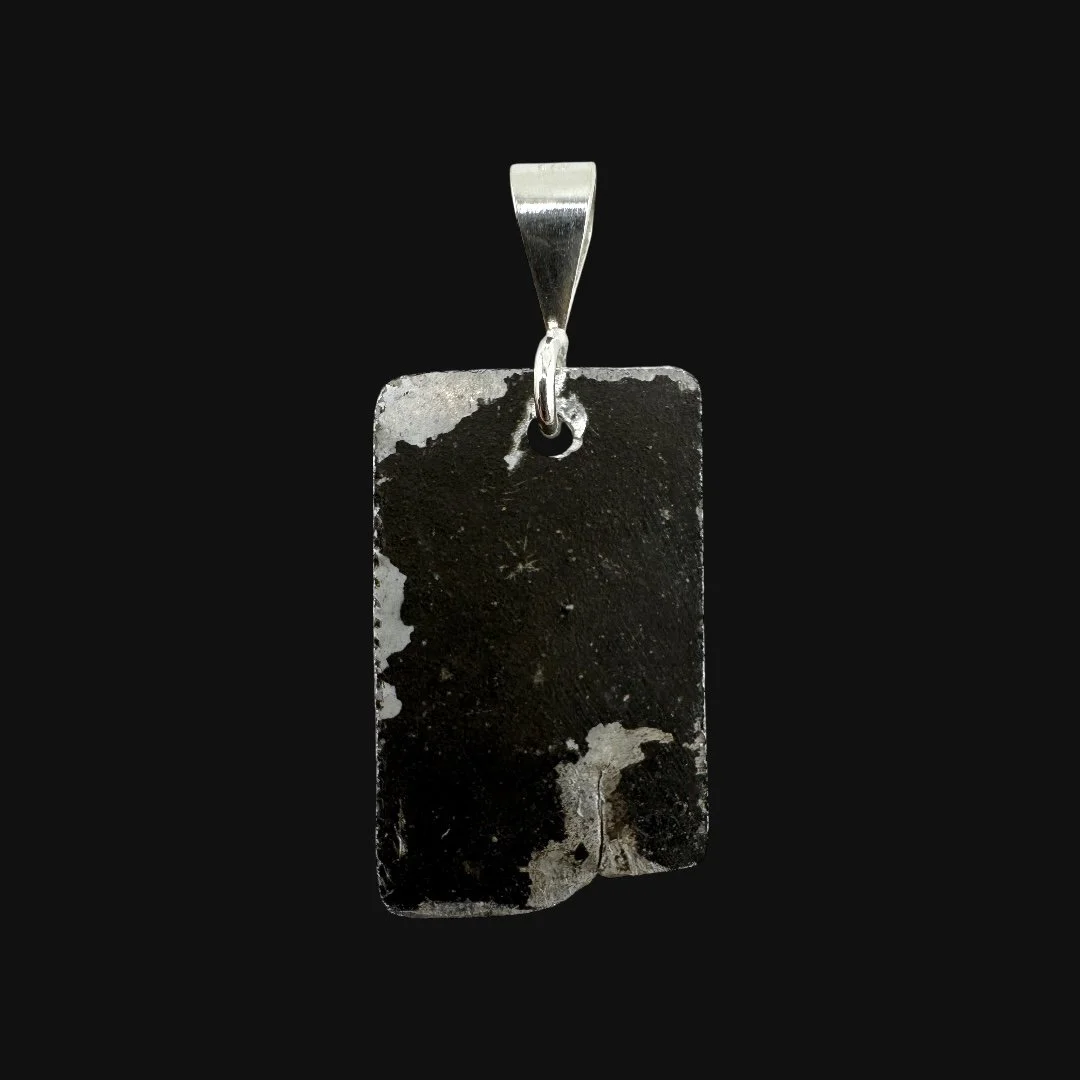
Comes with a hand-signed C.O.A. and a full historical research write-up
From: World War II
Dated: 1941-1945
Aircraft: Junkers Ju 87 - “Stuka”
Type: Dive Bomber & Ground-Attack Aircraft
Recovered: Combat Flown Wreckage Recovered From Eastern Front
National Origin: German (Luftwaffe)
Necklace Pendant Size: Roughly 1 inch x ½ inch
Pendant Clap Material: .925 Sterling Silver
*EACH WORLD WAR II “COMBAT FLOWN” AIRCRAFT METAL PENDANT IS HANDMADE AND TRULY ONE-OF-A-KIND. THIS IS THE EXACT WWII AIRCRAFT NECKLACE PENDANT YOU WILL RECEIVE.
Wearable History Collection:
This World War II necklace aircraft pendant is more truly one-of-a-kind. It is a preserved piece of an original WWII aircraft, transformed into a wearable artifact that carries with it the stories of a generation. No two pendants are alike, which makes each one truly unique and irreplaceable. Rich with aviation history, this “combat flown” aircraft pendant offers its wearer the rare chance to carry a genuine fragment of World War II aviation heritage. Every mark in the metal, every detail, holds a connection to the past and serves as a tangible reminder of courage, sacrifice, and resilience. As part of our exclusive Wearable History Collection, it is not only a timeless accessory but also a powerful conversation starter. Flown in the heat of combat during World War II and preserved across generations, this WWII aircraft pendant is a relic unlike any other. Featured in our Wearable History Collection, it represents a rare chance to wear a true fragment of the past.
Precision and Fear: The Historical Significance of the Ju 87 Dive Bomber:
The Junkers Ju 87 Stuka was one of the most distinctive and historically significant aircraft of the Second World War. Designed as a precision dive bomber, it featured inverted gull wings, fixed landing gear, and the infamous Jericho siren that created a terrifying wail as it dove. First tested in the Spanish Civil War, the Ju 87 proved the value of dive bombing in supporting ground forces, and when World War II began it became the spearhead of German blitzkrieg. In Poland and France, Stukas destroyed bridges, railways, and fortifications, helping clear the way for rapid armored advances. At Dunkirk they attacked retreating Allied troops and shipping, spreading panic as much with their sound as with their bombs.
Its limitations became clear during the Battle of Britain, where its slow speed and poor maneuverability left it highly vulnerable to RAF Spitfires and Hurricanes. Withdrawn from that campaign, the Ju 87 found new life on the Eastern Front, where Soviet air defenses were initially weak. Here it again became indispensable, destroying bridges and strongholds and, in its later G-variant, serving as a formidable anti-tank weapon. Pilots like Hans-Ulrich Rudel gained legendary reputations, with Rudel alone credited with destroying hundreds of Soviet tanks. Stukas supported major operations at Stalingrad and Kursk, where their precision and firepower were critical, even as Germany’s overall air superiority waned.
Beyond its battlefield effectiveness, the Ju 87 had immense psychological impact. Its screaming sirens became synonymous with terror from the skies, demoralizing enemy soldiers and civilians alike. The Stuka came to embody the image of blitzkrieg, a weapon not only of destruction but also of fear. While it became technologically outdated by the mid-war years, the Ju 87’s integration of close air support into ground operations influenced military doctrine for decades to come, laying the groundwork for modern ground-attack aircraft.
In retrospect, the Ju 87 Stuka’s legacy is one of both triumph and vulnerability. It demonstrated how precision bombing could amplify the effectiveness of ground offensives, but also how air superiority was essential for such aircraft to operate effectively. As both a practical weapon of war and a symbol of German power, the Ju 87 left an indelible mark on World War II, securing its place as one of the most iconic aircraft of the twentieth century.
Early War and Blitzkrieg Campaigns
Invasion of Poland (1939) – Used extensively to destroy railroads, bridges, and communications, crippling Polish defenses.
Norwegian Campaign (1940) – Stukas sank and damaged several Allied warships, including the British carrier HMS Glorious.
Battle of France (1940) – Played a major role in breaking the Maginot Line, blasting fortifications, and trapping Allied forces.
Battle of Dunkirk (1940) – Attacked Allied troops and evacuation ships, creating chaos during Operation Dynamo.
The Battle of Britain and the Mediterranean
Battle of Britain (1940) – Initially deployed to attack radar stations, airfields, and shipping, but suffered devastating losses to RAF fighters, forcing withdrawal.
Battle of Crete (1941) – Crucial in suppressing British defenses and sinking Royal Navy ships, helping Germany secure the island.
North African Campaign (1941–1943) – Provided ground support to Rommel’s Afrika Korps, targeting British armor and supply lines.
Eastern Front (Operation Barbarossa and beyond)
Operation Barbarossa (1941) – Opened the invasion of the Soviet Union, destroying bridges, supply columns, and airfields in the early blitz.
Siege of Sevastopol (1941–1942) – Stukas pounded Soviet fortifications during the long siege of the Crimean port.
Battle of Stalingrad (1942–1943) – Heavily used to bomb Soviet positions and supply routes during the street fighting.
Battle of Kursk (1943) – The Stuka G-variant, fitted with 37mm cannon, became a feared anti-tank weapon, flown by pilots such as Hans-Ulrich Rudel.
Final Years of the War
Defense of the Reich (1944–1945) – Stukas were increasingly obsolete but continued ground-attack and anti-tank roles on the Eastern Front.
Battle of Berlin (1945) – Flown in the final desperate defense, though few remained by this stage.
The Legacy Within This WWII Necklace Pendant:
This handcrafted World War II necklace pendant has been created from the very metal of a German Ju 87 Stuka dive bomber, once flown in combat during one of history’s most destructive conflicts. The Ju 87 was infamous for its terrifying dive sirens and precision strikes, a symbol of blitzkrieg that dominated the skies in the early war years. To hold this pendant is to hold a fragment of that past, a tangible piece of the aircraft that roared over battlefields from Poland and France to the Mediterranean and deep into the Eastern Front.
Every mark in the metal tells a story. It recalls the shriek of the Stuka’s dive, the smoke and fire of its bomb runs, and the endurance of the men, on both sides, who lived beneath those skies. Forged into a wearable piece, the pendant transforms a weapon of war into a symbol of remembrance, carrying with it the memory of courage, survival, and the heavy cost of global conflict.
Each pendant is entirely unique. No two carry the same scars or path through history. To wear it today is not simply to wear jewelry, but to carry with you a genuine piece of World War II. A natural conversation starter, it connects the present to the legacy of those who fought, endured, and were forever shaped by the war. This pendant is more than an accessory, it is a living fragment of history, honoring memory, sacrifice, and the enduring lessons of the past.
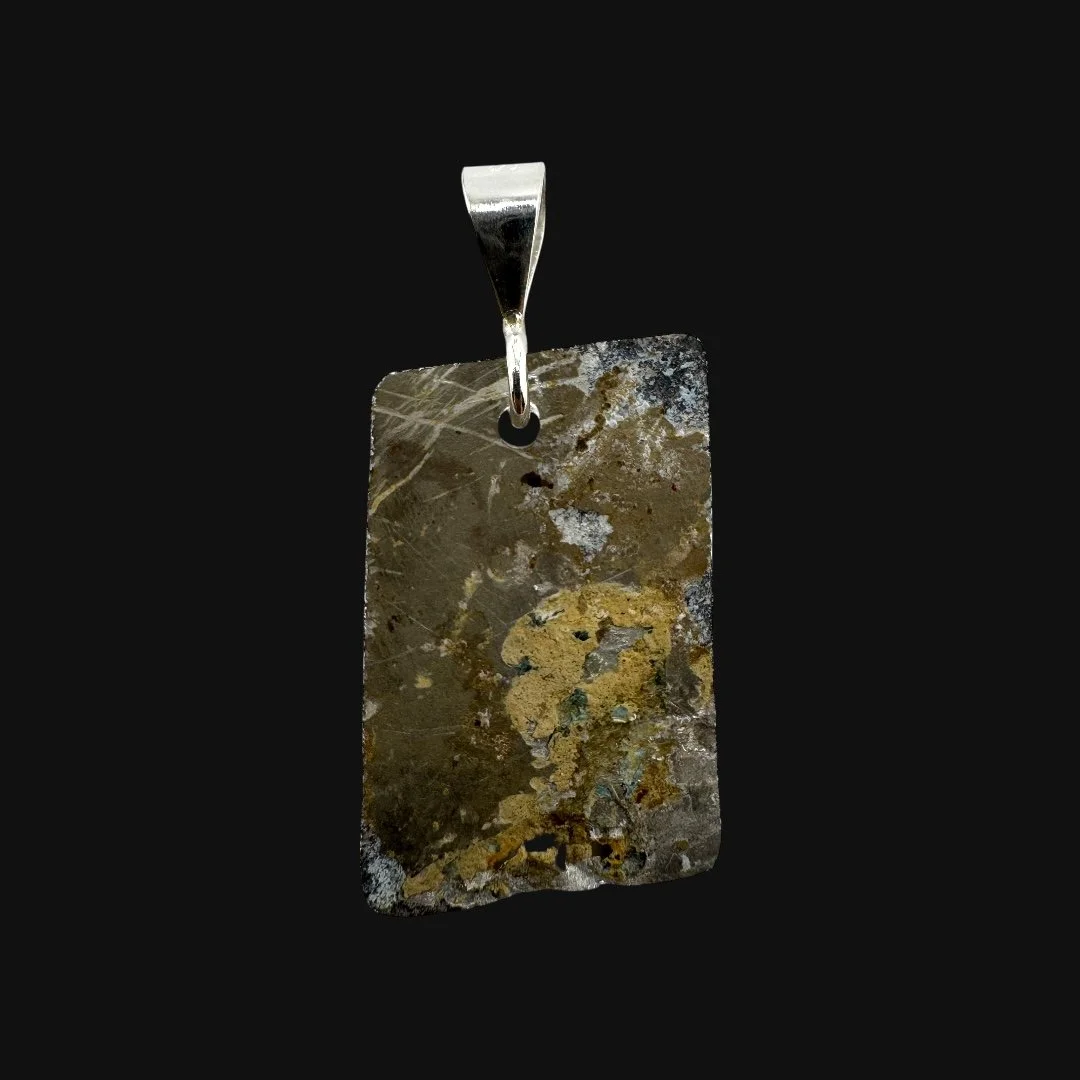
Comes with a hand-signed C.O.A. and a full historical research write-up
From: World War II
Dated: 1944-1945
Aircraft: Boeing B-17 Flying Fortress
Type: Heavy Bomber
From: European Theater “Combat Flown” U.S. Army Air Force (USAAF) 8th Air Force - 95th Bomb Group
National Origin: United States (American)
Necklace Pendant Size: Roughly 1 inch x ½ inch
Pendant Clap Material: .925 Sterling Silver
*EACH WORLD WAR II “COMBAT FLOWN” AIRCRAFT METAL PENDANT IS HANDMADE AND TRULY ONE-OF-A-KIND. THIS IS THE EXACT WWII AIRCRAFT NECKLACE PENDANT YOU WILL RECEIVE.
Wearable History Collection:
This World War II necklace aircraft pendant is more truly one-of-a-kind. It is a preserved piece of an original WWII aircraft, transformed into a wearable artifact that carries with it the stories of a generation. No two pendants are alike, which makes each one truly unique and irreplaceable. Rich with aviation history, this “combat flown” aircraft pendant offers its wearer the rare chance to carry a genuine fragment of World War II aviation heritage. Every mark in the metal, every detail, holds a connection to the past and serves as a tangible reminder of courage, sacrifice, and resilience. As part of our exclusive Wearable History Collection, it is not only a timeless accessory but also a powerful conversation starter. Flown in the heat of combat during World War II and preserved across generations, this WWII aircraft pendant is a relic unlike any other. Featured in our Wearable History Collection, it represents a rare chance to wear a true fragment of the past.
Strength and Sacrifice: The Legacy of the B-17 Flying Fortress:
The Boeing B-17 Flying Fortress was one of the most iconic and influential aircraft of the Second World War. Built for endurance and heavy defensive firepower, the B-17 was designed to withstand enemy attack and deliver precision bombing deep into enemy territory. With four powerful engines, a rugged frame, and up to thirteen machine guns, it embodied the name “Flying Fortress,” earning a reputation for bringing its crews home even when battered by flak and fighters.
When the United States entered the European air war, the B-17 became the backbone of the 8th Air Force, based in England. Daylight bombing campaigns carried American airpower directly over Nazi-occupied Europe, targeting industrial centers, oil refineries, and transportation hubs. Among the most distinguished units to fly the Fortress was the 95th Bomb Group, which pioneered long-range strategic missions and endured some of the fiercest opposition of the war.
Flying in massive combat box formations, the 95th and their sister groups faced relentless attacks from German fighters and the deadly curtain of flak that awaited them over cities like Regensburg, Schweinfurt, and Berlin. Losses were staggering, and missions often tested the resolve of even the most seasoned crews. Yet, the B-17’s durability and the determination of the men inside carried the campaign forward. Each successful strike weakened the German war machine, setting the stage for Allied ground offensives.
The B-17’s defining contribution came during the relentless air campaign of 1943 and 1944, when the 8th Air Force fought for air superiority over Europe. By the time of D-Day in June 1944, the skies were largely under Allied control, thanks in no small part to the sacrifices of B-17 crews. The 95th Bomb Group, flying from Horham, Suffolk, continued striking railways, bridges, and airfields, ensuring German forces could not disrupt the landings in Normandy.
Beyond its destructive power, the B-17 carried immense symbolic weight. To the Allies, it represented resilience and the promise of eventual victory. To civilians in occupied Europe, its contrails overhead signaled hope. And to German forces, the sight of a thousand-plane raid testified to the industrial might and determination of the United States.
In retrospect, the legacy of the B-17 is one of both heroism and sacrifice. It demonstrated the strategic value of precision bombing but also underscored the human cost of such campaigns. The 95th Bomb Group became a symbol of that struggle, its men flying mission after mission in the face of unimaginable danger. The Flying Fortress not only helped pave the road to victory in Europe but also secured its place as one of the most iconic aircraft of the twentieth century, remembered as much for the courage of its crews as for the strength of the machine itself.
The Flying Fortress in the European War:
Early Missions and Heavy Losses (1942–1943)
First Raids from England (1942) – The Boeing B-17 Flying Fortress began its European campaign with the 8th Air Force, flying out of bases in England. Designed for long-range precision bombing, it was tasked with striking deep into occupied Europe. Crews quickly learned that daylight raids came at a heavy cost, as formations were savaged by flak and German fighters.
The 95th Bomb Group Joins the Fight (1943) – Activated in 1942 and deployed to Horham, Suffolk, the 95th became one of the first groups to carry the burden of sustained strategic bombing. Their missions against U-boat pens, aircraft factories, and industrial targets proved both the potential and the peril of America’s daylight bombing strategy.
Forging a Strategy (1943–1944)
Regensburg and Schweinfurt (1943) – The 95th Bomb Group took part in the famed raids against German ball-bearing factories and aircraft plants. Losses were staggering, but these missions demonstrated American resolve and the B-17’s role as the workhorse of the 8th Air Force.
Building Air Superiority – Flying in tight defensive formations, the Fortresses unleashed destruction on the German war machine while absorbing punishment that would have downed lesser aircraft. Their endurance set the stage for long-term strategic bombing success once long-range escorts like the P-51 Mustang arrived.
D-Day and the Battle for Normandy (June 1944)
June 6, 1944 – On D-Day, B-17s of the 95th Bomb Group bombed coastal defenses, road networks, and communication hubs across northern France. Their mission was to isolate the battlefield, prevent reinforcements from reaching Normandy, and soften German resistance for the troops storming the beaches.
Sustained Operations Over France – In the weeks that followed, the group continued striking railways, bridges, and fortified positions behind enemy lines. Each mission supported the breakout from Normandy and the eventual liberation of Paris.
Driving the War Home (1944–1945)
The Strategic Bombing Offensive – As the Allies gained air superiority, the 95th Bomb Group and other units of the 8th Air Force shifted to crippling Germany’s industrial heartland. Oil refineries, rail yards, and manufacturing plants were relentlessly targeted, starving the Wehrmacht of fuel and weapons.
Battle of the Bulge (1944–1945) – Flying in brutal winter conditions, B-17s struck supply depots, troop concentrations, and transportation routes, aiding the defense of American lines during Germany’s last great counteroffensive.
Final Missions into Germany – In early 1945, the Fortresses continued bombing campaigns that destroyed bridges across the Rhine and shattered what remained of German infrastructure. Their missions paved the way for Allied forces to push into the heart of the Reich.
The Legacy Within This WWII Necklace Pendant:
This handcrafted World War II necklace pendant has been created from the very metal of a Boeing B-17 Flying Fortress, once flown in combat by the 8th Air Force’s 95th Bomb Group. The B-17 was the backbone of America’s daylight bombing campaign over Europe, a rugged and resilient aircraft that carried its crews deep into enemy territory. Flying from bases in England, the 95th Bomb Group braved waves of German fighters and deadly flak to strike at factories, railways, and fortifications that fueled the Nazi war machine.
Every mark in this metal carries echoes of those missions. It recalls the roar of four engines lifting into the cold morning skies over Suffolk. It remembers the black bursts of flak that dotted the horizon above Berlin, and the determination of the crews who held formation against impossible odds. Forged into a pendant, this fragment ceases to be just a remnant of a machine. It becomes a symbol of resilience, sacrifice, and the relentless fight that brought victory in Europe.
Each pendant is unique, a singular survivor of history. To wear it is to hold not just jewelry, but a piece of the air war over Europe. It invites conversation, sparks reflection, and connects the present to the courage of those who flew with the 95th Bomb Group. More than an accessory, this pendant is a living fragment of history. A remembrance of sacrifice. And a lasting tribute to the men and missions that helped carry the war to its end.
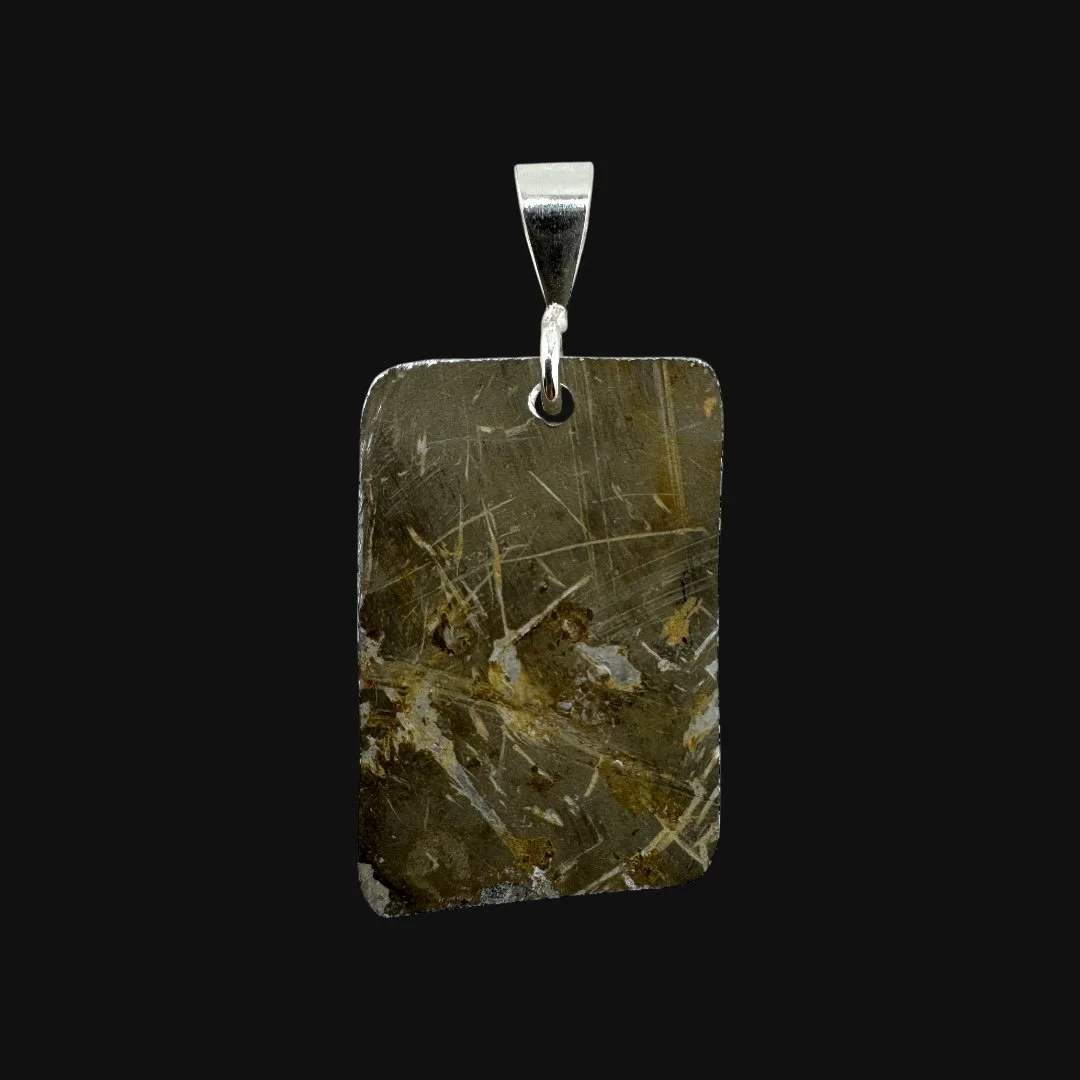
Comes with a hand-signed C.O.A. and a full historical research write-up
From: World War II
Dated: 1944-1945
Aircraft: Boeing B-17 Flying Fortress
Type: Heavy Bomber
From: European Theater “Combat Flown” U.S. Army Air Force (USAAF) 8th Air Force - 95th Bomb Group
National Origin: United States (American)
Necklace Pendant Size: Roughly 1 inch x ½ inch
Pendant Clap Material: .925 Sterling Silver
*EACH WORLD WAR II “COMBAT FLOWN” AIRCRAFT METAL PENDANT IS HANDMADE AND TRULY ONE-OF-A-KIND. THIS IS THE EXACT WWII AIRCRAFT NECKLACE PENDANT YOU WILL RECEIVE.
Wearable History Collection:
This World War II necklace aircraft pendant is more truly one-of-a-kind. It is a preserved piece of an original WWII aircraft, transformed into a wearable artifact that carries with it the stories of a generation. No two pendants are alike, which makes each one truly unique and irreplaceable. Rich with aviation history, this “combat flown” aircraft pendant offers its wearer the rare chance to carry a genuine fragment of World War II aviation heritage. Every mark in the metal, every detail, holds a connection to the past and serves as a tangible reminder of courage, sacrifice, and resilience. As part of our exclusive Wearable History Collection, it is not only a timeless accessory but also a powerful conversation starter. Flown in the heat of combat during World War II and preserved across generations, this WWII aircraft pendant is a relic unlike any other. Featured in our Wearable History Collection, it represents a rare chance to wear a true fragment of the past.
Strength and Sacrifice: The Legacy of the B-17 Flying Fortress:
The Boeing B-17 Flying Fortress was one of the most iconic and influential aircraft of the Second World War. Built for endurance and heavy defensive firepower, the B-17 was designed to withstand enemy attack and deliver precision bombing deep into enemy territory. With four powerful engines, a rugged frame, and up to thirteen machine guns, it embodied the name “Flying Fortress,” earning a reputation for bringing its crews home even when battered by flak and fighters.
When the United States entered the European air war, the B-17 became the backbone of the 8th Air Force, based in England. Daylight bombing campaigns carried American airpower directly over Nazi-occupied Europe, targeting industrial centers, oil refineries, and transportation hubs. Among the most distinguished units to fly the Fortress was the 95th Bomb Group, which pioneered long-range strategic missions and endured some of the fiercest opposition of the war.
Flying in massive combat box formations, the 95th and their sister groups faced relentless attacks from German fighters and the deadly curtain of flak that awaited them over cities like Regensburg, Schweinfurt, and Berlin. Losses were staggering, and missions often tested the resolve of even the most seasoned crews. Yet, the B-17’s durability and the determination of the men inside carried the campaign forward. Each successful strike weakened the German war machine, setting the stage for Allied ground offensives.
The B-17’s defining contribution came during the relentless air campaign of 1943 and 1944, when the 8th Air Force fought for air superiority over Europe. By the time of D-Day in June 1944, the skies were largely under Allied control, thanks in no small part to the sacrifices of B-17 crews. The 95th Bomb Group, flying from Horham, Suffolk, continued striking railways, bridges, and airfields, ensuring German forces could not disrupt the landings in Normandy.
Beyond its destructive power, the B-17 carried immense symbolic weight. To the Allies, it represented resilience and the promise of eventual victory. To civilians in occupied Europe, its contrails overhead signaled hope. And to German forces, the sight of a thousand-plane raid testified to the industrial might and determination of the United States.
In retrospect, the legacy of the B-17 is one of both heroism and sacrifice. It demonstrated the strategic value of precision bombing but also underscored the human cost of such campaigns. The 95th Bomb Group became a symbol of that struggle, its men flying mission after mission in the face of unimaginable danger. The Flying Fortress not only helped pave the road to victory in Europe but also secured its place as one of the most iconic aircraft of the twentieth century, remembered as much for the courage of its crews as for the strength of the machine itself.
The Flying Fortress in the European War:
Early Missions and Heavy Losses (1942–1943)
First Raids from England (1942) – The Boeing B-17 Flying Fortress began its European campaign with the 8th Air Force, flying out of bases in England. Designed for long-range precision bombing, it was tasked with striking deep into occupied Europe. Crews quickly learned that daylight raids came at a heavy cost, as formations were savaged by flak and German fighters.
The 95th Bomb Group Joins the Fight (1943) – Activated in 1942 and deployed to Horham, Suffolk, the 95th became one of the first groups to carry the burden of sustained strategic bombing. Their missions against U-boat pens, aircraft factories, and industrial targets proved both the potential and the peril of America’s daylight bombing strategy.
Forging a Strategy (1943–1944)
Regensburg and Schweinfurt (1943) – The 95th Bomb Group took part in the famed raids against German ball-bearing factories and aircraft plants. Losses were staggering, but these missions demonstrated American resolve and the B-17’s role as the workhorse of the 8th Air Force.
Building Air Superiority – Flying in tight defensive formations, the Fortresses unleashed destruction on the German war machine while absorbing punishment that would have downed lesser aircraft. Their endurance set the stage for long-term strategic bombing success once long-range escorts like the P-51 Mustang arrived.
D-Day and the Battle for Normandy (June 1944)
June 6, 1944 – On D-Day, B-17s of the 95th Bomb Group bombed coastal defenses, road networks, and communication hubs across northern France. Their mission was to isolate the battlefield, prevent reinforcements from reaching Normandy, and soften German resistance for the troops storming the beaches.
Sustained Operations Over France – In the weeks that followed, the group continued striking railways, bridges, and fortified positions behind enemy lines. Each mission supported the breakout from Normandy and the eventual liberation of Paris.
Driving the War Home (1944–1945)
The Strategic Bombing Offensive – As the Allies gained air superiority, the 95th Bomb Group and other units of the 8th Air Force shifted to crippling Germany’s industrial heartland. Oil refineries, rail yards, and manufacturing plants were relentlessly targeted, starving the Wehrmacht of fuel and weapons.
Battle of the Bulge (1944–1945) – Flying in brutal winter conditions, B-17s struck supply depots, troop concentrations, and transportation routes, aiding the defense of American lines during Germany’s last great counteroffensive.
Final Missions into Germany – In early 1945, the Fortresses continued bombing campaigns that destroyed bridges across the Rhine and shattered what remained of German infrastructure. Their missions paved the way for Allied forces to push into the heart of the Reich.
The Legacy Within This WWII Necklace Pendant:
This handcrafted World War II necklace pendant has been created from the very metal of a Boeing B-17 Flying Fortress, once flown in combat by the 8th Air Force’s 95th Bomb Group. The B-17 was the backbone of America’s daylight bombing campaign over Europe, a rugged and resilient aircraft that carried its crews deep into enemy territory. Flying from bases in England, the 95th Bomb Group braved waves of German fighters and deadly flak to strike at factories, railways, and fortifications that fueled the Nazi war machine.
Every mark in this metal carries echoes of those missions. It recalls the roar of four engines lifting into the cold morning skies over Suffolk. It remembers the black bursts of flak that dotted the horizon above Berlin, and the determination of the crews who held formation against impossible odds. Forged into a pendant, this fragment ceases to be just a remnant of a machine. It becomes a symbol of resilience, sacrifice, and the relentless fight that brought victory in Europe.
Each pendant is unique, a singular survivor of history. To wear it is to hold not just jewelry, but a piece of the air war over Europe. It invites conversation, sparks reflection, and connects the present to the courage of those who flew with the 95th Bomb Group. More than an accessory, this pendant is a living fragment of history. A remembrance of sacrifice. And a lasting tribute to the men and missions that helped carry the war to its end.
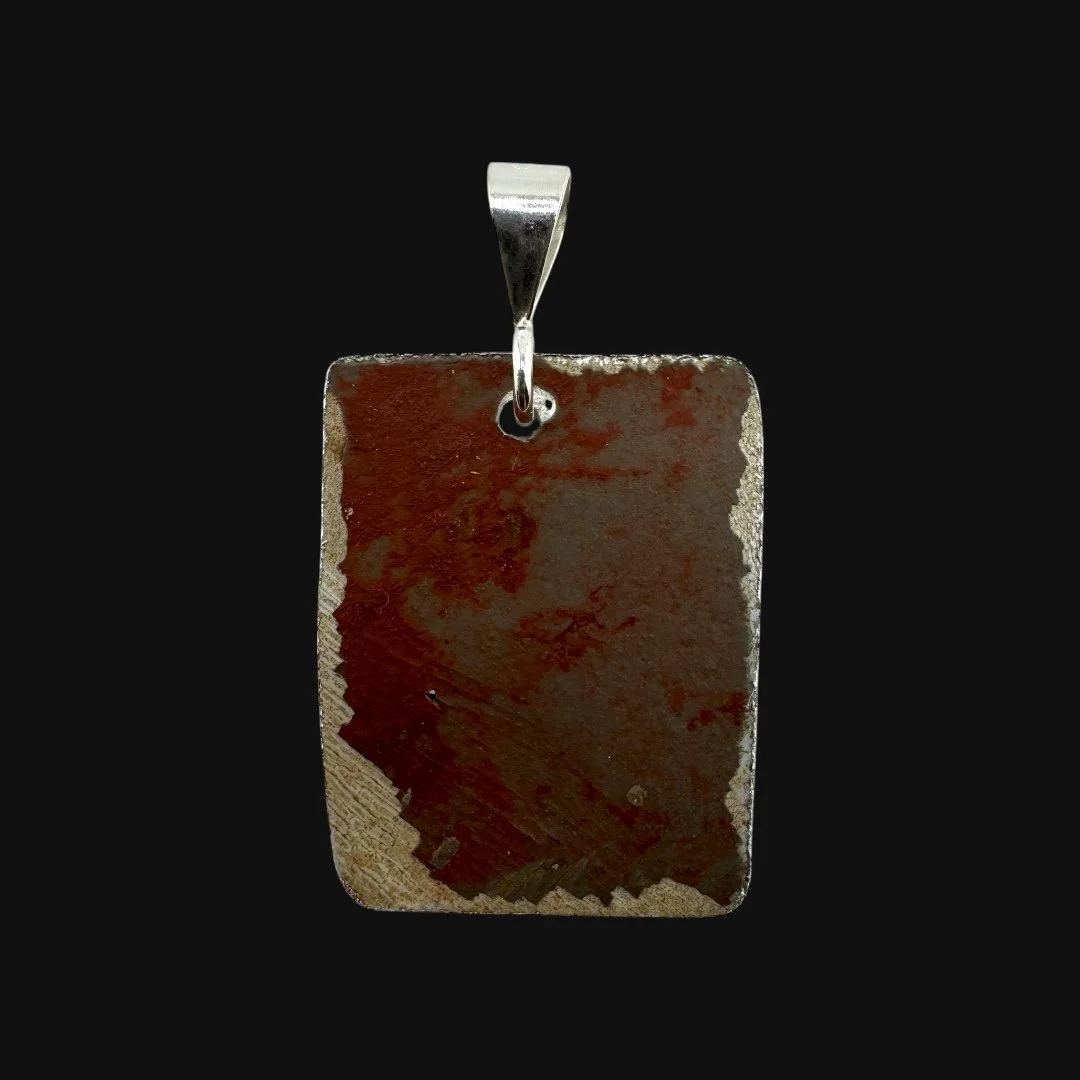
Comes with a hand-signed C.O.A. and a full historical research write-up
From: World War II
Dated: 1945
Aircraft: Gloster Meteor
Type: JetFighter Aircraft (The 1st British jet fighter and the only Allied jet to see combat during the Second World War)
From: Royal Air Force (RAF) 2nd Tactical Air Force No. 616 Squadron Gloster Meteor Aircraft Recovered From Melsbroek, Belgium
National Origin: United Kingdom (British)
Necklace Pendant Size: Roughly 1 inch x ½ inch
Pendant Clap Material: .925 Sterling Silver
*EACH WORLD WAR II “COMBAT FLOWN” AIRCRAFT METAL PENDANT IS HANDMADE AND TRULY ONE-OF-A-KIND. THIS IS THE EXACT WWII AIRCRAFT NECKLACE PENDANT YOU WILL RECEIVE.
Wearable History Collection:
This World War II necklace aircraft pendant is more truly one-of-a-kind. It is a preserved piece of an original WWII aircraft, transformed into a wearable artifact that carries with it the stories of a generation. No two pendants are alike, which makes each one truly unique and irreplaceable. Rich with aviation history, this “combat flown” aircraft pendant offers its wearer the rare chance to carry a genuine fragment of World War II aviation heritage. Every mark in the metal, every detail, holds a connection to the past and serves as a tangible reminder of courage, sacrifice, and resilience. As part of our exclusive Wearable History Collection, it is not only a timeless accessory but also a powerful conversation starter. Flown in the heat of combat during World War II and preserved across generations, this WWII aircraft pendant is a relic unlike any other. Featured in our Wearable History Collection, it represents a rare chance to wear a true fragment of the past.
Innovation and Resolve: The Significance of the Gloster Meteor
The Gloster Meteor was a revolutionary aircraft of the Second World War. As Britain’s first operational jet fighter, it represented a dramatic leap forward in aviation technology at a time when the skies of Europe were still dominated by piston-engine fighters. Unlike its German counterpart, the Me 262, which was rushed into service late in the war, the Meteor was steadily introduced into combat under the Royal Air Force, marking the beginning of a new era in aerial warfare.
Initially deployed in July 1944 with No. 616 Squadron RAF, the Meteor was first tasked with countering the V-1 flying bomb threat over Britain. Its speed made it one of the few aircraft capable of catching and destroying the pilotless weapons before they reached civilian targets. This mission demonstrated not only the Meteor’s effectiveness but also the RAF’s foresight in harnessing jet technology for both defense and offense.
The Meteor’s combat story expanded when No. 616 Squadron was deployed to the European mainland in early 1945. Operating from Melsbroek airfield in Belgium, Meteor pilots engaged in patrols, ground attack missions, and interception duties during the final push into Germany. Although deliberately kept from engaging German jets to prevent the risk of a Meteor being captured intact, the aircraft still played a critical role. It provided cover for advancing Allied armies, attacked transport networks, and demonstrated Allied mastery of jet technology at a decisive moment in the war.
For the pilots of No. 616 Squadron, flying from Melsbroek symbolized both progress and responsibility. They were not only combat aviators but pioneers, mastering an entirely new form of flight in the middle of a world war. Each mission flown from Belgian soil underscored that the age of the jet fighter had arrived, and it belonged not only to the Germans but also to the Allies who had embraced innovation and discipline.
In retrospect, the Gloster Meteor’s significance lies less in the number of enemy aircraft it destroyed than in what it represented. It was the first Allied jet to engage in wartime operations, proof that Britain had broken into a new technological frontier. Its missions with No. 616 Squadron from Melsbroek showed that jet-powered aircraft could be integrated into frontline combat, paving the way for the future of military aviation.
The Meteor’s legacy is therefore one of innovation and transition. It bridged the gap between the propeller-driven fighters of the early war and the jet age that would dominate the skies for decades to come. As both a practical weapon of war and a symbol of progress, the Gloster Meteor secured its place as one of the most influential aircraft of the twentieth century.
The Meteor in the European War:
Early Deployment and Pioneering Flights (1944)
Britain’s Jet Debut (July 1944) – The Gloster Meteor entered service with the Royal Air Force as the first operational Allied jet fighter. Initially assigned to No. 616 Squadron, the Meteor’s earliest missions were defensive, hunting V-1 flying bombs threatening British cities. With its unprecedented speed, it became one of the few aircraft able to intercept and destroy these weapons before they reached their targets.
Mastering the Jet Age – Pilots had to quickly adapt to jet propulsion, learning new tactics and flight characteristics. Unlike piston-engine fighters, the Meteor offered blistering speed and smooth performance, but demanded innovation in aerial combat methods.
To the Continent (Late 1944 – 1945)
Arrival in Europe – In early 1945, No. 616 Squadron deployed to Melsbroek Airfield in Belgium, bringing the Meteor into the heart of the European war. Operating from forward bases placed the jet within striking distance of German forces, marking the Allies’ full embrace of jet technology on the continent.
Operational Missions – While restricted from direct combat with German Me 262 jets to prevent capture of Allied jet technology, the Meteors carried out patrols, reconnaissance, and ground attack missions. They strafed transport networks, targeted enemy airfields, and provided cover for advancing Allied armies as they pressed deeper into German-held territory.
The Final Push into Germany (1945)
Rhine Operations – From Melsbroek, Meteors supported operations during the Allied crossing of the Rhine, flying missions against retreating German units and striking supply lines. Their presence signaled not only combat effectiveness but also the Allies’ technological superiority as the war neared its conclusion.
Consolidation of Air Power – By spring 1945, Meteor squadrons were fully integrated into RAF operations in Europe. Though their combat record was limited compared to piston-engine fighters, their arrival marked a decisive step into the future of air warfare.
The Legacy Within This WWII Necklace Pendant:
This handcrafted World War II necklace pendant has been created from the very metal of a Gloster Meteor, the first operational British jet fighter and the only Allied jet aircraft to see combat during the war. Flown by No. 616 Squadron of the Royal Air Force, Meteors represented the dawn of a new age in aviation. In early 1945, they were stationed at Melsbroek Airfield in Belgium, where they carried out patrols, ground attack missions, and reconnaissance flights during the final Allied push into Germany.
Every detail in the metal carries the echoes of that transformation. It recalls the roar of jet engines lifting from Belgian runways, the urgency of pilots adapting to an entirely new form of flight, and the determination to carry the fight into the heart of occupied Europe. Forged into a pendant, this fragment ceases to be just a remnant of a machine. It becomes a symbol of innovation, resilience, and the moment the jet age took its place on the battlefield.
Each pendant is one of a kind, carrying its own story of survival. To wear it is to hold not just jewelry, but a piece of history that marked the turning point from propellers to jets. It sparks conversation, invites reflection, and connects the present to the courage of those who flew into uncharted skies. More than an accessory, this pendant is a living fragment of history. A remembrance of sacrifice. And a tribute to the pioneering spirit of the men and machines of No. 616 Squadron RAF at Melsbroek.
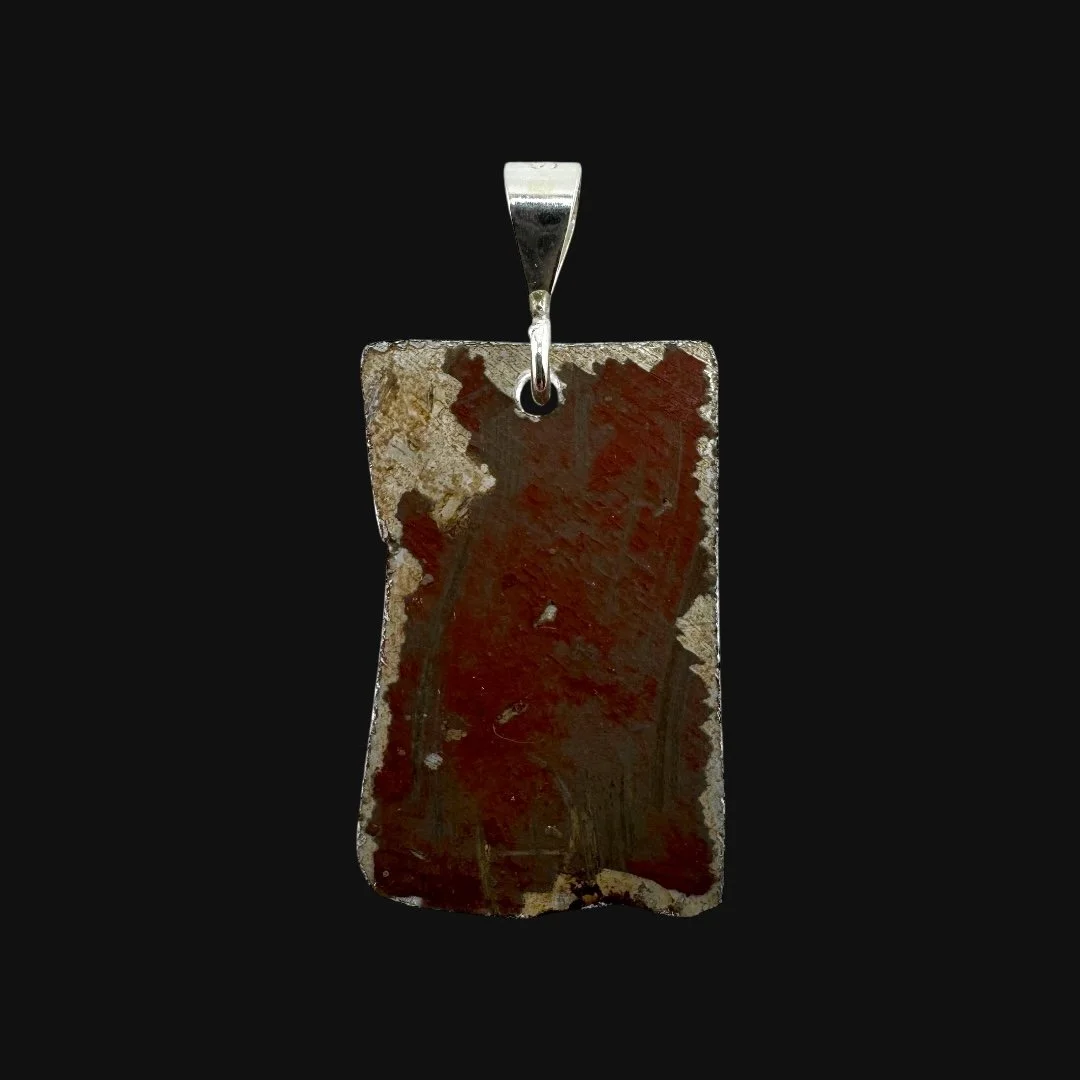
Comes with a hand-signed C.O.A. and a full historical research write-up
From: World War II
Dated: 1945
Aircraft: Gloster Meteor
Type: JetFighter Aircraft (The 1st British jet fighter and the only Allied jet to see combat during the Second World War)
From: Royal Air Force (RAF) 2nd Tactical Air Force No. 616 Squadron Gloster Meteor Aircraft Recovered From Melsbroek, Belgium
National Origin: United Kingdom (British)
Necklace Pendant Size: Roughly 1 inch x ½ inch
Pendant Clap Material: .925 Sterling Silver
*EACH WORLD WAR II “COMBAT FLOWN” AIRCRAFT METAL PENDANT IS HANDMADE AND TRULY ONE-OF-A-KIND. THIS IS THE EXACT WWII AIRCRAFT NECKLACE PENDANT YOU WILL RECEIVE.
Wearable History Collection:
This World War II necklace aircraft pendant is more truly one-of-a-kind. It is a preserved piece of an original WWII aircraft, transformed into a wearable artifact that carries with it the stories of a generation. No two pendants are alike, which makes each one truly unique and irreplaceable. Rich with aviation history, this “combat flown” aircraft pendant offers its wearer the rare chance to carry a genuine fragment of World War II aviation heritage. Every mark in the metal, every detail, holds a connection to the past and serves as a tangible reminder of courage, sacrifice, and resilience. As part of our exclusive Wearable History Collection, it is not only a timeless accessory but also a powerful conversation starter. Flown in the heat of combat during World War II and preserved across generations, this WWII aircraft pendant is a relic unlike any other. Featured in our Wearable History Collection, it represents a rare chance to wear a true fragment of the past.
Innovation and Resolve: The Significance of the Gloster Meteor
The Gloster Meteor was a revolutionary aircraft of the Second World War. As Britain’s first operational jet fighter, it represented a dramatic leap forward in aviation technology at a time when the skies of Europe were still dominated by piston-engine fighters. Unlike its German counterpart, the Me 262, which was rushed into service late in the war, the Meteor was steadily introduced into combat under the Royal Air Force, marking the beginning of a new era in aerial warfare.
Initially deployed in July 1944 with No. 616 Squadron RAF, the Meteor was first tasked with countering the V-1 flying bomb threat over Britain. Its speed made it one of the few aircraft capable of catching and destroying the pilotless weapons before they reached civilian targets. This mission demonstrated not only the Meteor’s effectiveness but also the RAF’s foresight in harnessing jet technology for both defense and offense.
The Meteor’s combat story expanded when No. 616 Squadron was deployed to the European mainland in early 1945. Operating from Melsbroek airfield in Belgium, Meteor pilots engaged in patrols, ground attack missions, and interception duties during the final push into Germany. Although deliberately kept from engaging German jets to prevent the risk of a Meteor being captured intact, the aircraft still played a critical role. It provided cover for advancing Allied armies, attacked transport networks, and demonstrated Allied mastery of jet technology at a decisive moment in the war.
For the pilots of No. 616 Squadron, flying from Melsbroek symbolized both progress and responsibility. They were not only combat aviators but pioneers, mastering an entirely new form of flight in the middle of a world war. Each mission flown from Belgian soil underscored that the age of the jet fighter had arrived, and it belonged not only to the Germans but also to the Allies who had embraced innovation and discipline.
In retrospect, the Gloster Meteor’s significance lies less in the number of enemy aircraft it destroyed than in what it represented. It was the first Allied jet to engage in wartime operations, proof that Britain had broken into a new technological frontier. Its missions with No. 616 Squadron from Melsbroek showed that jet-powered aircraft could be integrated into frontline combat, paving the way for the future of military aviation.
The Meteor’s legacy is therefore one of innovation and transition. It bridged the gap between the propeller-driven fighters of the early war and the jet age that would dominate the skies for decades to come. As both a practical weapon of war and a symbol of progress, the Gloster Meteor secured its place as one of the most influential aircraft of the twentieth century.
The Meteor in the European War:
Early Deployment and Pioneering Flights (1944)
Britain’s Jet Debut (July 1944) – The Gloster Meteor entered service with the Royal Air Force as the first operational Allied jet fighter. Initially assigned to No. 616 Squadron, the Meteor’s earliest missions were defensive, hunting V-1 flying bombs threatening British cities. With its unprecedented speed, it became one of the few aircraft able to intercept and destroy these weapons before they reached their targets.
Mastering the Jet Age – Pilots had to quickly adapt to jet propulsion, learning new tactics and flight characteristics. Unlike piston-engine fighters, the Meteor offered blistering speed and smooth performance, but demanded innovation in aerial combat methods.
To the Continent (Late 1944 – 1945)
Arrival in Europe – In early 1945, No. 616 Squadron deployed to Melsbroek Airfield in Belgium, bringing the Meteor into the heart of the European war. Operating from forward bases placed the jet within striking distance of German forces, marking the Allies’ full embrace of jet technology on the continent.
Operational Missions – While restricted from direct combat with German Me 262 jets to prevent capture of Allied jet technology, the Meteors carried out patrols, reconnaissance, and ground attack missions. They strafed transport networks, targeted enemy airfields, and provided cover for advancing Allied armies as they pressed deeper into German-held territory.
The Final Push into Germany (1945)
Rhine Operations – From Melsbroek, Meteors supported operations during the Allied crossing of the Rhine, flying missions against retreating German units and striking supply lines. Their presence signaled not only combat effectiveness but also the Allies’ technological superiority as the war neared its conclusion.
Consolidation of Air Power – By spring 1945, Meteor squadrons were fully integrated into RAF operations in Europe. Though their combat record was limited compared to piston-engine fighters, their arrival marked a decisive step into the future of air warfare.
The Legacy Within This WWII Necklace Pendant:
This handcrafted World War II necklace pendant has been created from the very metal of a Gloster Meteor, the first operational British jet fighter and the only Allied jet aircraft to see combat during the war. Flown by No. 616 Squadron of the Royal Air Force, Meteors represented the dawn of a new age in aviation. In early 1945, they were stationed at Melsbroek Airfield in Belgium, where they carried out patrols, ground attack missions, and reconnaissance flights during the final Allied push into Germany.
Every detail in the metal carries the echoes of that transformation. It recalls the roar of jet engines lifting from Belgian runways, the urgency of pilots adapting to an entirely new form of flight, and the determination to carry the fight into the heart of occupied Europe. Forged into a pendant, this fragment ceases to be just a remnant of a machine. It becomes a symbol of innovation, resilience, and the moment the jet age took its place on the battlefield.
Each pendant is one of a kind, carrying its own story of survival. To wear it is to hold not just jewelry, but a piece of history that marked the turning point from propellers to jets. It sparks conversation, invites reflection, and connects the present to the courage of those who flew into uncharted skies. More than an accessory, this pendant is a living fragment of history. A remembrance of sacrifice. And a tribute to the pioneering spirit of the men and machines of No. 616 Squadron RAF at Melsbroek.
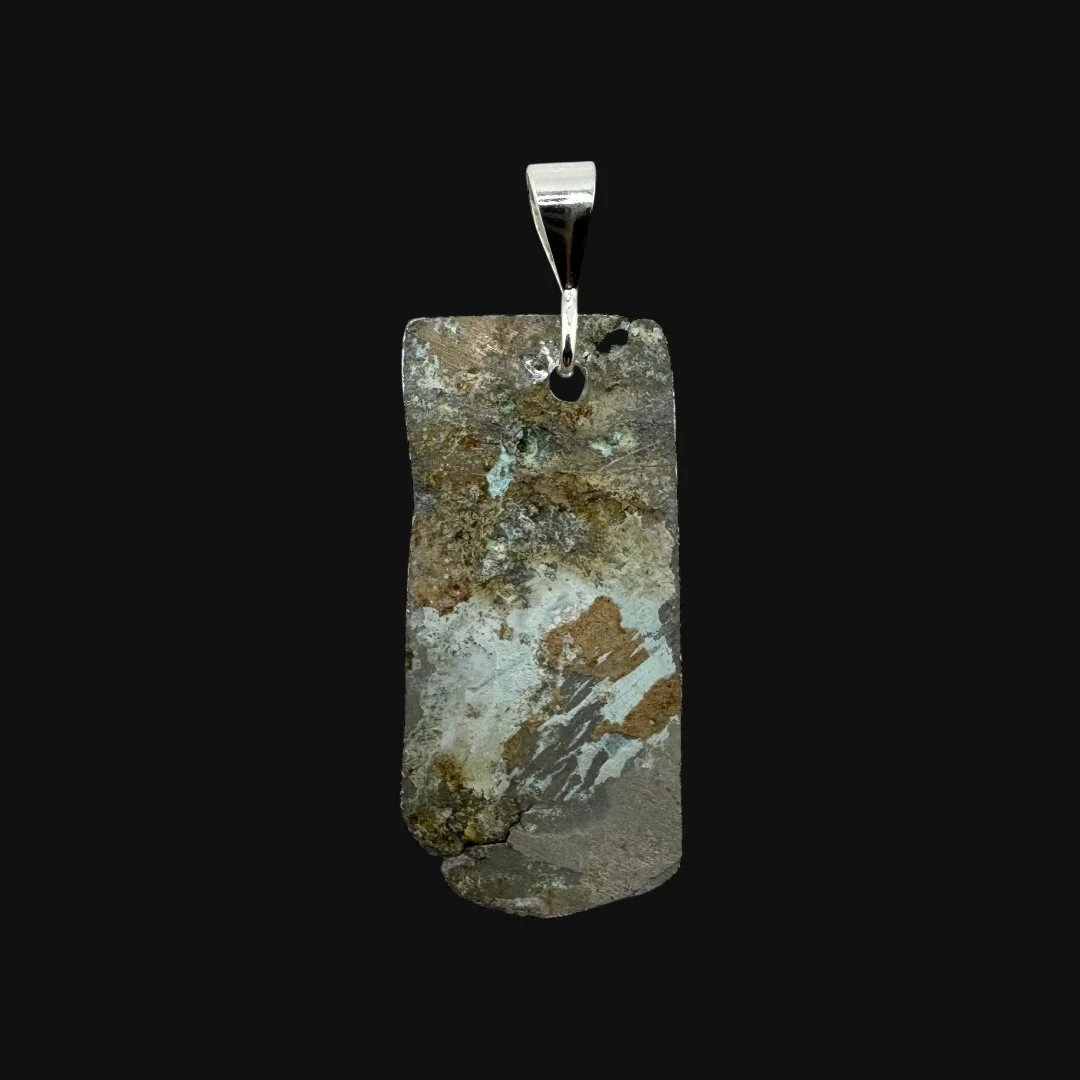
Comes with a hand-signed C.O.A. and a full historical research write-up
From: World War II
Dated: June 6th, 1944
Aircraft: Martin B-26 Marauder
Type: Medium Bomber
From: D-Day Mission “Combat Flown” U.S. Army Air Force (USAAF) 9th Air Force - 394th Bomb Group - 587th Bombardment Squadron
National Origin: United States (American)
Necklace Pendant Size: Roughly 1 inch x ½ inch
Pendant Clap Material: .925 Sterling Silver
*EACH WORLD WAR II “COMBAT FLOWN” AIRCRAFT METAL PENDANT IS HANDMADE AND TRULY ONE-OF-A-KIND. THIS IS THE EXACT WWII AIRCRAFT NECKLACE PENDANT YOU WILL RECEIVE.
Wearable History Collection:
This World War II necklace aircraft pendant is more truly one-of-a-kind. It is a preserved piece of an original WWII aircraft, transformed into a wearable artifact that carries with it the stories of a generation. No two pendants are alike, which makes each one truly unique and irreplaceable. Rich with aviation history, this “combat flown” aircraft pendant offers its wearer the rare chance to carry a genuine fragment of World War II aviation heritage. Every mark in the metal, every detail, holds a connection to the past and serves as a tangible reminder of courage, sacrifice, and resilience. As part of our exclusive Wearable History Collection, it is not only a timeless accessory but also a powerful conversation starter. Flown in the heat of combat during World War II and preserved across generations, this WWII aircraft pendant is a relic unlike any other. Featured in our Wearable History Collection, it represents a rare chance to wear a true fragment of the past.
Precision and Power: The Legacy of the Martin B-26 Marauder
The Martin B-26 Marauder was one of the most formidable medium bombers of the Second World War. Designed for speed and precision, the twin-engine aircraft earned both respect and notoriety. Early in the war, its high landing speeds and challenging flight characteristics gave it a reputation as the “Widowmaker.” But in skilled hands, the Marauder became a fast, resilient, and highly effective bomber that carried the fight deep into occupied Europe.
By 1943, Marauders were integrated into the 9th Air Force, where they would prove their worth as tactical bombers. Among the most distinguished units to fly them was the 394th Bomb Group, which became central to the air war over Western Europe. Operating from bases in England, the group specialized in precision strikes against bridges, rail lines, and fortified positions. These missions directly supported ground forces by disrupting German reinforcements and supply routes, setting the stage for the Allied invasion of France.
On D-Day, June 6, 1944, the Marauder came into its own. The 394th Bomb Group launched a series of carefully coordinated missions against German coastal defenses and transportation networks behind the beaches of Normandy. Flying through flak-filled skies, B-26 crews struck at critical road junctions, railway hubs, and artillery positions. Their objective was clear: isolate the battlefield, prevent German counterattacks, and give the landing forces a fighting chance. Unlike the heavy bombers that carpet-bombed inland, the Marauders of the 9th Air Force flew at lower altitudes, relying on speed and accuracy to deliver their payloads where they mattered most.
The Marauder’s contribution to D-Day cannot be overstated. By crippling transportation links and striking defensive positions, they ensured that German forces were delayed in mounting an organized counter-offensive. Casualties were heavy, but the precision and determination of the 394th Bomb Group helped secure the foothold that would ultimately liberate Western Europe.
In retrospect, the B-26 Marauder’s legacy is one of vindication. Once doubted, it went on to achieve the lowest loss rate of any Allied bomber in the European Theater. Its speed, durability, and accuracy made it indispensable to the tactical air war, particularly in the days when every bridge destroyed or train halted meant fewer German reinforcements on the front. For the crews of the 394th Bomb Group, the Marauder was not just a machine, but a weapon of precision that helped change the course of history.
Today, the Martin B-26 stands as a symbol of resilience and adaptation. Its role on D-Day with the 394th Bomb Group highlights the critical connection between air power and ground success, proving that victory in Normandy was as much about the skies as it was about the beaches.
The Marauder in the European War:
Early Combat and Growing Pains (1942–1943)
North Africa (1942–1943) – The Martin B-26 Marauder first entered combat in the Mediterranean Theater, where its speed and durability made it an asset for striking German supply lines. Initially known for its demanding flight characteristics, the Marauder earned a tough reputation. Yet, with experienced crews, it soon became one of the most reliable medium bombers in the Allied arsenal.
Italy and the Mediterranean Campaign (1943) – Marauders flew missions against bridges, railroads, and harbor facilities, disrupting Axis defenses as Allied forces advanced up the Italian peninsula.
Into the Heart of Europe (1943–1944)
Arrival in England – By late 1943, the B-26 had become a cornerstone of the 9th Air Force’s tactical bombing strategy. Among its most distinguished units was the 394th Bomb Group, stationed in England, tasked with crippling German transportation networks and softening fortifications ahead of the invasion of France.
Pre-Invasion Missions – Throughout early 1944, the 394th struck rail yards, bridges, and supply depots across occupied France. Every sortie weakened German mobility, paving the way for Operation Overlord.
D-Day and the Battle for Normandy (June 1944)
June 6, 1944 – On D-Day, Marauders of the 394th Bomb Group launched precision bombing runs against German gun emplacements, road junctions, and communication hubs near the Normandy coast. Flying at medium altitudes through anti-aircraft fire, they aimed to block German reinforcements from reaching the beaches. Their strikes on bridges and crossroads proved vital in isolating the battlefield and protecting Allied troops as they fought their way ashore.
Hedgerows of Normandy – In the weeks that followed, B-26 crews provided continuous support to ground forces, targeting fortified positions and supply lines deep in occupied France.
Driving Toward Victory (1944–1945)
Breakout from Normandy – The Marauder’s speed and precision allowed it to deliver punishing strikes on German defensive lines during Operation Cobra, helping the Allies break free from the bocage and begin the drive across France.
The Low Countries and the Rhine – As the war pressed eastward, Marauders hammered bridges and industrial targets, clearing the way for Allied advances into Belgium, Holland, and Germany itself.
Final Months of the War
Winter of 1944–1945 – During the Battle of the Bulge, Marauders flew in bitter weather to strike German supply depots and troop concentrations, supporting the embattled American lines.
Crossing the Rhine – In the final push into Germany, B-26s bombed enemy positions with relentless precision, hastening the collapse of Nazi defenses.
The Legacy Within This WWII Necklace Pendant:
This handcrafted World War II necklace pendant has been created from the very metal of a Martin B-26 Marauder bomber, once flown in combat during the largest invasion in history. The Marauder, known for its speed and precision, was the backbone of the 9th Air Force’s tactical bombing force. On June 6th, 1944, aircraft of the 394th Bomb Grouplaunched from English airfields to strike German defenses and transportation hubs, ensuring that reinforcements could not reach the beaches of Normandy.
Every mark in this metal carries echoes of that day. It recalls the thunder of engines as squadrons of Marauders roared across the Channel. It remembers the bursts of flak that filled the sky, and the resolve of crews who pressed on to deliver their bombs with accuracy. Transformed into a pendant, this fragment ceases to be a remnant of a machine alone. It becomes a symbol of precision, courage, and the pivotal moments that decided the fate of Europe.
Each pendant is unique, a singular survivor of history. To wear it is to hold not just jewelry, but a piece of the air war over Normandy. It sparks conversation, invites reflection, and connects the present to the legacy of those who flew against overwhelming odds. More than an accessory, this pendant is a living fragment of history. A remembrance of sacrifice. And a lasting tribute to the men and missions that carried D-Day to victory.
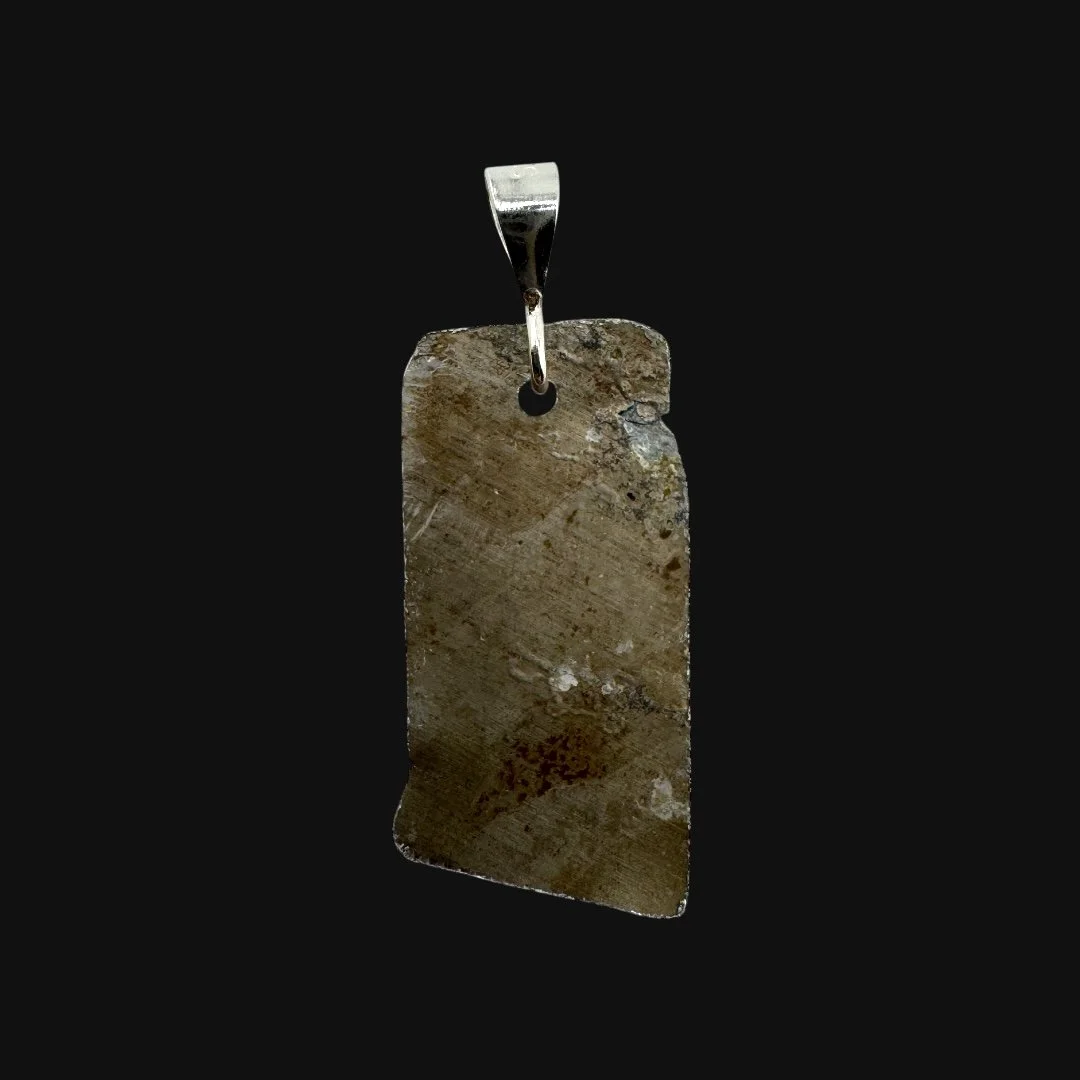
Comes with a hand-signed C.O.A. and a full historical research write-up
From: World War II
Dated: June 6th, 1944
Aircraft: Martin B-26 Marauder
Type: Medium Bomber
From: D-Day Mission “Combat Flown” U.S. Army Air Force (USAAF) 9th Air Force - 394th Bomb Group - 587th Bombardment Squadron
National Origin: United States (American)
Necklace Pendant Size: Roughly 1 inch x ½ inch
Pendant Clap Material: .925 Sterling Silver
*EACH WORLD WAR II “COMBAT FLOWN” AIRCRAFT METAL PENDANT IS HANDMADE AND TRULY ONE-OF-A-KIND. THIS IS THE EXACT WWII AIRCRAFT NECKLACE PENDANT YOU WILL RECEIVE.
Wearable History Collection:
This World War II necklace aircraft pendant is more truly one-of-a-kind. It is a preserved piece of an original WWII aircraft, transformed into a wearable artifact that carries with it the stories of a generation. No two pendants are alike, which makes each one truly unique and irreplaceable. Rich with aviation history, this “combat flown” aircraft pendant offers its wearer the rare chance to carry a genuine fragment of World War II aviation heritage. Every mark in the metal, every detail, holds a connection to the past and serves as a tangible reminder of courage, sacrifice, and resilience. As part of our exclusive Wearable History Collection, it is not only a timeless accessory but also a powerful conversation starter. Flown in the heat of combat during World War II and preserved across generations, this WWII aircraft pendant is a relic unlike any other. Featured in our Wearable History Collection, it represents a rare chance to wear a true fragment of the past.
Precision and Power: The Legacy of the Martin B-26 Marauder
The Martin B-26 Marauder was one of the most formidable medium bombers of the Second World War. Designed for speed and precision, the twin-engine aircraft earned both respect and notoriety. Early in the war, its high landing speeds and challenging flight characteristics gave it a reputation as the “Widowmaker.” But in skilled hands, the Marauder became a fast, resilient, and highly effective bomber that carried the fight deep into occupied Europe.
By 1943, Marauders were integrated into the 9th Air Force, where they would prove their worth as tactical bombers. Among the most distinguished units to fly them was the 394th Bomb Group, which became central to the air war over Western Europe. Operating from bases in England, the group specialized in precision strikes against bridges, rail lines, and fortified positions. These missions directly supported ground forces by disrupting German reinforcements and supply routes, setting the stage for the Allied invasion of France.
On D-Day, June 6, 1944, the Marauder came into its own. The 394th Bomb Group launched a series of carefully coordinated missions against German coastal defenses and transportation networks behind the beaches of Normandy. Flying through flak-filled skies, B-26 crews struck at critical road junctions, railway hubs, and artillery positions. Their objective was clear: isolate the battlefield, prevent German counterattacks, and give the landing forces a fighting chance. Unlike the heavy bombers that carpet-bombed inland, the Marauders of the 9th Air Force flew at lower altitudes, relying on speed and accuracy to deliver their payloads where they mattered most.
The Marauder’s contribution to D-Day cannot be overstated. By crippling transportation links and striking defensive positions, they ensured that German forces were delayed in mounting an organized counter-offensive. Casualties were heavy, but the precision and determination of the 394th Bomb Group helped secure the foothold that would ultimately liberate Western Europe.
In retrospect, the B-26 Marauder’s legacy is one of vindication. Once doubted, it went on to achieve the lowest loss rate of any Allied bomber in the European Theater. Its speed, durability, and accuracy made it indispensable to the tactical air war, particularly in the days when every bridge destroyed or train halted meant fewer German reinforcements on the front. For the crews of the 394th Bomb Group, the Marauder was not just a machine, but a weapon of precision that helped change the course of history.
Today, the Martin B-26 stands as a symbol of resilience and adaptation. Its role on D-Day with the 394th Bomb Group highlights the critical connection between air power and ground success, proving that victory in Normandy was as much about the skies as it was about the beaches.
The Marauder in the European War:
Early Combat and Growing Pains (1942–1943)
North Africa (1942–1943) – The Martin B-26 Marauder first entered combat in the Mediterranean Theater, where its speed and durability made it an asset for striking German supply lines. Initially known for its demanding flight characteristics, the Marauder earned a tough reputation. Yet, with experienced crews, it soon became one of the most reliable medium bombers in the Allied arsenal.
Italy and the Mediterranean Campaign (1943) – Marauders flew missions against bridges, railroads, and harbor facilities, disrupting Axis defenses as Allied forces advanced up the Italian peninsula.
Into the Heart of Europe (1943–1944)
Arrival in England – By late 1943, the B-26 had become a cornerstone of the 9th Air Force’s tactical bombing strategy. Among its most distinguished units was the 394th Bomb Group, stationed in England, tasked with crippling German transportation networks and softening fortifications ahead of the invasion of France.
Pre-Invasion Missions – Throughout early 1944, the 394th struck rail yards, bridges, and supply depots across occupied France. Every sortie weakened German mobility, paving the way for Operation Overlord.
D-Day and the Battle for Normandy (June 1944)
June 6, 1944 – On D-Day, Marauders of the 394th Bomb Group launched precision bombing runs against German gun emplacements, road junctions, and communication hubs near the Normandy coast. Flying at medium altitudes through anti-aircraft fire, they aimed to block German reinforcements from reaching the beaches. Their strikes on bridges and crossroads proved vital in isolating the battlefield and protecting Allied troops as they fought their way ashore.
Hedgerows of Normandy – In the weeks that followed, B-26 crews provided continuous support to ground forces, targeting fortified positions and supply lines deep in occupied France.
Driving Toward Victory (1944–1945)
Breakout from Normandy – The Marauder’s speed and precision allowed it to deliver punishing strikes on German defensive lines during Operation Cobra, helping the Allies break free from the bocage and begin the drive across France.
The Low Countries and the Rhine – As the war pressed eastward, Marauders hammered bridges and industrial targets, clearing the way for Allied advances into Belgium, Holland, and Germany itself.
Final Months of the War
Winter of 1944–1945 – During the Battle of the Bulge, Marauders flew in bitter weather to strike German supply depots and troop concentrations, supporting the embattled American lines.
Crossing the Rhine – In the final push into Germany, B-26s bombed enemy positions with relentless precision, hastening the collapse of Nazi defenses.
The Legacy Within This WWII Necklace Pendant:
This handcrafted World War II necklace pendant has been created from the very metal of a Martin B-26 Marauder bomber, once flown in combat during the largest invasion in history. The Marauder, known for its speed and precision, was the backbone of the 9th Air Force’s tactical bombing force. On June 6th, 1944, aircraft of the 394th Bomb Grouplaunched from English airfields to strike German defenses and transportation hubs, ensuring that reinforcements could not reach the beaches of Normandy.
Every mark in this metal carries echoes of that day. It recalls the thunder of engines as squadrons of Marauders roared across the Channel. It remembers the bursts of flak that filled the sky, and the resolve of crews who pressed on to deliver their bombs with accuracy. Transformed into a pendant, this fragment ceases to be a remnant of a machine alone. It becomes a symbol of precision, courage, and the pivotal moments that decided the fate of Europe.
Each pendant is unique, a singular survivor of history. To wear it is to hold not just jewelry, but a piece of the air war over Normandy. It sparks conversation, invites reflection, and connects the present to the legacy of those who flew against overwhelming odds. More than an accessory, this pendant is a living fragment of history. A remembrance of sacrifice. And a lasting tribute to the men and missions that carried D-Day to victory.
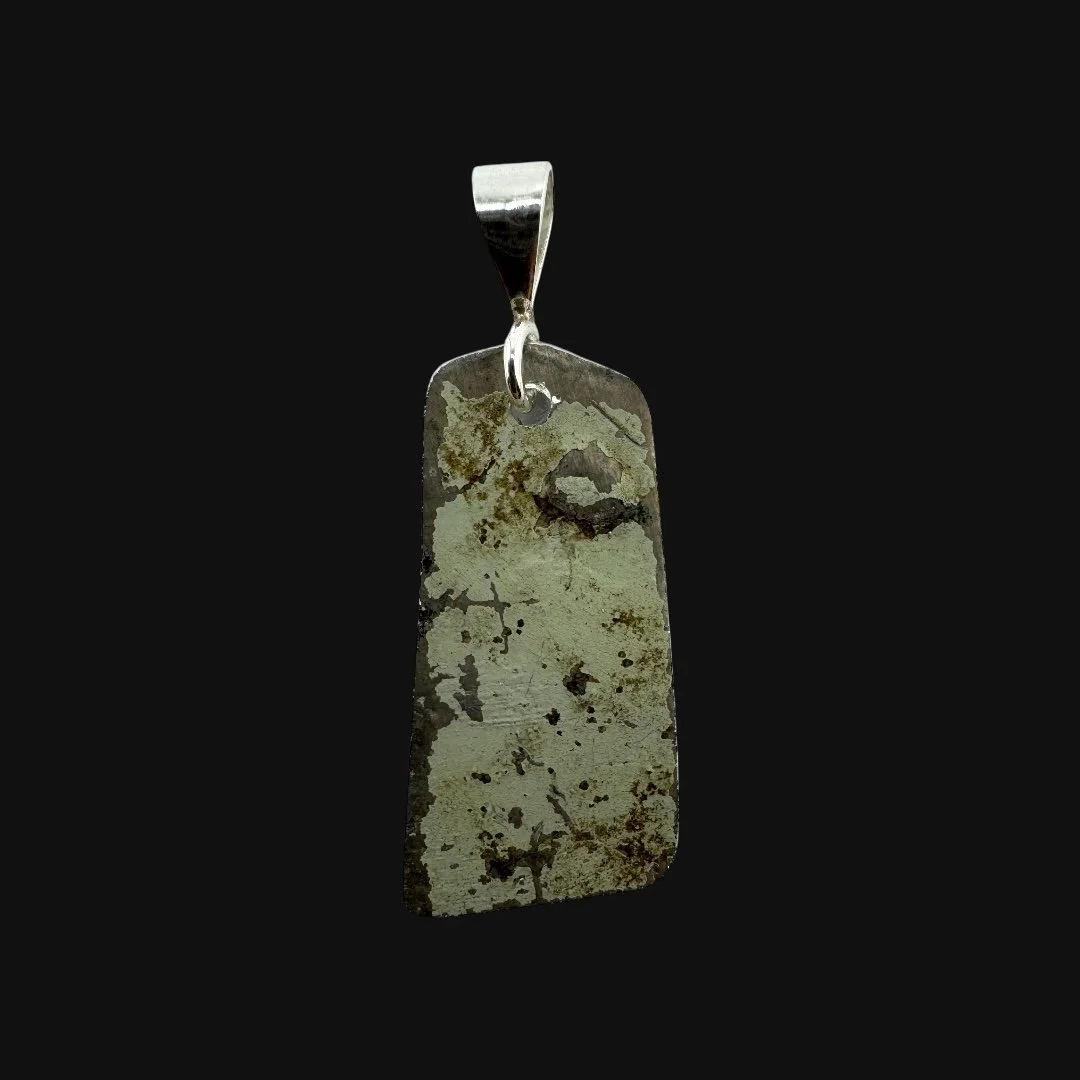
Comes with a hand-signed C.O.A. and a full historical research write-up
From: World War II
Dated: 1942-1943
Aircraft: Grumman F4F Wildcat
Type: Fighter Aircraft
Recovered: Henderson Field - Battle of Guadalcanal
National Origin: United States (American)
Necklace Pendant Size: Roughly 1 inch x ½ inch
Pendant Clap Material: .925 Sterling Silver
*EACH WORLD WAR II “COMBAT FLOWN” AIRCRAFT METAL PENDANT IS HANDMADE AND TRULY ONE-OF-A-KIND. THIS IS THE EXACT WWII AIRCRAFT NECKLACE PENDANT YOU WILL RECEIVE.
Wearable History Collection:
This World War II necklace aircraft pendant is more truly one-of-a-kind. It is a preserved piece of an original WWII aircraft, transformed into a wearable artifact that carries with it the stories of a generation. No two pendants are alike, which makes each one truly unique and irreplaceable. Rich with aviation history, this “combat flown” aircraft pendant offers its wearer the rare chance to carry a genuine fragment of World War II aviation heritage. Every mark in the metal, every detail, holds a connection to the past and serves as a tangible reminder of courage, sacrifice, and resilience. As part of our exclusive Wearable History Collection, it is not only a timeless accessory but also a powerful conversation starter. Flown in the heat of combat during World War II and preserved across generations, this WWII aircraft pendant is a relic unlike any other. Featured in our Wearable History Collection, it represents a rare chance to wear a true fragment of the past.
Courage in the Skies: The Grumman F4F Wildcat at Guadalcanal
The Grumman F4F Wildcat was the workhorse fighter of the United States Navy and Marine Corps during the early years of World War II. Compact, rugged, and dependable, the Wildcat faced overwhelming odds in the Pacific Theater, where it became synonymous with courage in the face of adversity. With folding wings and a powerful radial engine, it was designed to launch from aircraft carriers and endure punishing damage that might have destroyed more delicate planes.
Its defining chapter came in the struggle for Henderson Field on Guadalcanal. After U.S. Marines captured the unfinished Japanese airstrip in August 1942, Henderson became the lifeline of the island. Wildcats based there formed the core of the so-called “Cactus Air Force,” a patchwork group of Navy, Marine, and Army Air Force pilots who fought against constant Japanese assaults. Each mission was desperate. Outnumbered and often flying against the faster, more agile Mitsubishi A6M Zero, the Wildcat pilots relied on discipline, teamwork, and tactics to survive. The famous “Thach Weave,” a defensive maneuver developed by Commander John Thach, allowed Wildcats to cover one another and offset the Zero’s superior maneuverability.
Day after day, Wildcats scrambled from Henderson to meet incoming raids of Japanese bombers and their Zero escorts. The runways were cratered by artillery, fuel and parts were scarce, and pilots flew until exhaustion blurred the line between survival and sacrifice. Yet the Wildcat endured. Its tough frame absorbed punishment, its guns struck hard when aimed with precision, and its pilots earned a reputation for dogged resilience.
At Guadalcanal, the Wildcat was more than just an aircraft. It was a symbol of American determination to hold the line. The defense of Henderson Field prevented Japanese reinforcements from retaking the island, marking the first major Allied offensive victory in the Pacific. Without the Wildcat and its pilots, the tenuous foothold at Guadalcanal might have been lost, altering the entire trajectory of the Pacific War.
In hindsight, the F4F Wildcat represented the transition between old and new eras of air combat. Though soon replaced by the faster F6F Hellcat, the Wildcat’s role at Guadalcanal proved that toughness, tactical innovation, and sheer will could stand against seemingly insurmountable odds. Its legacy lives on not in speed or elegance, but in the story of a fighter and its pilots who refused to yield when the fate of the Pacific hung in the balance.
The Wildcat in the Pacific War:
Early Pacific Battles (1941–1942)
Pearl Harbor and Wake Island (1941) – Wildcats scrambled during the opening attacks of the Pacific War. At Wake, Marine pilots flying the outnumbered fighters managed to down Japanese aircraft and resist repeated assaults before the island fell.
Battle of the Coral Sea (1942) – Wildcats flew escort and defense for American carriers, helping blunt the first Japanese attempt to expand southward, marking the first carrier-versus-carrier battle in history.
Turning the Tide at Midway (1942)
Battle of Midway (June 1942) – Wildcats formed the defensive shield for U.S. carriers as dive bombers struck the Japanese fleet. Though often outmatched by the faster Mitsubishi Zero, Wildcat pilots fought doggedly to protect torpedo and dive bombers, contributing to the decisive American victory that crippled Japan’s carrier force.
The Crucible of Guadalcanal (1942–1943)
Henderson Field (August 1942 – February 1943) – Captured by U.S. Marines, the airstrip became the heart of the struggle for Guadalcanal. Wildcats of the “Cactus Air Force” flew daily from Henderson, intercepting Japanese bombers and dogfighting Zero escorts. The Thach Weave, a coordinated defensive tactic, allowed Wildcats to survive and score victories despite their slower speed.
Naval Battles around Guadalcanal – Wildcats provided air cover during ferocious sea battles in Ironbottom Sound, protecting American convoys that supplied the embattled Marines ashore.
Expanding the Offensive (1943–1944)
Solomon Islands Campaign – Wildcats continued to escort bombers, support amphibious landings, and provide critical air defense until gradually phased out by the newer F6F Hellcat.
Gilbert and Marshall Islands – Wildcats saw service in secondary roles, often from escort carriers, where their toughness and short takeoff ability were well suited to smaller decks.
Final Roles in the War (1944–1945)
Escort Carrier Operations – As newer fighters took the front lines, Wildcats remained in service aboard escort carriers, providing air cover for convoys, anti-submarine patrols, and close air support during invasions.
Battle of Leyte Gulf (1944) – Wildcats flying from escort carriers played a role in protecting U.S. naval forces during one of the largest naval battles in history.
The Legacy Within This WWII Necklace Pendant:
This handcrafted World War II necklace pendant has been created from the very metal of a Grumman F4F Wildcat fighter, once flown in combat during the ferocious battles for control of the Pacific. The Wildcat was the first great American naval fighter of the war, a rugged and resilient aircraft that helped secure victory against impossible odds. At Henderson Field on Guadalcanal, these fighters of the “Cactus Air Force” rose daily into the skies, intercepting Japanese bombers and dueling Zero escorts in desperate fights that decided the fate of the island.
Every detail in the metal carries memory. It echoes the roar of engines straining over shattered runways. It recalls the rattle of machine guns in dogfights above Guadalcanal and the exhaustion of young pilots who flew mission after mission to keep Henderson in American hands. Transformed into a pendant, the fragment ceases to be only the relic of a machine. It becomes a symbol of resilience, courage, and the turning point of the Pacific War.
Each pendant is entirely unique, marked by its own path through history. To wear it is to carry not just jewelry, but a piece of the struggle that shifted momentum in the Pacific. It invites conversation, sparks reflection, and connects the present with the legacy of those who refused to yield. This pendant is more than an accessory. It is a living fragment of history. A remembrance of sacrifice. And a reminder of the courage that defined one of World War II’s most pivotal campaigns.
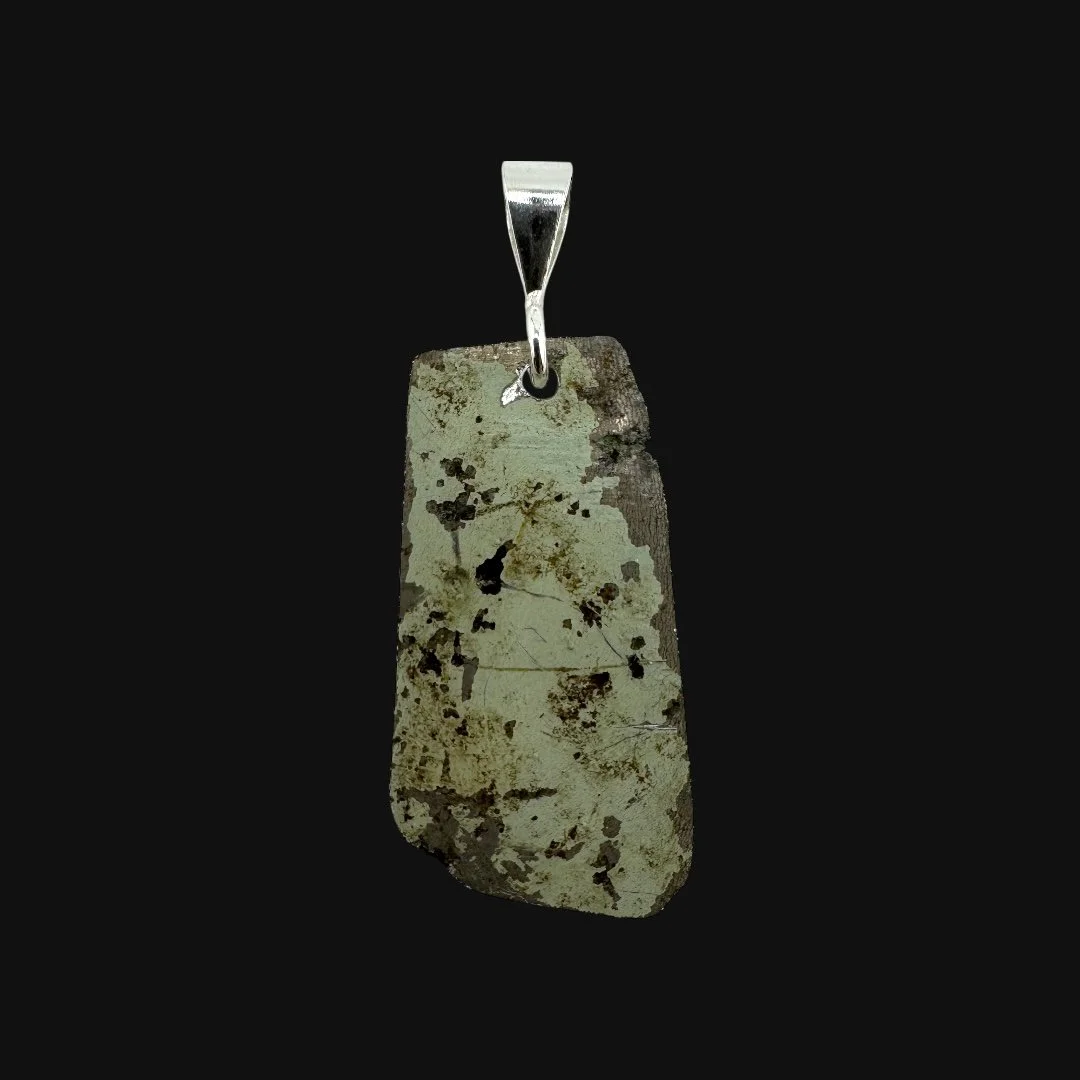
Comes with a hand-signed C.O.A. and a full historical research write-up
From: World War II
Dated: 1942-1943
Aircraft: Grumman F4F Wildcat
Type: Fighter Aircraft
Recovered: Henderson Field - Battle of Guadalcanal
National Origin: United States (American)
Necklace Pendant Size: Roughly 1 inch x ½ inch
Pendant Clap Material: .925 Sterling Silver
*EACH WORLD WAR II “COMBAT FLOWN” AIRCRAFT METAL PENDANT IS HANDMADE AND TRULY ONE-OF-A-KIND. THIS IS THE EXACT WWII AIRCRAFT NECKLACE PENDANT YOU WILL RECEIVE.
Wearable History Collection:
This World War II necklace aircraft pendant is more truly one-of-a-kind. It is a preserved piece of an original WWII aircraft, transformed into a wearable artifact that carries with it the stories of a generation. No two pendants are alike, which makes each one truly unique and irreplaceable. Rich with aviation history, this “combat flown” aircraft pendant offers its wearer the rare chance to carry a genuine fragment of World War II aviation heritage. Every mark in the metal, every detail, holds a connection to the past and serves as a tangible reminder of courage, sacrifice, and resilience. As part of our exclusive Wearable History Collection, it is not only a timeless accessory but also a powerful conversation starter. Flown in the heat of combat during World War II and preserved across generations, this WWII aircraft pendant is a relic unlike any other. Featured in our Wearable History Collection, it represents a rare chance to wear a true fragment of the past.
Courage in the Skies: The Grumman F4F Wildcat at Guadalcanal
The Grumman F4F Wildcat was the workhorse fighter of the United States Navy and Marine Corps during the early years of World War II. Compact, rugged, and dependable, the Wildcat faced overwhelming odds in the Pacific Theater, where it became synonymous with courage in the face of adversity. With folding wings and a powerful radial engine, it was designed to launch from aircraft carriers and endure punishing damage that might have destroyed more delicate planes.
Its defining chapter came in the struggle for Henderson Field on Guadalcanal. After U.S. Marines captured the unfinished Japanese airstrip in August 1942, Henderson became the lifeline of the island. Wildcats based there formed the core of the so-called “Cactus Air Force,” a patchwork group of Navy, Marine, and Army Air Force pilots who fought against constant Japanese assaults. Each mission was desperate. Outnumbered and often flying against the faster, more agile Mitsubishi A6M Zero, the Wildcat pilots relied on discipline, teamwork, and tactics to survive. The famous “Thach Weave,” a defensive maneuver developed by Commander John Thach, allowed Wildcats to cover one another and offset the Zero’s superior maneuverability.
Day after day, Wildcats scrambled from Henderson to meet incoming raids of Japanese bombers and their Zero escorts. The runways were cratered by artillery, fuel and parts were scarce, and pilots flew until exhaustion blurred the line between survival and sacrifice. Yet the Wildcat endured. Its tough frame absorbed punishment, its guns struck hard when aimed with precision, and its pilots earned a reputation for dogged resilience.
At Guadalcanal, the Wildcat was more than just an aircraft. It was a symbol of American determination to hold the line. The defense of Henderson Field prevented Japanese reinforcements from retaking the island, marking the first major Allied offensive victory in the Pacific. Without the Wildcat and its pilots, the tenuous foothold at Guadalcanal might have been lost, altering the entire trajectory of the Pacific War.
In hindsight, the F4F Wildcat represented the transition between old and new eras of air combat. Though soon replaced by the faster F6F Hellcat, the Wildcat’s role at Guadalcanal proved that toughness, tactical innovation, and sheer will could stand against seemingly insurmountable odds. Its legacy lives on not in speed or elegance, but in the story of a fighter and its pilots who refused to yield when the fate of the Pacific hung in the balance.
The Wildcat in the Pacific War:
Early Pacific Battles (1941–1942)
Pearl Harbor and Wake Island (1941) – Wildcats scrambled during the opening attacks of the Pacific War. At Wake, Marine pilots flying the outnumbered fighters managed to down Japanese aircraft and resist repeated assaults before the island fell.
Battle of the Coral Sea (1942) – Wildcats flew escort and defense for American carriers, helping blunt the first Japanese attempt to expand southward, marking the first carrier-versus-carrier battle in history.
Turning the Tide at Midway (1942)
Battle of Midway (June 1942) – Wildcats formed the defensive shield for U.S. carriers as dive bombers struck the Japanese fleet. Though often outmatched by the faster Mitsubishi Zero, Wildcat pilots fought doggedly to protect torpedo and dive bombers, contributing to the decisive American victory that crippled Japan’s carrier force.
The Crucible of Guadalcanal (1942–1943)
Henderson Field (August 1942 – February 1943) – Captured by U.S. Marines, the airstrip became the heart of the struggle for Guadalcanal. Wildcats of the “Cactus Air Force” flew daily from Henderson, intercepting Japanese bombers and dogfighting Zero escorts. The Thach Weave, a coordinated defensive tactic, allowed Wildcats to survive and score victories despite their slower speed.
Naval Battles around Guadalcanal – Wildcats provided air cover during ferocious sea battles in Ironbottom Sound, protecting American convoys that supplied the embattled Marines ashore.
Expanding the Offensive (1943–1944)
Solomon Islands Campaign – Wildcats continued to escort bombers, support amphibious landings, and provide critical air defense until gradually phased out by the newer F6F Hellcat.
Gilbert and Marshall Islands – Wildcats saw service in secondary roles, often from escort carriers, where their toughness and short takeoff ability were well suited to smaller decks.
Final Roles in the War (1944–1945)
Escort Carrier Operations – As newer fighters took the front lines, Wildcats remained in service aboard escort carriers, providing air cover for convoys, anti-submarine patrols, and close air support during invasions.
Battle of Leyte Gulf (1944) – Wildcats flying from escort carriers played a role in protecting U.S. naval forces during one of the largest naval battles in history.
The Legacy Within This WWII Necklace Pendant:
This handcrafted World War II necklace pendant has been created from the very metal of a Grumman F4F Wildcat fighter, once flown in combat during the ferocious battles for control of the Pacific. The Wildcat was the first great American naval fighter of the war, a rugged and resilient aircraft that helped secure victory against impossible odds. At Henderson Field on Guadalcanal, these fighters of the “Cactus Air Force” rose daily into the skies, intercepting Japanese bombers and dueling Zero escorts in desperate fights that decided the fate of the island.
Every detail in the metal carries memory. It echoes the roar of engines straining over shattered runways. It recalls the rattle of machine guns in dogfights above Guadalcanal and the exhaustion of young pilots who flew mission after mission to keep Henderson in American hands. Transformed into a pendant, the fragment ceases to be only the relic of a machine. It becomes a symbol of resilience, courage, and the turning point of the Pacific War.
Each pendant is entirely unique, marked by its own path through history. To wear it is to carry not just jewelry, but a piece of the struggle that shifted momentum in the Pacific. It invites conversation, sparks reflection, and connects the present with the legacy of those who refused to yield. This pendant is more than an accessory. It is a living fragment of history. A remembrance of sacrifice. And a reminder of the courage that defined one of World War II’s most pivotal campaigns.
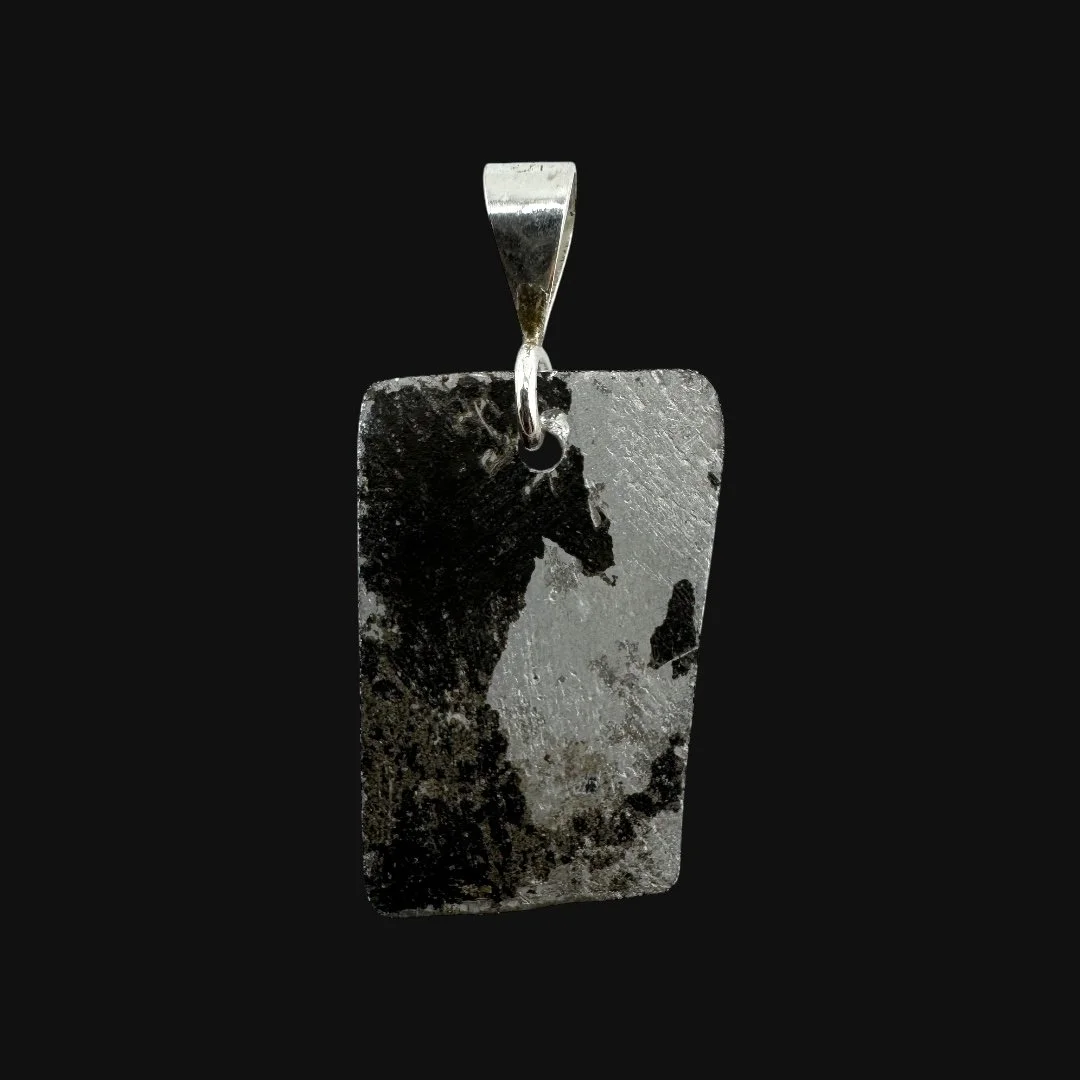
Comes with a hand-signed C.O.A. and a full historical research write-up
From: World War II
Dated: 1941-1945
Aircraft: Junkers Ju 87 - “Stuka”
Type: Dive Bomber & Ground-Attack Aircraft
Recovered: Combat Flown Wreckage Recovered From Eastern Front
National Origin: German (Luftwaffe)
Necklace Pendant Size: Roughly 1 inch x ½ inch
Pendant Clap Material: .925 Sterling Silver
*EACH WORLD WAR II “COMBAT FLOWN” AIRCRAFT METAL PENDANT IS HANDMADE AND TRULY ONE-OF-A-KIND. THIS IS THE EXACT WWII AIRCRAFT NECKLACE PENDANT YOU WILL RECEIVE.
Wearable History Collection:
This World War II necklace aircraft pendant is more truly one-of-a-kind. It is a preserved piece of an original WWII aircraft, transformed into a wearable artifact that carries with it the stories of a generation. No two pendants are alike, which makes each one truly unique and irreplaceable. Rich with aviation history, this “combat flown” aircraft pendant offers its wearer the rare chance to carry a genuine fragment of World War II aviation heritage. Every mark in the metal, every detail, holds a connection to the past and serves as a tangible reminder of courage, sacrifice, and resilience. As part of our exclusive Wearable History Collection, it is not only a timeless accessory but also a powerful conversation starter. Flown in the heat of combat during World War II and preserved across generations, this WWII aircraft pendant is a relic unlike any other. Featured in our Wearable History Collection, it represents a rare chance to wear a true fragment of the past.
Precision and Fear: The Historical Significance of the Ju 87 Dive Bomber:
The Junkers Ju 87 Stuka was one of the most distinctive and historically significant aircraft of the Second World War. Designed as a precision dive bomber, it featured inverted gull wings, fixed landing gear, and the infamous Jericho siren that created a terrifying wail as it dove. First tested in the Spanish Civil War, the Ju 87 proved the value of dive bombing in supporting ground forces, and when World War II began it became the spearhead of German blitzkrieg. In Poland and France, Stukas destroyed bridges, railways, and fortifications, helping clear the way for rapid armored advances. At Dunkirk they attacked retreating Allied troops and shipping, spreading panic as much with their sound as with their bombs.
Its limitations became clear during the Battle of Britain, where its slow speed and poor maneuverability left it highly vulnerable to RAF Spitfires and Hurricanes. Withdrawn from that campaign, the Ju 87 found new life on the Eastern Front, where Soviet air defenses were initially weak. Here it again became indispensable, destroying bridges and strongholds and, in its later G-variant, serving as a formidable anti-tank weapon. Pilots like Hans-Ulrich Rudel gained legendary reputations, with Rudel alone credited with destroying hundreds of Soviet tanks. Stukas supported major operations at Stalingrad and Kursk, where their precision and firepower were critical, even as Germany’s overall air superiority waned.
Beyond its battlefield effectiveness, the Ju 87 had immense psychological impact. Its screaming sirens became synonymous with terror from the skies, demoralizing enemy soldiers and civilians alike. The Stuka came to embody the image of blitzkrieg, a weapon not only of destruction but also of fear. While it became technologically outdated by the mid-war years, the Ju 87’s integration of close air support into ground operations influenced military doctrine for decades to come, laying the groundwork for modern ground-attack aircraft.
In retrospect, the Ju 87 Stuka’s legacy is one of both triumph and vulnerability. It demonstrated how precision bombing could amplify the effectiveness of ground offensives, but also how air superiority was essential for such aircraft to operate effectively. As both a practical weapon of war and a symbol of German power, the Ju 87 left an indelible mark on World War II, securing its place as one of the most iconic aircraft of the twentieth century.
Early War and Blitzkrieg Campaigns
Invasion of Poland (1939) – Used extensively to destroy railroads, bridges, and communications, crippling Polish defenses.
Norwegian Campaign (1940) – Stukas sank and damaged several Allied warships, including the British carrier HMS Glorious.
Battle of France (1940) – Played a major role in breaking the Maginot Line, blasting fortifications, and trapping Allied forces.
Battle of Dunkirk (1940) – Attacked Allied troops and evacuation ships, creating chaos during Operation Dynamo.
The Battle of Britain and the Mediterranean
Battle of Britain (1940) – Initially deployed to attack radar stations, airfields, and shipping, but suffered devastating losses to RAF fighters, forcing withdrawal.
Battle of Crete (1941) – Crucial in suppressing British defenses and sinking Royal Navy ships, helping Germany secure the island.
North African Campaign (1941–1943) – Provided ground support to Rommel’s Afrika Korps, targeting British armor and supply lines.
Eastern Front (Operation Barbarossa and beyond)
Operation Barbarossa (1941) – Opened the invasion of the Soviet Union, destroying bridges, supply columns, and airfields in the early blitz.
Siege of Sevastopol (1941–1942) – Stukas pounded Soviet fortifications during the long siege of the Crimean port.
Battle of Stalingrad (1942–1943) – Heavily used to bomb Soviet positions and supply routes during the street fighting.
Battle of Kursk (1943) – The Stuka G-variant, fitted with 37mm cannon, became a feared anti-tank weapon, flown by pilots such as Hans-Ulrich Rudel.
Final Years of the War
Defense of the Reich (1944–1945) – Stukas were increasingly obsolete but continued ground-attack and anti-tank roles on the Eastern Front.
Battle of Berlin (1945) – Flown in the final desperate defense, though few remained by this stage.
The Legacy Within This WWII Necklace Pendant:
This handcrafted World War II necklace pendant has been created from the very metal of a German Ju 87 Stuka dive bomber, once flown in combat during one of history’s most destructive conflicts. The Ju 87 was infamous for its terrifying dive sirens and precision strikes, a symbol of blitzkrieg that dominated the skies in the early war years. To hold this pendant is to hold a fragment of that past, a tangible piece of the aircraft that roared over battlefields from Poland and France to the Mediterranean and deep into the Eastern Front.
Every mark in the metal tells a story. It recalls the shriek of the Stuka’s dive, the smoke and fire of its bomb runs, and the endurance of the men, on both sides, who lived beneath those skies. Forged into a wearable piece, the pendant transforms a weapon of war into a symbol of remembrance, carrying with it the memory of courage, survival, and the heavy cost of global conflict.
Each pendant is entirely unique. No two carry the same scars or path through history. To wear it today is not simply to wear jewelry, but to carry with you a genuine piece of World War II. A natural conversation starter, it connects the present to the legacy of those who fought, endured, and were forever shaped by the war. This pendant is more than an accessory, it is a living fragment of history, honoring memory, sacrifice, and the enduring lessons of the past.
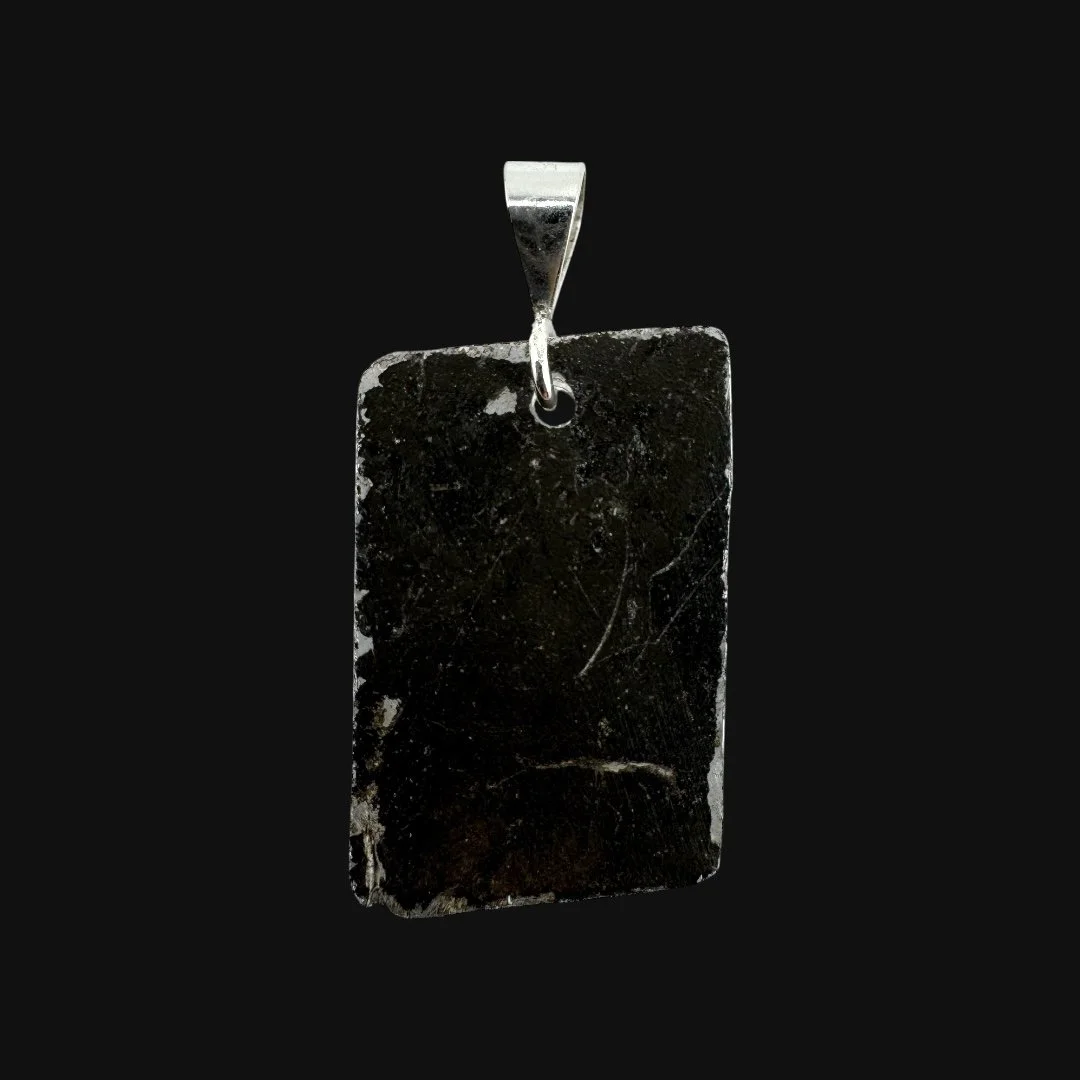
Comes with a hand-signed C.O.A. and a full historical research write-up
From: World War II
Dated: 1941-1945
Aircraft: Junkers Ju 87 - “Stuka”
Type: Dive Bomber & Ground-Attack Aircraft
Recovered: Combat Flown Wreckage Recovered From Eastern Front
National Origin: German (Luftwaffe)
Necklace Pendant Size: Roughly 1 inch x ½ inch
Pendant Clap Material: .925 Sterling Silver
*EACH WORLD WAR II “COMBAT FLOWN” AIRCRAFT METAL PENDANT IS HANDMADE AND TRULY ONE-OF-A-KIND. THIS IS THE EXACT WWII AIRCRAFT NECKLACE PENDANT YOU WILL RECEIVE.
Wearable History Collection:
This World War II necklace aircraft pendant is more truly one-of-a-kind. It is a preserved piece of an original WWII aircraft, transformed into a wearable artifact that carries with it the stories of a generation. No two pendants are alike, which makes each one truly unique and irreplaceable. Rich with aviation history, this “combat flown” aircraft pendant offers its wearer the rare chance to carry a genuine fragment of World War II aviation heritage. Every mark in the metal, every detail, holds a connection to the past and serves as a tangible reminder of courage, sacrifice, and resilience. As part of our exclusive Wearable History Collection, it is not only a timeless accessory but also a powerful conversation starter. Flown in the heat of combat during World War II and preserved across generations, this WWII aircraft pendant is a relic unlike any other. Featured in our Wearable History Collection, it represents a rare chance to wear a true fragment of the past.
Precision and Fear: The Historical Significance of the Ju 87 Dive Bomber:
The Junkers Ju 87 Stuka was one of the most distinctive and historically significant aircraft of the Second World War. Designed as a precision dive bomber, it featured inverted gull wings, fixed landing gear, and the infamous Jericho siren that created a terrifying wail as it dove. First tested in the Spanish Civil War, the Ju 87 proved the value of dive bombing in supporting ground forces, and when World War II began it became the spearhead of German blitzkrieg. In Poland and France, Stukas destroyed bridges, railways, and fortifications, helping clear the way for rapid armored advances. At Dunkirk they attacked retreating Allied troops and shipping, spreading panic as much with their sound as with their bombs.
Its limitations became clear during the Battle of Britain, where its slow speed and poor maneuverability left it highly vulnerable to RAF Spitfires and Hurricanes. Withdrawn from that campaign, the Ju 87 found new life on the Eastern Front, where Soviet air defenses were initially weak. Here it again became indispensable, destroying bridges and strongholds and, in its later G-variant, serving as a formidable anti-tank weapon. Pilots like Hans-Ulrich Rudel gained legendary reputations, with Rudel alone credited with destroying hundreds of Soviet tanks. Stukas supported major operations at Stalingrad and Kursk, where their precision and firepower were critical, even as Germany’s overall air superiority waned.
Beyond its battlefield effectiveness, the Ju 87 had immense psychological impact. Its screaming sirens became synonymous with terror from the skies, demoralizing enemy soldiers and civilians alike. The Stuka came to embody the image of blitzkrieg, a weapon not only of destruction but also of fear. While it became technologically outdated by the mid-war years, the Ju 87’s integration of close air support into ground operations influenced military doctrine for decades to come, laying the groundwork for modern ground-attack aircraft.
In retrospect, the Ju 87 Stuka’s legacy is one of both triumph and vulnerability. It demonstrated how precision bombing could amplify the effectiveness of ground offensives, but also how air superiority was essential for such aircraft to operate effectively. As both a practical weapon of war and a symbol of German power, the Ju 87 left an indelible mark on World War II, securing its place as one of the most iconic aircraft of the twentieth century.
Early War and Blitzkrieg Campaigns
Invasion of Poland (1939) – Used extensively to destroy railroads, bridges, and communications, crippling Polish defenses.
Norwegian Campaign (1940) – Stukas sank and damaged several Allied warships, including the British carrier HMS Glorious.
Battle of France (1940) – Played a major role in breaking the Maginot Line, blasting fortifications, and trapping Allied forces.
Battle of Dunkirk (1940) – Attacked Allied troops and evacuation ships, creating chaos during Operation Dynamo.
The Battle of Britain and the Mediterranean
Battle of Britain (1940) – Initially deployed to attack radar stations, airfields, and shipping, but suffered devastating losses to RAF fighters, forcing withdrawal.
Battle of Crete (1941) – Crucial in suppressing British defenses and sinking Royal Navy ships, helping Germany secure the island.
North African Campaign (1941–1943) – Provided ground support to Rommel’s Afrika Korps, targeting British armor and supply lines.
Eastern Front (Operation Barbarossa and beyond)
Operation Barbarossa (1941) – Opened the invasion of the Soviet Union, destroying bridges, supply columns, and airfields in the early blitz.
Siege of Sevastopol (1941–1942) – Stukas pounded Soviet fortifications during the long siege of the Crimean port.
Battle of Stalingrad (1942–1943) – Heavily used to bomb Soviet positions and supply routes during the street fighting.
Battle of Kursk (1943) – The Stuka G-variant, fitted with 37mm cannon, became a feared anti-tank weapon, flown by pilots such as Hans-Ulrich Rudel.
Final Years of the War
Defense of the Reich (1944–1945) – Stukas were increasingly obsolete but continued ground-attack and anti-tank roles on the Eastern Front.
Battle of Berlin (1945) – Flown in the final desperate defense, though few remained by this stage.
The Legacy Within This WWII Necklace Pendant:
This handcrafted World War II necklace pendant has been created from the very metal of a German Ju 87 Stuka dive bomber, once flown in combat during one of history’s most destructive conflicts. The Ju 87 was infamous for its terrifying dive sirens and precision strikes, a symbol of blitzkrieg that dominated the skies in the early war years. To hold this pendant is to hold a fragment of that past, a tangible piece of the aircraft that roared over battlefields from Poland and France to the Mediterranean and deep into the Eastern Front.
Every mark in the metal tells a story. It recalls the shriek of the Stuka’s dive, the smoke and fire of its bomb runs, and the endurance of the men, on both sides, who lived beneath those skies. Forged into a wearable piece, the pendant transforms a weapon of war into a symbol of remembrance, carrying with it the memory of courage, survival, and the heavy cost of global conflict.
Each pendant is entirely unique. No two carry the same scars or path through history. To wear it today is not simply to wear jewelry, but to carry with you a genuine piece of World War II. A natural conversation starter, it connects the present to the legacy of those who fought, endured, and were forever shaped by the war. This pendant is more than an accessory, it is a living fragment of history, honoring memory, sacrifice, and the enduring lessons of the past.

It’s as easy as 1…2…3
WIN FREE D-DAY ARTIFACTS FROM NORMANDY, FRACE
As part of our mission to preserve and share the legacy of the Greatest Generation, every Premier Relic watch owner is invited to join our exclusive monthly giveaway! Every month, one person who has purchased a D-Day parachute watch is selected to receive an authentic World War II D-Day battlefield artifact recovered from the historic drop zones of Normandy, where the 101st and 82nd Airborne Divisions parachuted into battle on June 6, 1944.


Comes with a hand-signed C.O.A. and a full historical research write-up
From: World War II
Branch: U.S. Army
Division: 101st Airborne Division
Dated: 1944-1945
Ring Size: 9.25 (US)
Material: Sterling Silver
Theater: European Theater
Wearable History Collection:
This authentic 1944-1945 WWII-era ring, preserved in its original and unaltered condition, combines exceptional craftsmanship with lasting durability, making it fully suitable for modern wear today. As part of our exclusive World War II “Wearable History Ring Collection,” it offers the rare opportunity to own and wear a genuine piece of World War II. Both a timeless accessory and a tangible link to the past, this truly one-of-a-kind ring stands as a wearable tribute to the courage and sacrifice of a generation.
Historical Significance to the 101st Airborne Division:
The 101st Airborne Division, the “Screaming Eagles,” was activated on August 16, 1942, and trained as an elite airborne force specializing in parachute and glider operations. Known for discipline, mobility, and precision, it was led in World War II by figures like Major General William C. Lee and Major General Maxwell D. Taylor.
Their combat debut came on June 6, 1944, in the pre-dawn hours of D-Day. Dropping into Normandy behind Utah Beach, the division’s mission was to seize causeways, secure roads, and block German reinforcements. Poor visibility scattered units across the countryside, yet paratroopers regrouped, captured Carentan after bitter street fighting, and ensured the link between the Utah and Omaha Beachheads.
In September 1944, during Operation Market Garden, the 101st parachuted into the Netherlands to seize and hold bridges along “Hell’s Highway” from Eindhoven to Veghel. For over a week they fought off German counterattacks, maintaining critical supply and armor routes despite heavy casualties and constant pressure.
Their most famous stand came in December 1944 at Bastogne during the Battle of the Bulge. Surrounded by German forces, short on ammunition, food, and winter gear, the division endured artillery barrages and repeated assaults. When ordered to surrender, Brigadier General Anthony McAuliffe famously replied, “Nuts!” They held until relieved by Patton’s Third Army on December 26, 1944.
In the final months of the war, the Screaming Eagles advanced into Germany, capturing towns, liberating concentration camp prisoners, and in May 1945 taking Hitler’s mountain retreat at Berchtesgaden and the Eagle’s Nest.
By V-E Day, the 101st had fought in Normandy, the Netherlands, Ardennes-Alsace, and Central Europe, earning two Presidential Unit Citations. Their actions, marked by speed, resilience, and refusal to yield, cemented their place as one of the most legendary units of the Second World War.
The Legacy Within This Ring:
This original World War II 101st Airborne Division ring, featuring the iconic Screaming Eagle on its face and finely detailed eagles on each side, was a privately commissioned piece, handcrafted in sterling silver for a paratrooper of the 101st Airborne Division. Unlike standard-issue insignia, this was a personal work of wartime artistry, created to honor the wearer’s service in one of the most elite units of the Allied forces. For the soldier who owned it, the ring was far more than an accessory. It was a daily reminder of the courage, skill, and unity forged in operations from the drop zones of Normandy to the frozen streets of Bastogne. Each detail reflects the proud traditions of the Airborne, capturing the spirit of men who fought with extraordinary bravery behind enemy lines. Today, it endures as a rare and tangible link to the 101st’s storied legacy, a preserved fragment of history and a wearable tribute to the paratroopers who changed the course of the Second World War.